

Dissipative Particle Dynamics Approaches to Modeling …
89
unfavorable enthalpic interactions along with the increase in entropy arising from
ion migration.
Sindelka et al. recently modeled a system of positively and negatively charged
chains denoted by (A
+ ) m B n and (A
− ) m B n respectively, where m and n represent the
number of beads in the respective segments [139]. The simulations varied the length
of the positively charged block from 5 to 8, i.e. (A
+ ) 5-8 B 5 , and maintained the negatively charge blocks at the same length (A
− ) 5 B 5 . Also, the number of positively
charged chains were varied while the negatively charged chains held constant. Counterions were added to the solvent to maintain charge neutrality in all the systems.
By varying the number of positively charged chains, the solubility of the polyelectrolyte backbone, and the interactions with the counterions, the resulting aggregates
from the non-stoichiometric mixtures were determined to be charged. In addition, the
aggregation number was observed to be partially dependent on the ratio of positive
to negative chains (Fig. 3a).
Another approach to distribute the charge throughout a predetermined volume is
by introducing a Drude oscillator. Peter and Pivkin introduced a water model, where
the DPD bead is tethered to two particles. The two particles contain opposite charges
and are connected to the central DPD bead by harmonic bonds with an equilibrium
angle of 0° [140]. In order to incorporate the electrostatics into the DPD potential, a
coulombic non-bonded force was included:
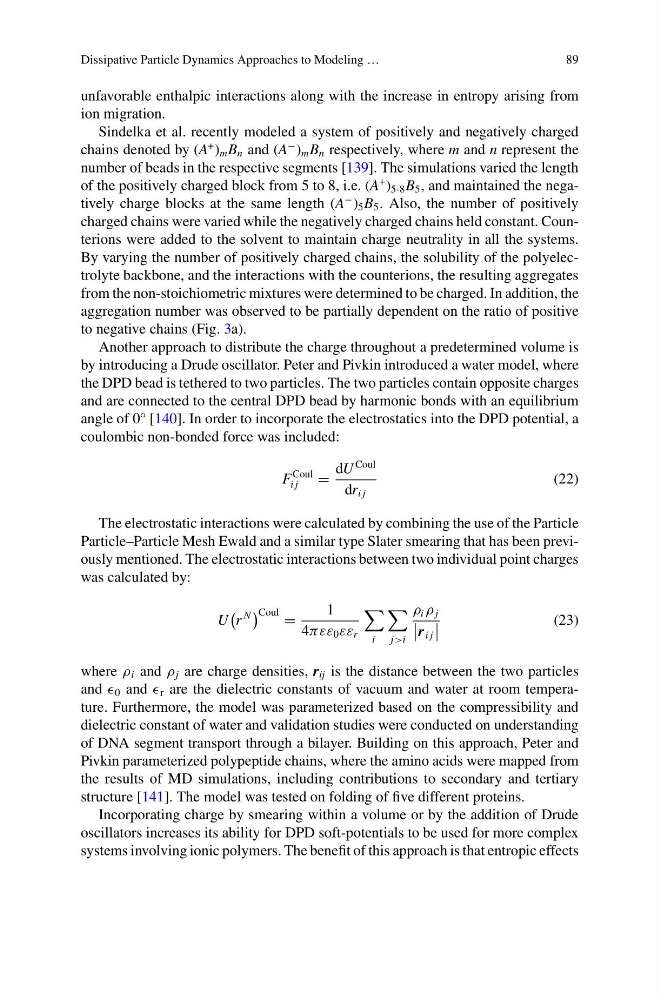
F
Coul
i j
=
dU
Coul
dr i j
(22)
The electrostatic interactions were calculated by combining the use of the Particle
Particle–Particle Mesh Ewald and a similar type Slater smearing that has been previously mentioned. The electrostatic interactions between two individual point charges
was calculated by:
U
r
N
Coul =
1
4πεε 0 εε r
i
j>i
ρ i ρ j
r i j
(23)
where ρ i and ρ j are charge densities, r ij is the distance between the two particles
and 0 and r are the dielectric constants of vacuum and water at room temperature. Furthermore, the model was parameterized based on the compressibility and
dielectric constant of water and validation studies were conducted on understanding
of DNA segment transport through a bilayer. Building on this approach, Peter and
Pivkin parameterized polypeptide chains, where the amino acids were mapped from
the results of MD simulations, including contributions to secondary and tertiary
structure [141]. The model was tested on folding of five different proteins.
Incorporating charge by smearing within a volume or by the addition of Drude
oscillators increases its ability for DPD soft-potentials to be used for more complex
systems involving ionic polymers. The benefit of this approach is that entropic effects
89
unfavorable enthalpic interactions along with the increase in entropy arising from
ion migration.
Sindelka et al. recently modeled a system of positively and negatively charged
chains denoted by (A
+ ) m B n and (A
− ) m B n respectively, where m and n represent the
number of beads in the respective segments [139]. The simulations varied the length
of the positively charged block from 5 to 8, i.e. (A
+ ) 5-8 B 5 , and maintained the negatively charge blocks at the same length (A
− ) 5 B 5 . Also, the number of positively
charged chains were varied while the negatively charged chains held constant. Counterions were added to the solvent to maintain charge neutrality in all the systems.
By varying the number of positively charged chains, the solubility of the polyelectrolyte backbone, and the interactions with the counterions, the resulting aggregates
from the non-stoichiometric mixtures were determined to be charged. In addition, the
aggregation number was observed to be partially dependent on the ratio of positive
to negative chains (Fig. 3a).
Another approach to distribute the charge throughout a predetermined volume is
by introducing a Drude oscillator. Peter and Pivkin introduced a water model, where
the DPD bead is tethered to two particles. The two particles contain opposite charges
and are connected to the central DPD bead by harmonic bonds with an equilibrium
angle of 0° [140]. In order to incorporate the electrostatics into the DPD potential, a
coulombic non-bonded force was included:
F
Coul
i j
=
dU
Coul
dr i j
(22)
The electrostatic interactions were calculated by combining the use of the Particle
Particle–Particle Mesh Ewald and a similar type Slater smearing that has been previously mentioned. The electrostatic interactions between two individual point charges
was calculated by:
U
r
N
Coul =
1
4πεε 0 εε r
i
j>i
ρ i ρ j
r i j
(23)
where ρ i and ρ j are charge densities, r ij is the distance between the two particles
and 0 and r are the dielectric constants of vacuum and water at room temperature. Furthermore, the model was parameterized based on the compressibility and
dielectric constant of water and validation studies were conducted on understanding
of DNA segment transport through a bilayer. Building on this approach, Peter and
Pivkin parameterized polypeptide chains, where the amino acids were mapped from
the results of MD simulations, including contributions to secondary and tertiary
structure [141]. The model was tested on folding of five different proteins.
Incorporating charge by smearing within a volume or by the addition of Drude
oscillators increases its ability for DPD soft-potentials to be used for more complex
systems involving ionic polymers. The benefit of this approach is that entropic effects