

76
T. A. Deaton et al.
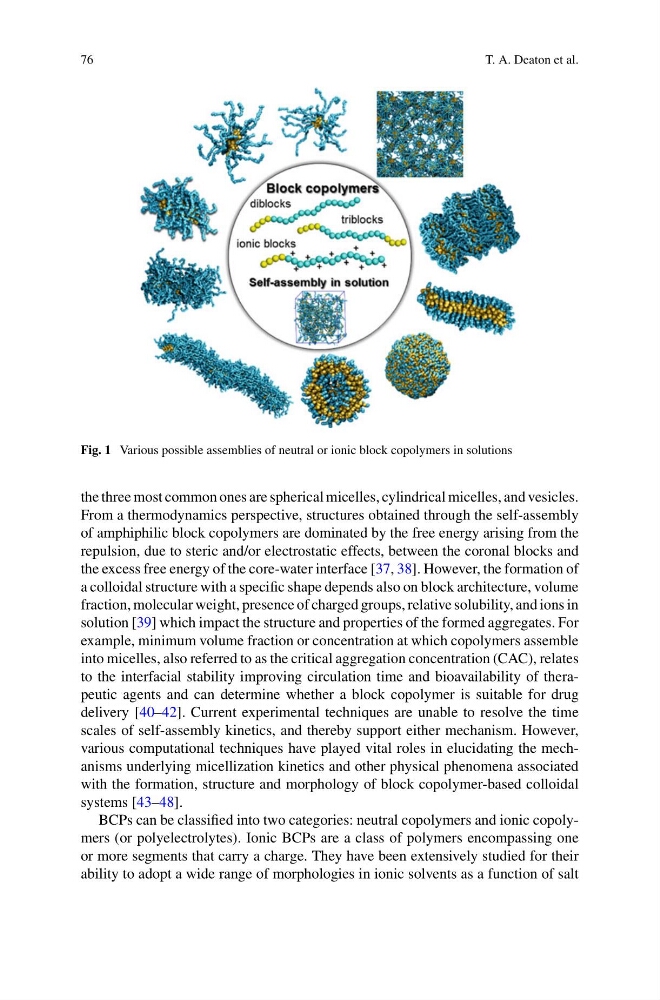
Fig. 1 Various possible assemblies of neutral or ionic block copolymers in solutions
the three most common ones are spherical micelles, cylindrical micelles, and vesicles.
From a thermodynamics perspective, structures obtained through the self-assembly
of amphiphilic block copolymers are dominated by the free energy arising from the
repulsion, due to steric and/or electrostatic effects, between the coronal blocks and
the excess free energy of the core-water interface [37, 38]. However, the formation of
a colloidal structure with a specific shape depends also on block architecture, volume
fraction, molecular weight, presence of charged groups, relative solubility, and ions in
solution [39] which impact the structure and properties of the formed aggregates. For
example, minimum volume fraction or concentration at which copolymers assemble
into micelles, also referred to as the critical aggregation concentration (CAC), relates
to the interfacial stability improving circulation time and bioavailability of therapeutic agents and can determine whether a block copolymer is suitable for drug
delivery [40–42]. Current experimental techniques are unable to resolve the time
scales of self-assembly kinetics, and thereby support either mechanism. However,
various computational techniques have played vital roles in elucidating the mechanisms underlying micellization kinetics and other physical phenomena associated
with the formation, structure and morphology of block copolymer-based colloidal
systems [43–48].
BCPs can be classified into two categories: neutral copolymers and ionic copolymers (or polyelectrolytes). Ionic BCPs are a class of polymers encompassing one
or more segments that carry a charge. They have been extensively studied for their
ability to adopt a wide range of morphologies in ionic solvents as a function of salt
T. A. Deaton et al.
Fig. 1 Various possible assemblies of neutral or ionic block copolymers in solutions
the three most common ones are spherical micelles, cylindrical micelles, and vesicles.
From a thermodynamics perspective, structures obtained through the self-assembly
of amphiphilic block copolymers are dominated by the free energy arising from the
repulsion, due to steric and/or electrostatic effects, between the coronal blocks and
the excess free energy of the core-water interface [37, 38]. However, the formation of
a colloidal structure with a specific shape depends also on block architecture, volume
fraction, molecular weight, presence of charged groups, relative solubility, and ions in
solution [39] which impact the structure and properties of the formed aggregates. For
example, minimum volume fraction or concentration at which copolymers assemble
into micelles, also referred to as the critical aggregation concentration (CAC), relates
to the interfacial stability improving circulation time and bioavailability of therapeutic agents and can determine whether a block copolymer is suitable for drug
delivery [40–42]. Current experimental techniques are unable to resolve the time
scales of self-assembly kinetics, and thereby support either mechanism. However,
various computational techniques have played vital roles in elucidating the mechanisms underlying micellization kinetics and other physical phenomena associated
with the formation, structure and morphology of block copolymer-based colloidal
systems [43–48].
BCPs can be classified into two categories: neutral copolymers and ionic copolymers (or polyelectrolytes). Ionic BCPs are a class of polymers encompassing one
or more segments that carry a charge. They have been extensively studied for their
ability to adopt a wide range of morphologies in ionic solvents as a function of salt