

Coarse-Grained Modeling and Simulations of Thermoresponsive …
59
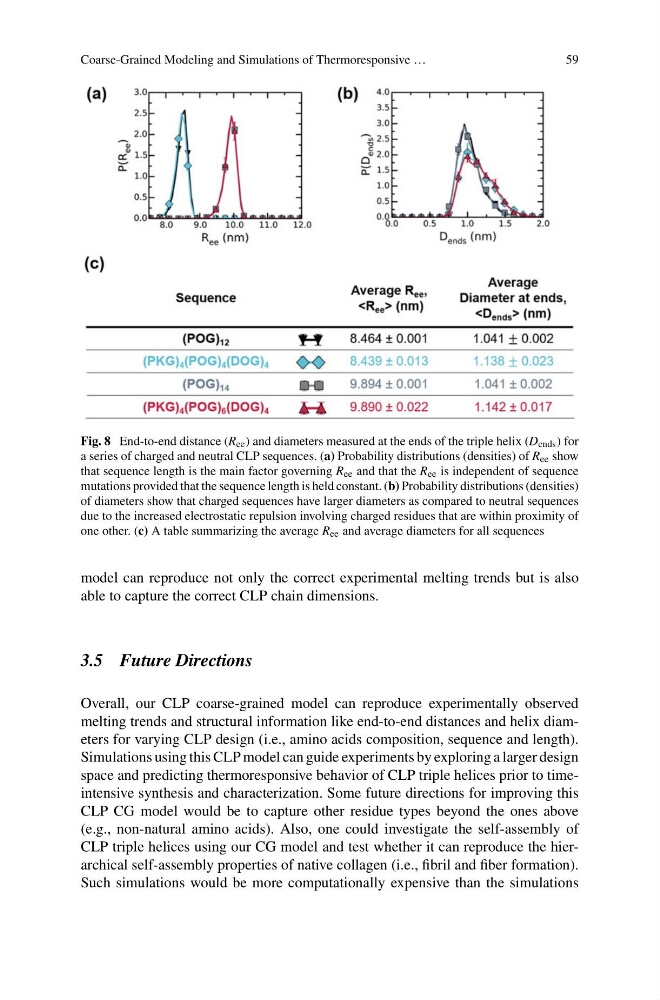
Fig. 8 End-to-end distance (R ee ) and diameters measured at the ends of the triple helix (D ends ) for
a series of charged and neutral CLP sequences. (a) Probability distributions (densities) of R ee show
that sequence length is the main factor governing R ee and that the R ee is independent of sequence
mutations provided that the sequence length is held constant. (b) Probability distributions (densities)
of diameters show that charged sequences have larger diameters as compared to neutral sequences
due to the increased electrostatic repulsion involving charged residues that are within proximity of
one other. (c) A table summarizing the average R ee and average diameters for all sequences
model can reproduce not only the correct experimental melting trends but is also
able to capture the correct CLP chain dimensions.
3.5 Future Directions
Overall, our CLP coarse-grained model can reproduce experimentally observed
melting trends and structural information like end-to-end distances and helix diameters for varying CLP design (i.e., amino acids composition, sequence and length).
Simulations using this CLP model can guide experiments by exploring a larger design
space and predicting thermoresponsive behavior of CLP triple helices prior to timeintensive synthesis and characterization. Some future directions for improving this
CLP CG model would be to capture other residue types beyond the ones above
(e.g., non-natural amino acids). Also, one could investigate the self-assembly of
CLP triple helices using our CG model and test whether it can reproduce the hierarchical self-assembly properties of native collagen (i.e., fibril and fiber formation).
Such simulations would be more computationally expensive than the simulations
59
Fig. 8 End-to-end distance (R ee ) and diameters measured at the ends of the triple helix (D ends ) for
a series of charged and neutral CLP sequences. (a) Probability distributions (densities) of R ee show
that sequence length is the main factor governing R ee and that the R ee is independent of sequence
mutations provided that the sequence length is held constant. (b) Probability distributions (densities)
of diameters show that charged sequences have larger diameters as compared to neutral sequences
due to the increased electrostatic repulsion involving charged residues that are within proximity of
one other. (c) A table summarizing the average R ee and average diameters for all sequences
model can reproduce not only the correct experimental melting trends but is also
able to capture the correct CLP chain dimensions.
3.5 Future Directions
Overall, our CLP coarse-grained model can reproduce experimentally observed
melting trends and structural information like end-to-end distances and helix diameters for varying CLP design (i.e., amino acids composition, sequence and length).
Simulations using this CLP model can guide experiments by exploring a larger design
space and predicting thermoresponsive behavior of CLP triple helices prior to timeintensive synthesis and characterization. Some future directions for improving this
CLP CG model would be to capture other residue types beyond the ones above
(e.g., non-natural amino acids). Also, one could investigate the self-assembly of
CLP triple helices using our CG model and test whether it can reproduce the hierarchical self-assembly properties of native collagen (i.e., fibril and fiber formation).
Such simulations would be more computationally expensive than the simulations