

The Role of Entropy in the Structural Transitions in Zeolitic …
31
S(T ) =
ω max
0
⎡
⎣ −k B ln
1 − exp
−
ω
k B T
+
1
T
ω
exp
ω
k B T
− 1
⎤
⎦ g(ω)dω
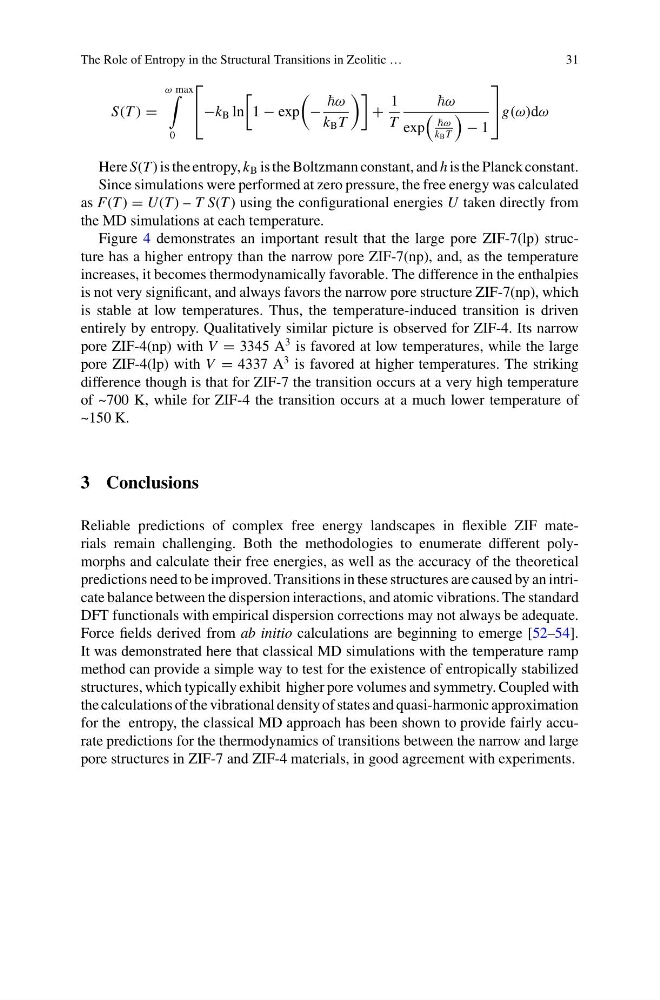
Here S(T ) is the entropy, k B is the Boltzmann constant, and h is the Planck constant.
Since simulations were performed at zero pressure, the free energy was calculated
as F(T ) = U(T ) – T S(T ) using the configurational energies U taken directly from
the MD simulations at each temperature.
Figure 4 demonstrates an important result that the large pore ZIF-7(lp) structure has a higher entropy than the narrow pore ZIF-7(np), and, as the temperature
increases, it becomes thermodynamically favorable. The difference in the enthalpies
is not very significant, and always favors the narrow pore structure ZIF-7(np), which
is stable at low temperatures. Thus, the temperature-induced transition is driven
entirely by entropy. Qualitatively similar picture is observed for ZIF-4. Its narrow
pore ZIF-4(np) with V = 3345 A
3 is favored at low temperatures, while the large
pore ZIF-4(lp) with V = 4337 A
3 is favored at higher temperatures. The striking
difference though is that for ZIF-7 the transition occurs at a very high temperature
of ~700 K, while for ZIF-4 the transition occurs at a much lower temperature of
~150 K.
3 Conclusions
Reliable predictions of complex free energy landscapes in flexible ZIF materials remain challenging. Both the methodologies to enumerate different polymorphs and calculate their free energies, as well as the accuracy of the theoretical
predictions need to be improved. Transitions in these structures are caused by an intricate balance between the dispersion interactions, and atomic vibrations. The standard
DFT functionals with empirical dispersion corrections may not always be adequate.
Force fields derived from ab initio calculations are beginning to emerge [52–54].
It was demonstrated here that classical MD simulations with the temperature ramp
method can provide a simple way to test for the existence of entropically stabilized
structures, which typically exhibit higher pore volumes and symmetry. Coupled with
the calculations of the vibrational density of states and quasi-harmonic approximation
for the entropy, the classical MD approach has been shown to provide fairly accurate predictions for the thermodynamics of transitions between the narrow and large
pore structures in ZIF-7 and ZIF-4 materials, in good agreement with experiments.
31
S(T ) =
ω max
0
⎡
⎣ −k B ln
1 − exp
−
ω
k B T
+
1
T
ω
exp
ω
k B T
− 1
⎤
⎦ g(ω)dω
Here S(T ) is the entropy, k B is the Boltzmann constant, and h is the Planck constant.
Since simulations were performed at zero pressure, the free energy was calculated
as F(T ) = U(T ) – T S(T ) using the configurational energies U taken directly from
the MD simulations at each temperature.
Figure 4 demonstrates an important result that the large pore ZIF-7(lp) structure has a higher entropy than the narrow pore ZIF-7(np), and, as the temperature
increases, it becomes thermodynamically favorable. The difference in the enthalpies
is not very significant, and always favors the narrow pore structure ZIF-7(np), which
is stable at low temperatures. Thus, the temperature-induced transition is driven
entirely by entropy. Qualitatively similar picture is observed for ZIF-4. Its narrow
pore ZIF-4(np) with V = 3345 A
3 is favored at low temperatures, while the large
pore ZIF-4(lp) with V = 4337 A
3 is favored at higher temperatures. The striking
difference though is that for ZIF-7 the transition occurs at a very high temperature
of ~700 K, while for ZIF-4 the transition occurs at a much lower temperature of
~150 K.
3 Conclusions
Reliable predictions of complex free energy landscapes in flexible ZIF materials remain challenging. Both the methodologies to enumerate different polymorphs and calculate their free energies, as well as the accuracy of the theoretical
predictions need to be improved. Transitions in these structures are caused by an intricate balance between the dispersion interactions, and atomic vibrations. The standard
DFT functionals with empirical dispersion corrections may not always be adequate.
Force fields derived from ab initio calculations are beginning to emerge [52–54].
It was demonstrated here that classical MD simulations with the temperature ramp
method can provide a simple way to test for the existence of entropically stabilized
structures, which typically exhibit higher pore volumes and symmetry. Coupled with
the calculations of the vibrational density of states and quasi-harmonic approximation
for the entropy, the classical MD approach has been shown to provide fairly accurate predictions for the thermodynamics of transitions between the narrow and large
pore structures in ZIF-7 and ZIF-4 materials, in good agreement with experiments.