

The Role of Entropy in the Structural Transitions in Zeolitic …
27
[49] with the time constant of 0.1 ps. The length of simulations at each temperature was 1 ps. Simulations were typically performed with 3 × 2 × 2 or 3 × 3 × 3
supercells. Simulations were also performed with 2 × 2 × 2 and single unit cell to
confirm the results. The use of larger supercells is preferred to minimize fluctuations
in volume and pressure, and to reduce statistical noise, but does not significantly
affect the averages.
A typical example of the temperature ramp MD simulations for ZIF-7 is shown in
Fig. 1. At low temperatures, ZIF-7 exists in a narrow pore structure ZIF-7(np), which
with increasing temperature gradually becomes less dense, and eventually transitions
abruptly at ~600 K into a hexagonally symmetric large pore ZIF-7(lp) structure. This
is very similar to the experimental X-ray diffraction measurements, which uncovered
that upon heating in vacuum ZIF-7 transitions from the narrow pore structure into
the more open large pore ZIF-7(lp) structure at ~700 K [23].
Predicted ZIF-7 polymorphs are shown in Fig. 2. As expected, the difference
in their enthalpies correlates with the framework densities [50], and the force field
describes this trend. Moreover, the difference between the enthalpies of ZIF-7(lp)
and ZIF-7(np) of ~6 kJ/(mol Zn) agrees well with the experimental calorimetric
measurements [23].
Below it is demonstrated that calculations of the vibrational density of states for
ZIFs provide fairly accurate route to thermodynamic properties such as entropy and
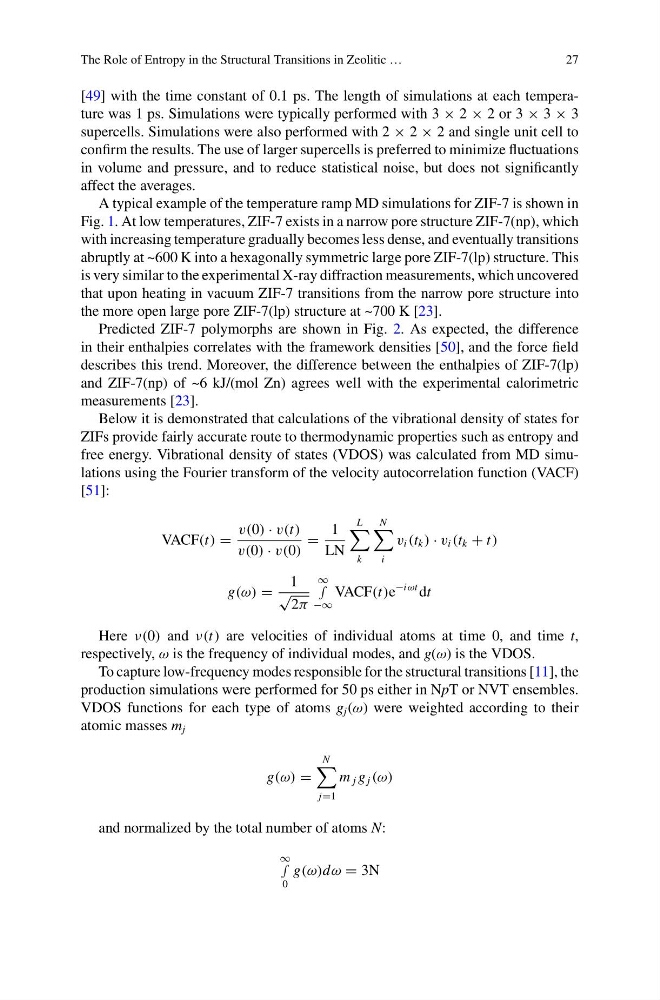
free energy. Vibrational density of states (VDOS) was calculated from MD simulations using the Fourier transform of the velocity autocorrelation function (VACF)
[51]:
VACF(t) =
v(0) · v(t)
v(0) · v(0)
=
1
LN
L
k
N
i
v i (t k ) · v i (t k + t)
g(ω) =
1
√
2π
∞
∫
−∞
VACF(t)e
−iωt dt
Here ν(0) and ν(t) are velocities of individual atoms at time 0, and time t,
respectively, ω is the frequency of individual modes, and g(ω) is the VDOS.
To capture low-frequency modes responsible for the structural transitions [11], the
production simulations were performed for 50 ps either in NpT or NVT ensembles.
VDOS functions for each type of atoms g j (ω) were weighted according to their
atomic masses m j
g(ω) =
N
j=1
m j g j (ω)
and normalized by the total number of atoms N:
∞
∫
0
g(ω)dω = 3N
27
[49] with the time constant of 0.1 ps. The length of simulations at each temperature was 1 ps. Simulations were typically performed with 3 × 2 × 2 or 3 × 3 × 3
supercells. Simulations were also performed with 2 × 2 × 2 and single unit cell to
confirm the results. The use of larger supercells is preferred to minimize fluctuations
in volume and pressure, and to reduce statistical noise, but does not significantly
affect the averages.
A typical example of the temperature ramp MD simulations for ZIF-7 is shown in
Fig. 1. At low temperatures, ZIF-7 exists in a narrow pore structure ZIF-7(np), which
with increasing temperature gradually becomes less dense, and eventually transitions
abruptly at ~600 K into a hexagonally symmetric large pore ZIF-7(lp) structure. This
is very similar to the experimental X-ray diffraction measurements, which uncovered
that upon heating in vacuum ZIF-7 transitions from the narrow pore structure into
the more open large pore ZIF-7(lp) structure at ~700 K [23].
Predicted ZIF-7 polymorphs are shown in Fig. 2. As expected, the difference
in their enthalpies correlates with the framework densities [50], and the force field
describes this trend. Moreover, the difference between the enthalpies of ZIF-7(lp)
and ZIF-7(np) of ~6 kJ/(mol Zn) agrees well with the experimental calorimetric
measurements [23].
Below it is demonstrated that calculations of the vibrational density of states for
ZIFs provide fairly accurate route to thermodynamic properties such as entropy and
free energy. Vibrational density of states (VDOS) was calculated from MD simulations using the Fourier transform of the velocity autocorrelation function (VACF)
[51]:
VACF(t) =
v(0) · v(t)
v(0) · v(0)
=
1
LN
L
k
N
i
v i (t k ) · v i (t k + t)
g(ω) =
1
√
2π
∞
∫
−∞
VACF(t)e
−iωt dt
Here ν(0) and ν(t) are velocities of individual atoms at time 0, and time t,
respectively, ω is the frequency of individual modes, and g(ω) is the VDOS.
To capture low-frequency modes responsible for the structural transitions [11], the
production simulations were performed for 50 ps either in NpT or NVT ensembles.
VDOS functions for each type of atoms g j (ω) were weighted according to their
atomic masses m j
g(ω) =
N
j=1
m j g j (ω)
and normalized by the total number of atoms N:
∞
∫
0
g(ω)dω = 3N