

12
E. K. Hamal and M. C. Toroker
and at all strains applied according to the projected density of states. Hence, the
presence of Ni atoms surrounding the active site is vital for good performance.
3. The bond distances at the active site need to be optimal for the first deprotonation
reaction to be as low as the second intermediate reaction step. For pure NiOOH,
the first two reactions have equal free energies (but high overpotential) at −
5% compressive strain. For Ni 1−x Fe x OOH with Fe
4+ at the active site, the high
oxidation state of Fe reduces bond distances at the active site and compressive
strain is not needed to reduce the overpotential.
4. High Fe contents located on the surface at 42% alloying are less stable (higher
energy). According to previous experiments [10], this results in the formation
of FeOOH aggregates that reduce performance.
Moreover, at all Fe content percentages, application of strain affected the overpotential. Strain has a direct effect on the distances and hybridization of the bonds
at the active site. Hence, applying strain is another useful control handle that can be
used to understand and optimize catalytic efficiency.
Acknowledgements This research was supported by the Nancy and Stephen Grand Technion
Energy Program (GTEP), the I-CORE Program of the Planning and Budgeting Committee, The
Israel Science Foundation (Grant No. 152/11), the SPIRA Fund for Applied Research in the Field
of Energy, and a grant from the Ministry of Science and Technology (MOST), Israel. This work
was supported by the post LinkSCEEM-2 project, funded by the European Commission under
the 7th Framework Programme through Capacities Research Infrastructure, INFRA-2010-1.2.3
Virtual Research Communities, Combination of Collaborative Project and Coordination and Support
Actions (CP-CSA) under grant agreement no RI-261600.
Appendix
Supporting information available.
Further details on the calculated free energies and on the unit cells used for the
surfaces are provided in the supporting information and in the ioChem-BD repository.
Table of Contents Graphic.
The influence of mechanical strain on water oxidation catalysis for nickel
oxyhydroxide at different levels of iron content.
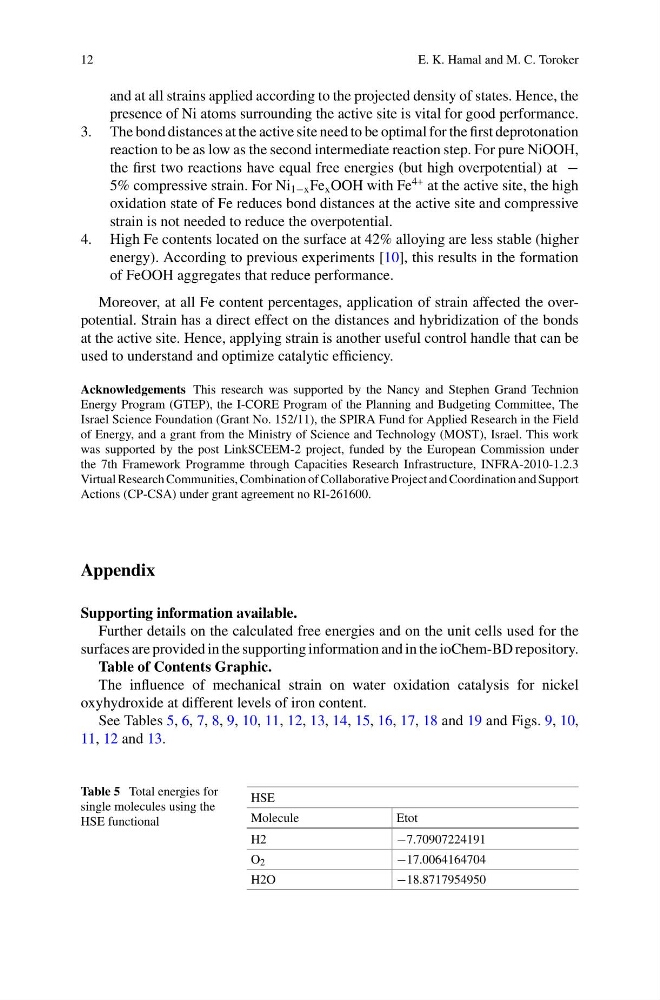
See Tables 5, 6, 7, 8, 9, 10, 11, 12, 13, 14, 15, 16, 17, 18 and 19 and Figs. 9, 10,
11, 12 and 13.
Table 5 Total energies for
single molecules using the
HSE functional
HSE
Molecule
Etot
H2
−7.70907224191
O 2
−17.0064164704
H2O
−18.8717954950
E. K. Hamal and M. C. Toroker
and at all strains applied according to the projected density of states. Hence, the
presence of Ni atoms surrounding the active site is vital for good performance.
3. The bond distances at the active site need to be optimal for the first deprotonation
reaction to be as low as the second intermediate reaction step. For pure NiOOH,
the first two reactions have equal free energies (but high overpotential) at −
5% compressive strain. For Ni 1−x Fe x OOH with Fe
4+ at the active site, the high
oxidation state of Fe reduces bond distances at the active site and compressive
strain is not needed to reduce the overpotential.
4. High Fe contents located on the surface at 42% alloying are less stable (higher
energy). According to previous experiments [10], this results in the formation
of FeOOH aggregates that reduce performance.
Moreover, at all Fe content percentages, application of strain affected the overpotential. Strain has a direct effect on the distances and hybridization of the bonds
at the active site. Hence, applying strain is another useful control handle that can be
used to understand and optimize catalytic efficiency.
Acknowledgements This research was supported by the Nancy and Stephen Grand Technion
Energy Program (GTEP), the I-CORE Program of the Planning and Budgeting Committee, The
Israel Science Foundation (Grant No. 152/11), the SPIRA Fund for Applied Research in the Field
of Energy, and a grant from the Ministry of Science and Technology (MOST), Israel. This work
was supported by the post LinkSCEEM-2 project, funded by the European Commission under
the 7th Framework Programme through Capacities Research Infrastructure, INFRA-2010-1.2.3
Virtual Research Communities, Combination of Collaborative Project and Coordination and Support
Actions (CP-CSA) under grant agreement no RI-261600.
Appendix
Supporting information available.
Further details on the calculated free energies and on the unit cells used for the
surfaces are provided in the supporting information and in the ioChem-BD repository.
Table of Contents Graphic.
The influence of mechanical strain on water oxidation catalysis for nickel
oxyhydroxide at different levels of iron content.
See Tables 5, 6, 7, 8, 9, 10, 11, 12, 13, 14, 15, 16, 17, 18 and 19 and Figs. 9, 10,
11, 12 and 13.
Table 5 Total energies for
single molecules using the
HSE functional
HSE
Molecule
Etot
H2
−7.70907224191
O 2
−17.0064164704
H2O
−18.8717954950