

How Molecular Modelling Tools Can Help …
189
low-dense to dense state [61]. This approach expresses the viscosity as a sum of
two contributions: the viscosity of a dilute gas, where the intermolecular effects are
neglected, and the dense-state correction term. The dilute gas term can be calculated
by Chung’s expression [62], a modification of the Chapman–Enskog kinetic theory
[63]. The modelling of the viscosity entails calculating key thermodynamic properties
of the investigated system, primarily the temperature, pressure and density. It should
be noted that the accuracy of the calculated viscosity is strongly dependent on the
accuracy of the calculated thermodynamic properties; this is where molecular-based
theories, such as SAFT play a key role [64].
2.2 Molecular Simulations
Computational studies are an important endeavour in supporting experimental work
[65–67]. The term “molecular simulation” corresponds to computational techniques that explicitly account for molecular interactions. Molecular simulation is
composed of a set of techniques employing statistical mechanics, which are capable
of predicting phase equilibria, dynamic and structural properties. In this regard, statistical mechanics connects the properties of interacting molecules and the thermodynamics of their bulk phases, through introducing procedures for averaging over a
multitude of possible molecular configurations, representing the statistical ensemble
under consideration.
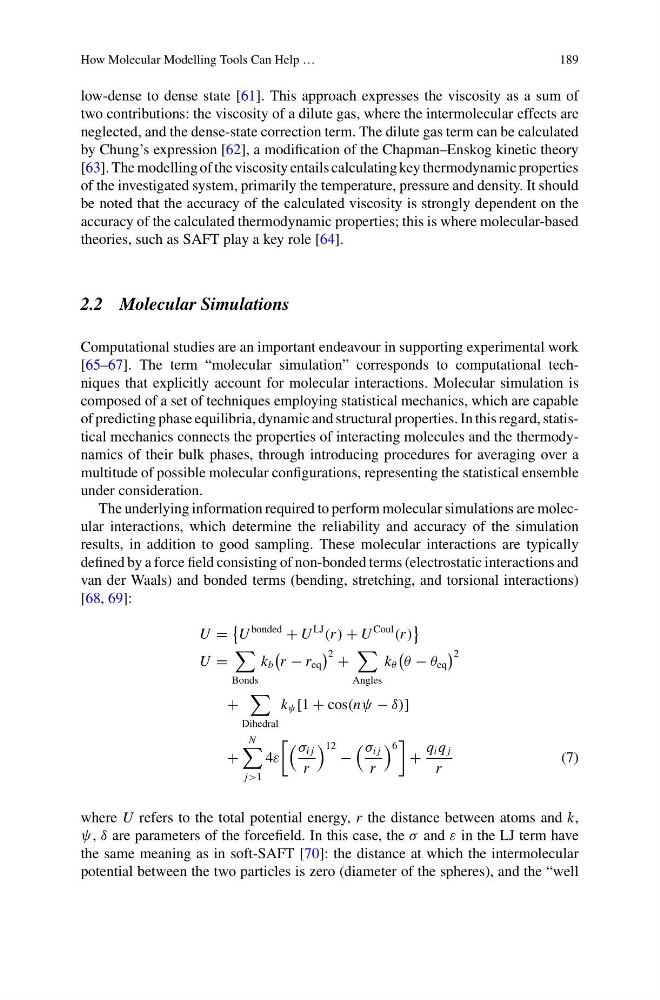
The underlying information required to perform molecular simulations are molecular interactions, which determine the reliability and accuracy of the simulation
results, in addition to good sampling. These molecular interactions are typically
defined by a force field consisting of non-bonded terms (electrostatic interactions and
van der Waals) and bonded terms (bending, stretching, and torsional interactions)
[68, 69]:
U =
U
bonded
+ U
LJ
(r ) + U
Coul
(r )
U =
Bonds
k b
r − r eq
2 +
Angles
k θ
θ − θ eq
2
+
Dihedral
k ψ [1 + cos(nψ − δ)]
+
N
j>1
4ε
σ i j
r
12 −
σ i j
r
6
+
q i q j
r
(7)
where U refers to the total potential energy, r the distance between atoms and k,
ψ, δ are parameters of the forcefield. In this case, the σ and ε in the LJ term have
the same meaning as in soft-SAFT [70]: the distance at which the intermolecular
potential between the two particles is zero (diameter of the spheres), and the “well
189
low-dense to dense state [61]. This approach expresses the viscosity as a sum of
two contributions: the viscosity of a dilute gas, where the intermolecular effects are
neglected, and the dense-state correction term. The dilute gas term can be calculated
by Chung’s expression [62], a modification of the Chapman–Enskog kinetic theory
[63]. The modelling of the viscosity entails calculating key thermodynamic properties
of the investigated system, primarily the temperature, pressure and density. It should
be noted that the accuracy of the calculated viscosity is strongly dependent on the
accuracy of the calculated thermodynamic properties; this is where molecular-based
theories, such as SAFT play a key role [64].
2.2 Molecular Simulations
Computational studies are an important endeavour in supporting experimental work
[65–67]. The term “molecular simulation” corresponds to computational techniques that explicitly account for molecular interactions. Molecular simulation is
composed of a set of techniques employing statistical mechanics, which are capable
of predicting phase equilibria, dynamic and structural properties. In this regard, statistical mechanics connects the properties of interacting molecules and the thermodynamics of their bulk phases, through introducing procedures for averaging over a
multitude of possible molecular configurations, representing the statistical ensemble
under consideration.
The underlying information required to perform molecular simulations are molecular interactions, which determine the reliability and accuracy of the simulation
results, in addition to good sampling. These molecular interactions are typically
defined by a force field consisting of non-bonded terms (electrostatic interactions and
van der Waals) and bonded terms (bending, stretching, and torsional interactions)
[68, 69]:
U =
U
bonded
+ U
LJ
(r ) + U
Coul
(r )
U =
Bonds
k b
r − r eq
2 +
Angles
k θ
θ − θ eq
2
+
Dihedral
k ψ [1 + cos(nψ − δ)]
+
N
j>1
4ε
σ i j
r
12 −
σ i j
r
6
+
q i q j
r
(7)
where U refers to the total potential energy, r the distance between atoms and k,
ψ, δ are parameters of the forcefield. In this case, the σ and ε in the LJ term have
the same meaning as in soft-SAFT [70]: the distance at which the intermolecular
potential between the two particles is zero (diameter of the spheres), and the “well