

182
L. F. Vega et al.
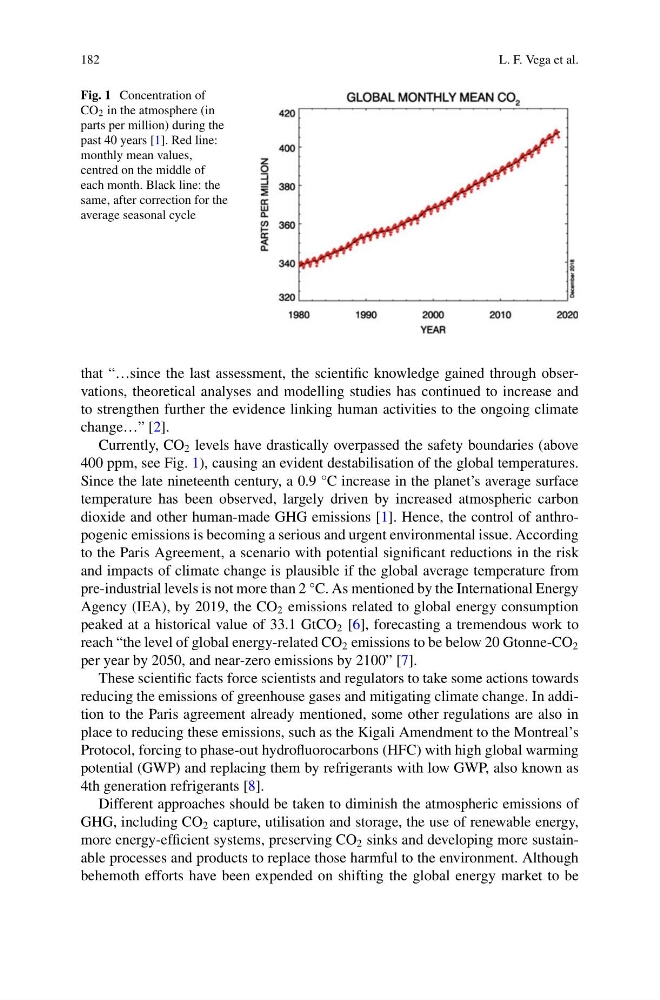
Fig. 1 Concentration of
CO 2 in the atmosphere (in
parts per million) during the
past 40 years [1]. Red line:
monthly mean values,
centred on the middle of
each month. Black line: the
same, after correction for the
average seasonal cycle
that “…since the last assessment, the scientific knowledge gained through observations, theoretical analyses and modelling studies has continued to increase and
to strengthen further the evidence linking human activities to the ongoing climate
change…” [2].
Currently, CO 2 levels have drastically overpassed the safety boundaries (above
400 ppm, see Fig. 1), causing an evident destabilisation of the global temperatures.
Since the late nineteenth century, a 0.9 °C increase in the planet’s average surface
temperature has been observed, largely driven by increased atmospheric carbon
dioxide and other human-made GHG emissions [1]. Hence, the control of anthropogenic emissions is becoming a serious and urgent environmental issue. According
to the Paris Agreement, a scenario with potential significant reductions in the risk
and impacts of climate change is plausible if the global average temperature from
pre-industrial levels is not more than 2 °C. As mentioned by the International Energy
Agency (IEA), by 2019, the CO 2 emissions related to global energy consumption
peaked at a historical value of 33.1 GtCO 2 [6], forecasting a tremendous work to
reach “the level of global energy-related CO 2 emissions to be below 20 Gtonne-CO 2
per year by 2050, and near-zero emissions by 2100” [7].
These scientific facts force scientists and regulators to take some actions towards
reducing the emissions of greenhouse gases and mitigating climate change. In addition to the Paris agreement already mentioned, some other regulations are also in
place to reducing these emissions, such as the Kigali Amendment to the Montreal’s
Protocol, forcing to phase-out hydrofluorocarbons (HFC) with high global warming
potential (GWP) and replacing them by refrigerants with low GWP, also known as
4th generation refrigerants [8].
Different approaches should be taken to diminish the atmospheric emissions of
GHG, including CO 2 capture, utilisation and storage, the use of renewable energy,
more energy-efficient systems, preserving CO 2 sinks and developing more sustainable processes and products to replace those harmful to the environment. Although
behemoth efforts have been expended on shifting the global energy market to be
L. F. Vega et al.
Fig. 1 Concentration of
CO 2 in the atmosphere (in
parts per million) during the
past 40 years [1]. Red line:
monthly mean values,
centred on the middle of
each month. Black line: the
same, after correction for the
average seasonal cycle
that “…since the last assessment, the scientific knowledge gained through observations, theoretical analyses and modelling studies has continued to increase and
to strengthen further the evidence linking human activities to the ongoing climate
change…” [2].
Currently, CO 2 levels have drastically overpassed the safety boundaries (above
400 ppm, see Fig. 1), causing an evident destabilisation of the global temperatures.
Since the late nineteenth century, a 0.9 °C increase in the planet’s average surface
temperature has been observed, largely driven by increased atmospheric carbon
dioxide and other human-made GHG emissions [1]. Hence, the control of anthropogenic emissions is becoming a serious and urgent environmental issue. According
to the Paris Agreement, a scenario with potential significant reductions in the risk
and impacts of climate change is plausible if the global average temperature from
pre-industrial levels is not more than 2 °C. As mentioned by the International Energy
Agency (IEA), by 2019, the CO 2 emissions related to global energy consumption
peaked at a historical value of 33.1 GtCO 2 [6], forecasting a tremendous work to
reach “the level of global energy-related CO 2 emissions to be below 20 Gtonne-CO 2
per year by 2050, and near-zero emissions by 2100” [7].
These scientific facts force scientists and regulators to take some actions towards
reducing the emissions of greenhouse gases and mitigating climate change. In addition to the Paris agreement already mentioned, some other regulations are also in
place to reducing these emissions, such as the Kigali Amendment to the Montreal’s
Protocol, forcing to phase-out hydrofluorocarbons (HFC) with high global warming
potential (GWP) and replacing them by refrigerants with low GWP, also known as
4th generation refrigerants [8].
Different approaches should be taken to diminish the atmospheric emissions of
GHG, including CO 2 capture, utilisation and storage, the use of renewable energy,
more energy-efficient systems, preserving CO 2 sinks and developing more sustainable processes and products to replace those harmful to the environment. Although
behemoth efforts have been expended on shifting the global energy market to be