

8
E. K. Hamal and M. C. Toroker
Table 3 Free energies and overpotentials for Ni 1−x Fe x OOH alloy at different iron concentrations
with or without strain at pH = 14 and V = 1 V
Reaction
Pure NiOOH Fe-doped
8%
Fe-doped 25% Fe-doped 33% Fe-doped 42%
A to B
−0.11
−0.41
−0.45
−0.51
−0.57
B to C
−0.72
−0.35
−0.43
−0.46
−0.42
C to D
−0.40
−0.69
−0.56
−0.63
−0.66
D to A
−1.59
−1.36
−1.38
−1.21
−1.16
Overpotential
[eV]
0.61
0.37
0.29
0.26
0.30
Units are eV
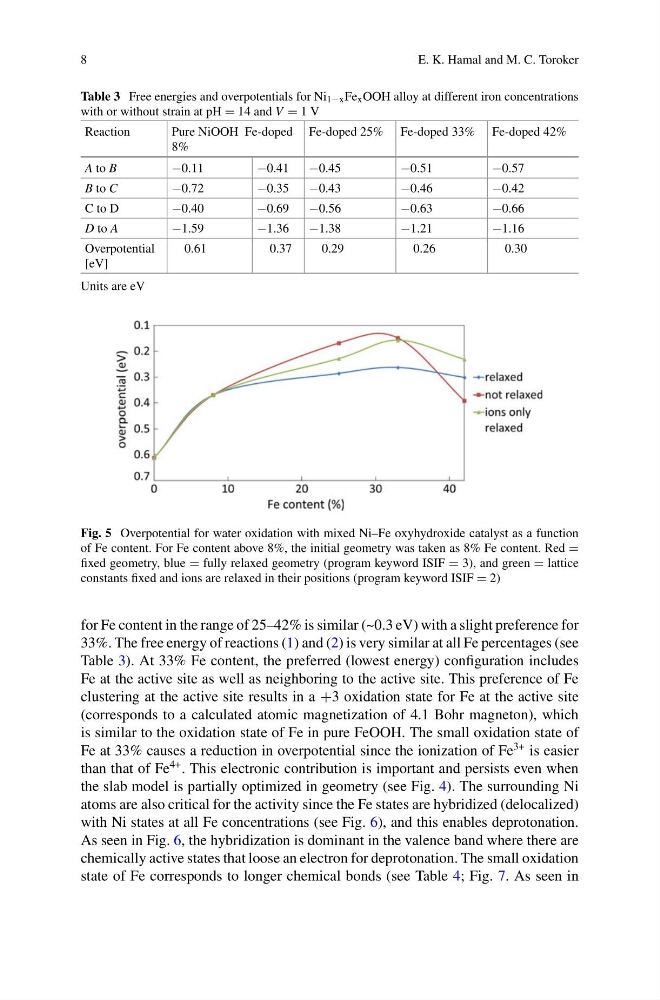
Fig. 5 Overpotential for water oxidation with mixed Ni–Fe oxyhydroxide catalyst as a function
of Fe content. For Fe content above 8%, the initial geometry was taken as 8% Fe content. Red =
fixed geometry, blue = fully relaxed geometry (program keyword ISIF = 3), and green = lattice
constants fixed and ions are relaxed in their positions (program keyword ISIF = 2)
for Fe content in the range of 25–42% is similar (~0.3 eV) with a slight preference for
33%. The free energy of reactions (1) and (2) is very similar at all Fe percentages (see
Table 3). At 33% Fe content, the preferred (lowest energy) configuration includes
Fe at the active site as well as neighboring to the active site. This preference of Fe
clustering at the active site results in a +3 oxidation state for Fe at the active site
(corresponds to a calculated atomic magnetization of 4.1 Bohr magneton), which
is similar to the oxidation state of Fe in pure FeOOH. The small oxidation state of
Fe at 33% causes a reduction in overpotential since the ionization of Fe
3+ is easier
than that of Fe
4+ . This electronic contribution is important and persists even when
the slab model is partially optimized in geometry (see Fig. 4). The surrounding Ni
atoms are also critical for the activity since the Fe states are hybridized (delocalized)
with Ni states at all Fe concentrations (see Fig. 6), and this enables deprotonation.
As seen in Fig. 6, the hybridization is dominant in the valence band where there are
chemically active states that loose an electron for deprotonation. The small oxidation
state of Fe corresponds to longer chemical bonds (see Table 4; Fig. 7. As seen in
E. K. Hamal and M. C. Toroker
Table 3 Free energies and overpotentials for Ni 1−x Fe x OOH alloy at different iron concentrations
with or without strain at pH = 14 and V = 1 V
Reaction
Pure NiOOH Fe-doped
8%
Fe-doped 25% Fe-doped 33% Fe-doped 42%
A to B
−0.11
−0.41
−0.45
−0.51
−0.57
B to C
−0.72
−0.35
−0.43
−0.46
−0.42
C to D
−0.40
−0.69
−0.56
−0.63
−0.66
D to A
−1.59
−1.36
−1.38
−1.21
−1.16
Overpotential
[eV]
0.61
0.37
0.29
0.26
0.30
Units are eV
Fig. 5 Overpotential for water oxidation with mixed Ni–Fe oxyhydroxide catalyst as a function
of Fe content. For Fe content above 8%, the initial geometry was taken as 8% Fe content. Red =
fixed geometry, blue = fully relaxed geometry (program keyword ISIF = 3), and green = lattice
constants fixed and ions are relaxed in their positions (program keyword ISIF = 2)
for Fe content in the range of 25–42% is similar (~0.3 eV) with a slight preference for
33%. The free energy of reactions (1) and (2) is very similar at all Fe percentages (see
Table 3). At 33% Fe content, the preferred (lowest energy) configuration includes
Fe at the active site as well as neighboring to the active site. This preference of Fe
clustering at the active site results in a +3 oxidation state for Fe at the active site
(corresponds to a calculated atomic magnetization of 4.1 Bohr magneton), which
is similar to the oxidation state of Fe in pure FeOOH. The small oxidation state of
Fe at 33% causes a reduction in overpotential since the ionization of Fe
3+ is easier
than that of Fe
4+ . This electronic contribution is important and persists even when
the slab model is partially optimized in geometry (see Fig. 4). The surrounding Ni
atoms are also critical for the activity since the Fe states are hybridized (delocalized)
with Ni states at all Fe concentrations (see Fig. 6), and this enables deprotonation.
As seen in Fig. 6, the hybridization is dominant in the valence band where there are
chemically active states that loose an electron for deprotonation. The small oxidation
state of Fe corresponds to longer chemical bonds (see Table 4; Fig. 7. As seen in