

The Statistical Mechanics of Solution-Phase Nucleation …
115
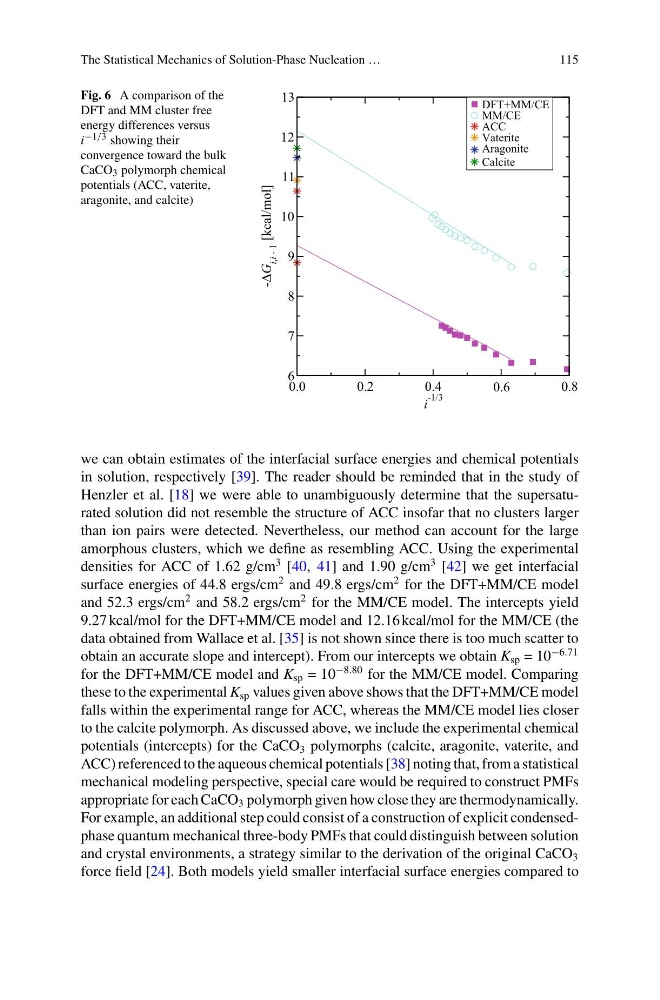
Fig. 6 A comparison of the
DFT and MM cluster free
energy differences versus
i −1/3 showing their
convergence toward the bulk
CaCO 3 polymorph chemical
potentials (ACC, vaterite,
aragonite, and calcite)
0.0
0.2
0.4
0.6
0.8
i
-1/3
6
7
8
9
10
11
12
13
-ΔG
i,i - 1
[kcal/mol]
DFT+MM/CE
MM/CE
ACC
Vaterite
Aragonite
Calcite
we can obtain estimates of the interfacial surface energies and chemical potentials
in solution, respectively [39]. The reader should be reminded that in the study of
Henzler et al. [18] we were able to unambiguously determine that the supersaturated solution did not resemble the structure of ACC insofar that no clusters larger
than ion pairs were detected. Nevertheless, our method can account for the large
amorphous clusters, which we define as resembling ACC. Using the experimental
densities for ACC of 1.62 g/cm
3 [40, 41] and 1.90 g/cm
3 [42] we get interfacial
surface energies of 44.8 ergs/cm
2 and 49.8 ergs/cm
2 for the DFT+MM/CE model
and 52.3 ergs/cm
2 and 58.2 ergs/cm
2 for the MM/CE model. The intercepts yield
9.27 kcal/mol for the DFT+MM/CE model and 12.16 kcal/mol for the MM/CE (the
data obtained from Wallace et al. [35] is not shown since there is too much scatter to
obtain an accurate slope and intercept). From our intercepts we obtain K sp = 10
−6.71
for the DFT+MM/CE model and K sp = 10
−8.80 for the MM/CE model. Comparing
these to the experimental K sp values given above shows that the DFT+MM/CE model
falls within the experimental range for ACC, whereas the MM/CE model lies closer
to the calcite polymorph. As discussed above, we include the experimental chemical
potentials (intercepts) for the CaCO 3 polymorphs (calcite, aragonite, vaterite, and
ACC) referenced to the aqueous chemical potentials [38] noting that, from a statistical
mechanical modeling perspective, special care would be required to construct PMFs
appropriate for each CaCO 3 polymorph given how close they are thermodynamically.
For example, an additional step could consist of a construction of explicit condensedphase quantum mechanical three-body PMFs that could distinguish between solution
and crystal environments, a strategy similar to the derivation of the original CaCO 3
force field [24]. Both models yield smaller interfacial surface energies compared to
115
Fig. 6 A comparison of the
DFT and MM cluster free
energy differences versus
i −1/3 showing their
convergence toward the bulk
CaCO 3 polymorph chemical
potentials (ACC, vaterite,
aragonite, and calcite)
0.0
0.2
0.4
0.6
0.8
i
-1/3
6
7
8
9
10
11
12
13
-ΔG
i,i - 1
[kcal/mol]
DFT+MM/CE
MM/CE
ACC
Vaterite
Aragonite
Calcite
we can obtain estimates of the interfacial surface energies and chemical potentials
in solution, respectively [39]. The reader should be reminded that in the study of
Henzler et al. [18] we were able to unambiguously determine that the supersaturated solution did not resemble the structure of ACC insofar that no clusters larger
than ion pairs were detected. Nevertheless, our method can account for the large
amorphous clusters, which we define as resembling ACC. Using the experimental
densities for ACC of 1.62 g/cm
3 [40, 41] and 1.90 g/cm
3 [42] we get interfacial
surface energies of 44.8 ergs/cm
2 and 49.8 ergs/cm
2 for the DFT+MM/CE model
and 52.3 ergs/cm
2 and 58.2 ergs/cm
2 for the MM/CE model. The intercepts yield
9.27 kcal/mol for the DFT+MM/CE model and 12.16 kcal/mol for the MM/CE (the
data obtained from Wallace et al. [35] is not shown since there is too much scatter to
obtain an accurate slope and intercept). From our intercepts we obtain K sp = 10
−6.71
for the DFT+MM/CE model and K sp = 10
−8.80 for the MM/CE model. Comparing
these to the experimental K sp values given above shows that the DFT+MM/CE model
falls within the experimental range for ACC, whereas the MM/CE model lies closer
to the calcite polymorph. As discussed above, we include the experimental chemical
potentials (intercepts) for the CaCO 3 polymorphs (calcite, aragonite, vaterite, and
ACC) referenced to the aqueous chemical potentials [38] noting that, from a statistical
mechanical modeling perspective, special care would be required to construct PMFs
appropriate for each CaCO 3 polymorph given how close they are thermodynamically.
For example, an additional step could consist of a construction of explicit condensedphase quantum mechanical three-body PMFs that could distinguish between solution
and crystal environments, a strategy similar to the derivation of the original CaCO 3
force field [24]. Both models yield smaller interfacial surface energies compared to