

The Statistical Mechanics of Solution-Phase Nucleation …
105
The detailed description of the PMF construction procedures and their validation is
presented elsewhere [18]. In short, the quantum mechanical PMF was obtained using
density functional theory (DFT) at the BLYP-D2 [21–23] level of theory while the
empirical molecular-mechanics (MM) based PMF was obtained using the force field
parameterized by Raiteri and co-workers [24] to reproduce the ion solvation energies
and crystalline structure. The long-range interactions between ions at separations
> 8 Å are treated as slowly varying and are represented by a simple Coulomb term
modulated by the dielectric screening ∼ r
−1 , where r represents the distance between
ions, which we call continuum electrostatics (CE). These interactions are truncated
at 20 Å. Additionally, due to the computational cost of condensed-phase quantum
mechanical simulations (at least five orders of magnitude higher when compared to
MM), the DFT-based PMF is truncated at 6 Å and then stitched to the MM-based
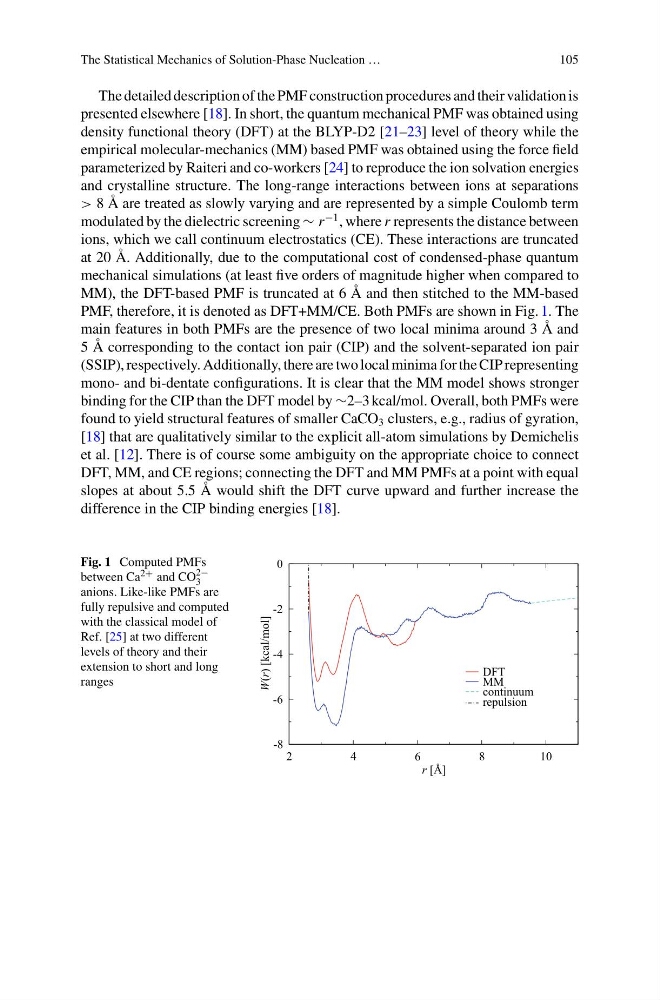
PMF, therefore, it is denoted as DFT+MM/CE. Both PMFs are shown in Fig. 1. The
main features in both PMFs are the presence of two local minima around 3 Å and
5 Å corresponding to the contact ion pair (CIP) and the solvent-separated ion pair
(SSIP), respectively. Additionally, there are two local minima for the CIP representing
mono- and bi-dentate configurations. It is clear that the MM model shows stronger
binding for the CIP than the DFT model by ∼2–3 kcal/mol. Overall, both PMFs were
found to yield structural features of smaller CaCO 3 clusters, e.g., radius of gyration,
[18] that are qualitatively similar to the explicit all-atom simulations by Demichelis
et al. [12]. There is of course some ambiguity on the appropriate choice to connect
DFT, MM, and CE regions; connecting the DFT and MM PMFs at a point with equal
slopes at about 5.5 Å would shift the DFT curve upward and further increase the
difference in the CIP binding energies [18].
Fig. 1 Computed PMFs
between Ca 2+ and CO
2−
3
anions. Like-like PMFs are
fully repulsive and computed
with the classical model of
Ref. [25] at two different
levels of theory and their
extension to short and long
ranges
2
4
6
8
1 0
r [Å]
-8
-6
-4
-2
0
W(r) [kcal/mol]
DFT
MM
continuum
repulsion
105
The detailed description of the PMF construction procedures and their validation is
presented elsewhere [18]. In short, the quantum mechanical PMF was obtained using
density functional theory (DFT) at the BLYP-D2 [21–23] level of theory while the
empirical molecular-mechanics (MM) based PMF was obtained using the force field
parameterized by Raiteri and co-workers [24] to reproduce the ion solvation energies
and crystalline structure. The long-range interactions between ions at separations
> 8 Å are treated as slowly varying and are represented by a simple Coulomb term
modulated by the dielectric screening ∼ r
−1 , where r represents the distance between
ions, which we call continuum electrostatics (CE). These interactions are truncated
at 20 Å. Additionally, due to the computational cost of condensed-phase quantum
mechanical simulations (at least five orders of magnitude higher when compared to
MM), the DFT-based PMF is truncated at 6 Å and then stitched to the MM-based
PMF, therefore, it is denoted as DFT+MM/CE. Both PMFs are shown in Fig. 1. The
main features in both PMFs are the presence of two local minima around 3 Å and
5 Å corresponding to the contact ion pair (CIP) and the solvent-separated ion pair
(SSIP), respectively. Additionally, there are two local minima for the CIP representing
mono- and bi-dentate configurations. It is clear that the MM model shows stronger
binding for the CIP than the DFT model by ∼2–3 kcal/mol. Overall, both PMFs were
found to yield structural features of smaller CaCO 3 clusters, e.g., radius of gyration,
[18] that are qualitatively similar to the explicit all-atom simulations by Demichelis
et al. [12]. There is of course some ambiguity on the appropriate choice to connect
DFT, MM, and CE regions; connecting the DFT and MM PMFs at a point with equal
slopes at about 5.5 Å would shift the DFT curve upward and further increase the
difference in the CIP binding energies [18].
Fig. 1 Computed PMFs
between Ca 2+ and CO
2−
3
anions. Like-like PMFs are
fully repulsive and computed
with the classical model of
Ref. [25] at two different
levels of theory and their
extension to short and long
ranges
2
4
6
8
1 0
r [Å]
-8
-6
-4
-2
0
W(r) [kcal/mol]
DFT
MM
continuum
repulsion