

76
Chapter 4 · There is More to Oleochemistry - Reactions at the Fatty Acid Alkyl Chain
4
distillation, and the remaining triglycerides are
then transesterified with methanol. In further
separation steps, the product mixture is then
separated into individual components and partially hydrogenated. Among others, dimethyl
α,ω-octadecanedioate is formed, an interesting
monomer for biopolymers (7 Chap. 19). Functionalized poly-olefins, which are used as lubricants, and biofuels (7 Chap. 20) are also available
in the Gresik biorefinery.
At the beginning of 2016, Elevance announced
that it now also has a second generation of technology: It can now also use Schrock-type molybdenum or tungsten catalysts suitable for ethenolysis
of fats and oils. A first demonstration plant with
this technology was successfully operated in Budapest (Hungary). Ethenolysis can significantly
expand the existing metathesis product portfolio.
work in this field. The company was founded in
2007 by a joint venture between Cargill, which
traditionally deals with renewable raw materials,
and Materia, which holds the worldwide rights
to ruthenium-based Grubbs metathesis catalysts.
Elevance commissioned a biochemical refinery in Gresik, Indonesia, in 2013. This plant on
the island of Java has a capacity of 180,000 tons
per year and uses palm oil as its preferred raw
material, but can also process other oils such
as jatropha or algae oils. A mixture of unsaturated diesters, unsaturated monoesters (e.g.
methyl 9-decenoate) and olefins is formed by
cross-metathesis of methyl oleate with 1-butene
(butenolysis) and a parallel self-metathesis of
the oleochemical. In the biorefinery in Gresik,
the palm oil is directly metathesized with
1-butene, the olefins produced are separated by
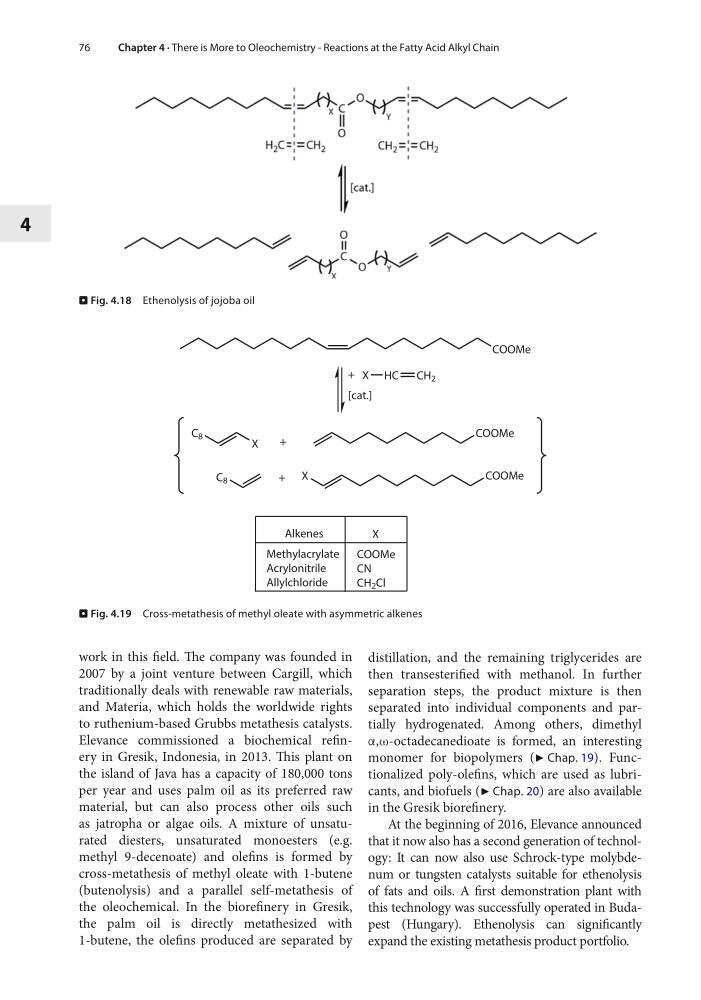
. Fig. 4.18 Ethenolysis of jojoba oil
. Fig. 4.19 Cross-metathesis of methyl oleate with asymmetric alkenes
COOMe
+
HC
CH 2
X
[cat.]
C 8
X
COOMe
C 8
COOMe
X
+
+
Methylacrylate
Acrylonitrile
Allylchloride
COOMe
CN
CH 2 Cl
Alkenes
X
Chapter 4 · There is More to Oleochemistry - Reactions at the Fatty Acid Alkyl Chain
4
distillation, and the remaining triglycerides are
then transesterified with methanol. In further
separation steps, the product mixture is then
separated into individual components and partially hydrogenated. Among others, dimethyl
α,ω-octadecanedioate is formed, an interesting
monomer for biopolymers (7 Chap. 19). Functionalized poly-olefins, which are used as lubricants, and biofuels (7 Chap. 20) are also available
in the Gresik biorefinery.
At the beginning of 2016, Elevance announced
that it now also has a second generation of technology: It can now also use Schrock-type molybdenum or tungsten catalysts suitable for ethenolysis
of fats and oils. A first demonstration plant with
this technology was successfully operated in Budapest (Hungary). Ethenolysis can significantly
expand the existing metathesis product portfolio.
work in this field. The company was founded in
2007 by a joint venture between Cargill, which
traditionally deals with renewable raw materials,
and Materia, which holds the worldwide rights
to ruthenium-based Grubbs metathesis catalysts.
Elevance commissioned a biochemical refinery in Gresik, Indonesia, in 2013. This plant on
the island of Java has a capacity of 180,000 tons
per year and uses palm oil as its preferred raw
material, but can also process other oils such
as jatropha or algae oils. A mixture of unsaturated diesters, unsaturated monoesters (e.g.
methyl 9-decenoate) and olefins is formed by
cross-metathesis of methyl oleate with 1-butene
(butenolysis) and a parallel self-metathesis of
the oleochemical. In the biorefinery in Gresik,
the palm oil is directly metathesized with
1-butene, the olefins produced are separated by
. Fig. 4.18 Ethenolysis of jojoba oil
. Fig. 4.19 Cross-metathesis of methyl oleate with asymmetric alkenes
COOMe
+
HC
CH 2
X
[cat.]
C 8
X
COOMe
C 8
COOMe
X
+
+
Methylacrylate
Acrylonitrile
Allylchloride
COOMe
CN
CH 2 Cl
Alkenes
X