

63
4
unsaturated compounds with a peracid to epoxides (oxiranes). This epoxidation was subsequently further developed and also applied to
unsaturated oleo chemicals, in particular on the
basis of soybean oil. Perbenzoic acid was originally used as peracid; today, performic acid
or peracetic acid is used almost exclusively in
industry. Peracids are produced relatively e asily
from the corresponding carboxylic acid and
hydrogen peroxide. Two basic approaches can be
distinguished here: On the one hand, peracid is
produced separately and then reacted with the
unsaturated oleochemical. On the other hand,
the peracid can also be produced in situ during
epoxidation. A typical example of an epoxidation, the reaction of triolein (glyceryl trioleate)
with performic acid, is shown in . Fig. 4.3.
Recently, numerous catalysts have been
developed which either accelerate in situ peracid
formation or epoxidation itself. Typical examples
are acidic ion exchangers, zeolites, hydrotalcites
and transition metal salts or oxides.
The use of enzymes is also a newer path to
epoxidized oleochemicals. Lipases, e.g. Novozym
435, catalyze the conversion of fatty acids with
hydrogen peroxide to peroxy fatty acids, which
then lead to epoxidized fatty acids by intermolecular oxygen transfer.
Epoxidized oleochemicals are widely used,
especially in plastics. They are excellent plasticizers and are used as flame retardants,
antioxidants and light stabilizers in plastics.
Epoxidized soybean oil (ESBO) is widely used
in polyvinyl-chloride and related polymers.
If hydrogen chloride is split off in a chlorinecontaining plastic by the influence of heat or
light, it is scavenged by a reaction with the
epoxide groups present in ESBO.
The epoxy group can also undergo numerous
subsequent reactions. Protic substrates lead to
ring opening: Diols are formed with water, ether
alcohols with alcohols, amino alcohols with secondary amines, hydroxyacetates with acetic acid
(. Fig. 4.4). Epoxidized triolein (see . Fig. 4.3)
thus forms a hexol that can be processed with
diisocyanates to polyurethane foams. Further
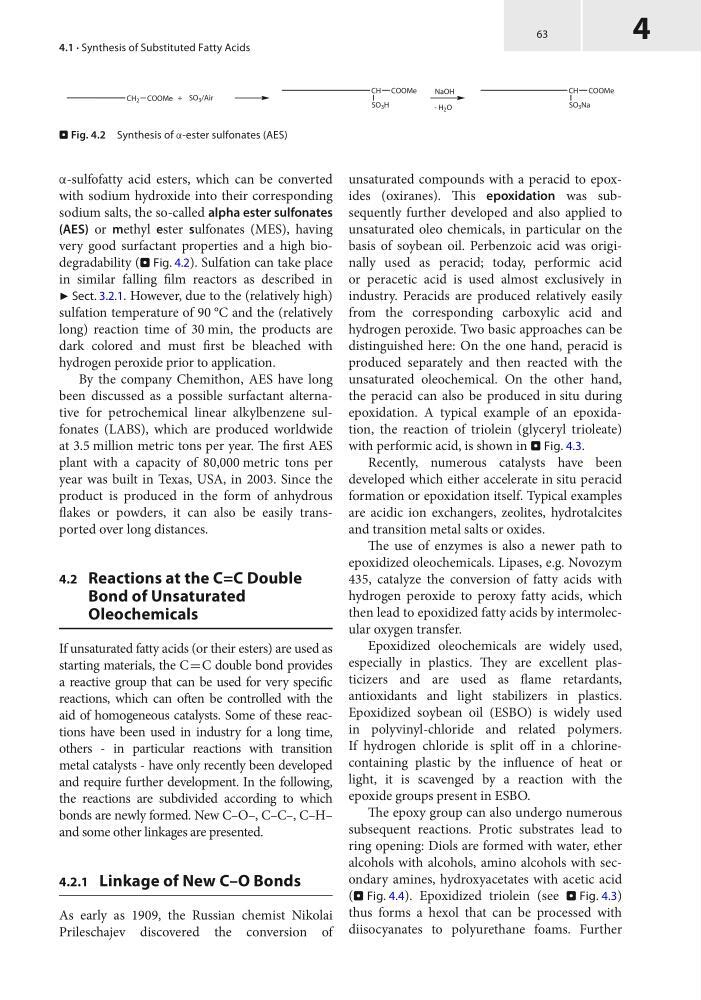
α-sulfofatty acid esters, which can be converted
with sodium hydroxide into their corresponding
sodium salts, the so-called alpha ester sulfonates
(AES) or methyl ester sulfonates (MES), having
very good surfactant properties and a high biodegradability (. Fig. 4.2). Sulfation can take place
in similar falling film reactors as described in
7 Sect. 3.2.1. However, due to the (relatively high)
sulfation temperature of 90 °C and the (relatively
long) reaction time of 30 min, the products are
dark colored and must first be bleached with
hydrogen peroxide prior to application.
By the company Chemithon, AES have long
been discussed as a possible surfactant alternative for petrochemical linear alkylbenzene sulfonates (LABS), which are produced worldwide
at 3.5 million metric tons per year. The first AES
plant with a capacity of 80,000 metric tons per
year was built in Texas, USA, in 2003. Since the
product is produced in the form of anhydrous
flakes or powders, it can also be easily transported over long distances.
4.2 Reactions at the C=C Double
Bond of Unsaturated
Oleochemicals
If unsaturated fatty acids (or their esters) are used as
starting materials, the C = C double bond provides
a reactive group that can be used for very specific
reactions, which can often be controlled with the
aid of homogeneous catalysts. Some of these reactions have been used in industry for a long time,
others - in particular reactions with transition
metal catalysts - have only recently been developed
and require further development. In the following,
the reactions are subdivided according to which
bonds are newly formed. New C–O–, C–C–, C–H–
and some other linkages are presented.
4.2.1 Linkage of New C–O Bonds
As early as 1909, the Russian chemist Nikolai
Prileschajev discovered the conversion of
+ SO 3 /Air
NaOH
CH 2
CH COOMe
SO 3 H
CH COOMe
SO 3 Na
- H 2 O
COOMe
. Fig. 4.2 Synthesis of α-ester sulfonates (AES)
4.1 · Synthesis of Substituted Fatty Acids
4
unsaturated compounds with a peracid to epoxides (oxiranes). This epoxidation was subsequently further developed and also applied to
unsaturated oleo chemicals, in particular on the
basis of soybean oil. Perbenzoic acid was originally used as peracid; today, performic acid
or peracetic acid is used almost exclusively in
industry. Peracids are produced relatively e asily
from the corresponding carboxylic acid and
hydrogen peroxide. Two basic approaches can be
distinguished here: On the one hand, peracid is
produced separately and then reacted with the
unsaturated oleochemical. On the other hand,
the peracid can also be produced in situ during
epoxidation. A typical example of an epoxidation, the reaction of triolein (glyceryl trioleate)
with performic acid, is shown in . Fig. 4.3.
Recently, numerous catalysts have been
developed which either accelerate in situ peracid
formation or epoxidation itself. Typical examples
are acidic ion exchangers, zeolites, hydrotalcites
and transition metal salts or oxides.
The use of enzymes is also a newer path to
epoxidized oleochemicals. Lipases, e.g. Novozym
435, catalyze the conversion of fatty acids with
hydrogen peroxide to peroxy fatty acids, which
then lead to epoxidized fatty acids by intermolecular oxygen transfer.
Epoxidized oleochemicals are widely used,
especially in plastics. They are excellent plasticizers and are used as flame retardants,
antioxidants and light stabilizers in plastics.
Epoxidized soybean oil (ESBO) is widely used
in polyvinyl-chloride and related polymers.
If hydrogen chloride is split off in a chlorinecontaining plastic by the influence of heat or
light, it is scavenged by a reaction with the
epoxide groups present in ESBO.
The epoxy group can also undergo numerous
subsequent reactions. Protic substrates lead to
ring opening: Diols are formed with water, ether
alcohols with alcohols, amino alcohols with secondary amines, hydroxyacetates with acetic acid
(. Fig. 4.4). Epoxidized triolein (see . Fig. 4.3)
thus forms a hexol that can be processed with
diisocyanates to polyurethane foams. Further
α-sulfofatty acid esters, which can be converted
with sodium hydroxide into their corresponding
sodium salts, the so-called alpha ester sulfonates
(AES) or methyl ester sulfonates (MES), having
very good surfactant properties and a high biodegradability (. Fig. 4.2). Sulfation can take place
in similar falling film reactors as described in
7 Sect. 3.2.1. However, due to the (relatively high)
sulfation temperature of 90 °C and the (relatively
long) reaction time of 30 min, the products are
dark colored and must first be bleached with
hydrogen peroxide prior to application.
By the company Chemithon, AES have long
been discussed as a possible surfactant alternative for petrochemical linear alkylbenzene sulfonates (LABS), which are produced worldwide
at 3.5 million metric tons per year. The first AES
plant with a capacity of 80,000 metric tons per
year was built in Texas, USA, in 2003. Since the
product is produced in the form of anhydrous
flakes or powders, it can also be easily transported over long distances.
4.2 Reactions at the C=C Double
Bond of Unsaturated
Oleochemicals
If unsaturated fatty acids (or their esters) are used as
starting materials, the C = C double bond provides
a reactive group that can be used for very specific
reactions, which can often be controlled with the
aid of homogeneous catalysts. Some of these reactions have been used in industry for a long time,
others - in particular reactions with transition
metal catalysts - have only recently been developed
and require further development. In the following,
the reactions are subdivided according to which
bonds are newly formed. New C–O–, C–C–, C–H–
and some other linkages are presented.
4.2.1 Linkage of New C–O Bonds
As early as 1909, the Russian chemist Nikolai
Prileschajev discovered the conversion of
+ SO 3 /Air
NaOH
CH 2
CH COOMe
SO 3 H
CH COOMe
SO 3 Na
- H 2 O
COOMe
. Fig. 4.2 Synthesis of α-ester sulfonates (AES)
4.1 · Synthesis of Substituted Fatty Acids