

55
3
3.2 · Reactions at the Carboxy Group of Fatty Acids
5 From 2 × n-decanol (caprin alcohol) the
2-octyl-1-dodecanol (C 20 ),
5 From 2 × n-dodecanol (lauryl alcohol) the
2-decyl-1-tetradecanol (C 24 ), etc.
A mixture of two different fatty alcohols results
in four different Guerbet alcohols, e.g. from
an octanol/decanol mixture in addition to the
homo-condensates listed above, the C 18 mixed
condensates 2-octyl-1-decanol and 2-hexyl-1dodecanol are formed.
The reaction is carried out at 250–300 °C in
the presence of basic catalysts such as KOH or
potassium alcoholates. Salts of the metals iron,
nickel, copper or lead are also added. The mechanism is similar to aldol condensation, but has
not yet been fully clarified due to the parallel
dehydrogenations, dehydrations and hydrogenations. The Guerbet alcohols listed above in the C
number range C 16 –C 24 are used as plasticizers for
nitrocellulose, as solvents for printing inks and as
components of lubricants and textile auxiliaries.
The main application of Guerbet alcohols are
cosmetic or pharmaceutical oils. However, global
production is relatively low (2000–3,000 t a −1 ).
As . Fig. 3.22 shows, Guerbet alcohols also
have an extensive downstream chemistry. Of
industrial importance are, for example, Guerbet
acids and Guerbet esters.
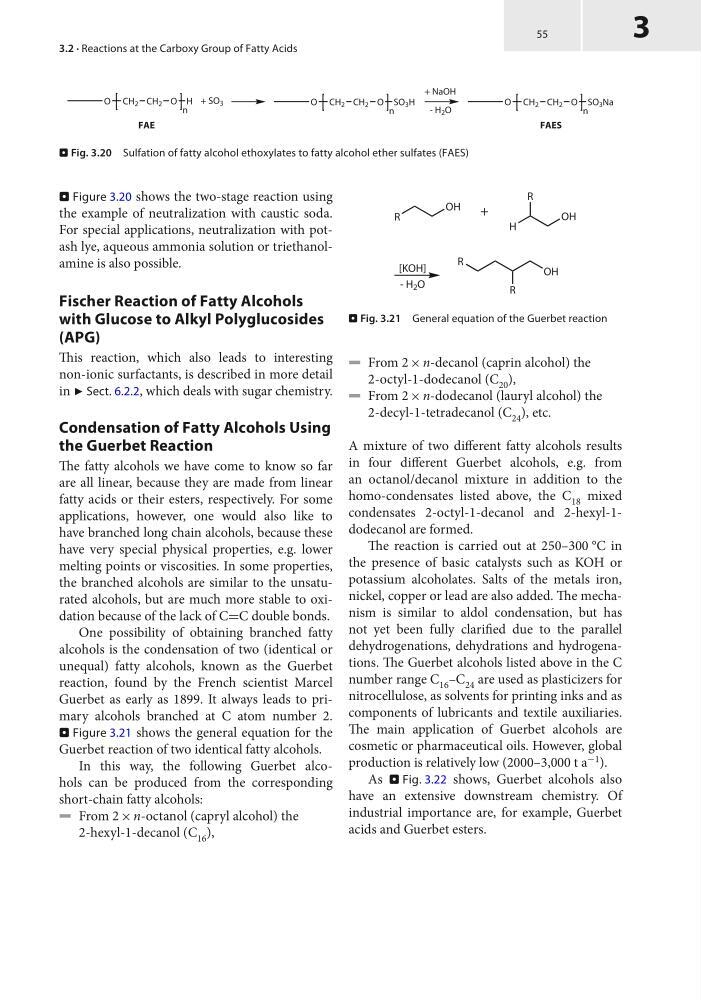
. Figure 3.20 shows the two-stage reaction using
the example of neutralization with caustic soda.
For special applications, neutralization with potash lye, aqueous ammonia solution or triethanolamine is also possible.
Fischer Reaction of Fatty Alcohols
with Glucose to Alkyl Polyglucosides
(APG)
This reaction, which also leads to interesting
non-ionic surfactants, is described in more detail
in 7 Sect. 6.2.2, which deals with sugar chemistry.
Condensation of Fatty Alcohols Using
the Guerbet Reaction
The fatty alcohols we have come to know so far
are all linear, because they are made from linear
fatty acids or their esters, respectively. For some
applications, however, one would also like to
have branched long chain alcohols, because these
have very special physical properties, e.g. lower
melting points or viscosities. In some properties,
the branched alcohols are similar to the unsaturated alcohols, but are much more stable to oxidation because of the lack of C=C double bonds.
One possibility of obtaining branched fatty
alcohols is the condensation of two (identical or
unequal) fatty alcohols, known as the Guerbet
reaction, found by the French scientist Marcel
Guerbet as early as 1899. It always leads to primary alcohols branched at C atom number 2.
. Figure 3.21 shows the general equation for the
Guerbet reaction of two identical fatty alcohols.
In this way, the following Guerbet alcohols can be produced from the corresponding
short-chain fatty alcohols:
5 From 2 × n-octanol (capryl alcohol) the
2-hexyl-1-decanol (C 16 ),
O CH 2 CH 2 O H
n
+ SO 3
FAE
- H 2 O
+ NaOH
FAES
O CH 2 CH 2 O SO 3 H
n
O CH 2 CH 2 O SO 3 Na
n
. Fig. 3.20 Sulfation of fatty alcohol ethoxylates to fatty alcohol ether sulfates (FAES)
- H 2 O
+
[KOH]
R
OH
H
OH
R
R
OH
R
. Fig. 3.21 General equation of the Guerbet reaction
3
3.2 · Reactions at the Carboxy Group of Fatty Acids
5 From 2 × n-decanol (caprin alcohol) the
2-octyl-1-dodecanol (C 20 ),
5 From 2 × n-dodecanol (lauryl alcohol) the
2-decyl-1-tetradecanol (C 24 ), etc.
A mixture of two different fatty alcohols results
in four different Guerbet alcohols, e.g. from
an octanol/decanol mixture in addition to the
homo-condensates listed above, the C 18 mixed
condensates 2-octyl-1-decanol and 2-hexyl-1dodecanol are formed.
The reaction is carried out at 250–300 °C in
the presence of basic catalysts such as KOH or
potassium alcoholates. Salts of the metals iron,
nickel, copper or lead are also added. The mechanism is similar to aldol condensation, but has
not yet been fully clarified due to the parallel
dehydrogenations, dehydrations and hydrogenations. The Guerbet alcohols listed above in the C
number range C 16 –C 24 are used as plasticizers for
nitrocellulose, as solvents for printing inks and as
components of lubricants and textile auxiliaries.
The main application of Guerbet alcohols are
cosmetic or pharmaceutical oils. However, global
production is relatively low (2000–3,000 t a −1 ).
As . Fig. 3.22 shows, Guerbet alcohols also
have an extensive downstream chemistry. Of
industrial importance are, for example, Guerbet
acids and Guerbet esters.
. Figure 3.20 shows the two-stage reaction using
the example of neutralization with caustic soda.
For special applications, neutralization with potash lye, aqueous ammonia solution or triethanolamine is also possible.
Fischer Reaction of Fatty Alcohols
with Glucose to Alkyl Polyglucosides
(APG)
This reaction, which also leads to interesting
non-ionic surfactants, is described in more detail
in 7 Sect. 6.2.2, which deals with sugar chemistry.
Condensation of Fatty Alcohols Using
the Guerbet Reaction
The fatty alcohols we have come to know so far
are all linear, because they are made from linear
fatty acids or their esters, respectively. For some
applications, however, one would also like to
have branched long chain alcohols, because these
have very special physical properties, e.g. lower
melting points or viscosities. In some properties,
the branched alcohols are similar to the unsaturated alcohols, but are much more stable to oxidation because of the lack of C=C double bonds.
One possibility of obtaining branched fatty
alcohols is the condensation of two (identical or
unequal) fatty alcohols, known as the Guerbet
reaction, found by the French scientist Marcel
Guerbet as early as 1899. It always leads to primary alcohols branched at C atom number 2.
. Figure 3.21 shows the general equation for the
Guerbet reaction of two identical fatty alcohols.
In this way, the following Guerbet alcohols can be produced from the corresponding
short-chain fatty alcohols:
5 From 2 × n-octanol (capryl alcohol) the
2-hexyl-1-decanol (C 16 ),
O CH 2 CH 2 O H
n
+ SO 3
FAE
- H 2 O
+ NaOH
FAES
O CH 2 CH 2 O SO 3 H
n
O CH 2 CH 2 O SO 3 Na
n
. Fig. 3.20 Sulfation of fatty alcohol ethoxylates to fatty alcohol ether sulfates (FAES)
- H 2 O
+
[KOH]
R
OH
H
OH
R
R
OH
R
. Fig. 3.21 General equation of the Guerbet reaction