

53
3
3.2 · Reactions at the Carboxy Group of Fatty Acids
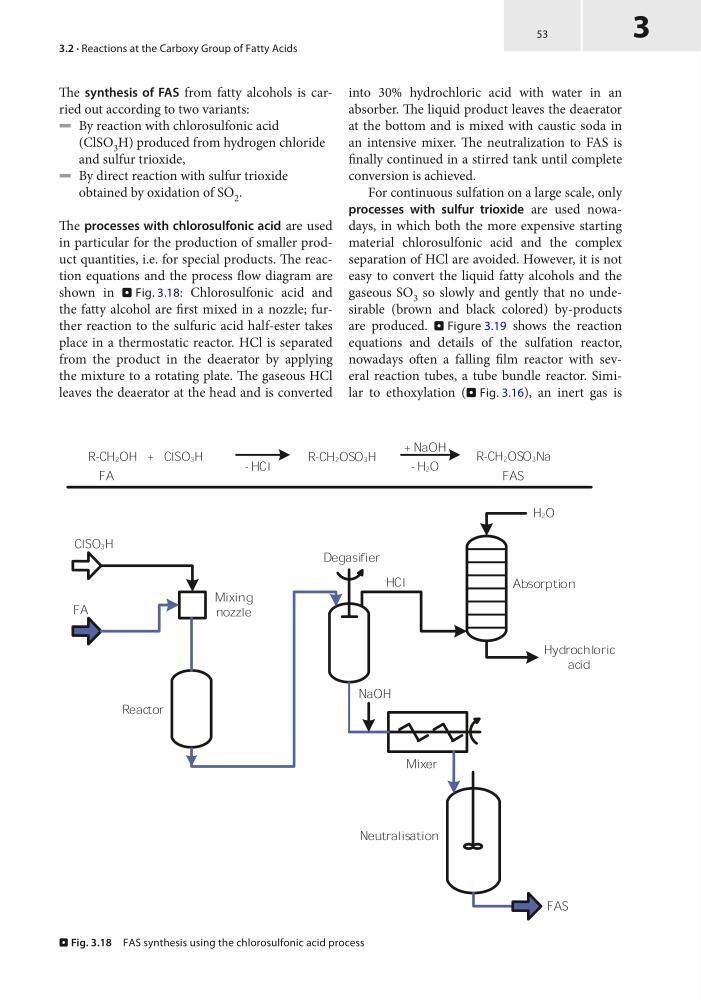
into 30% hydrochloric acid with water in an
absorber. The liquid product leaves the deaerator
at the bottom and is mixed with caustic soda in
an intensive mixer. The neutralization to FAS is
finally continued in a stirred tank until complete
conversion is achieved.
For continuous sulfation on a large scale, only
processes with sulfur trioxide are used nowadays, in which both the more expensive starting
material chlorosulfonic acid and the complex
separation of HCl are avoided. However, it is not
easy to convert the liquid fatty alcohols and the
gaseous SO 3 so slowly and gently that no undesirable (brown and black colored) by-products
are produced. . Figure 3.19 shows the reaction
equations and details of the sulfation reactor,
nowadays often a falling film reactor with several reaction tubes, a tube bundle reactor. Similar to ethoxylation (. Fig. 3.16), an inert gas is
The synthesis of FAS from fatty alcohols is carried out according to two variants:
5 By reaction with chlorosulfonic acid
(ClSO 3 H) produced from hydrogen chloride
and sulfur trioxide,
5 By direct reaction with sulfur trioxide
obtained by oxidation of SO 2 .
The processes with chlorosulfonic acid are used
in particular for the production of smaller product quantities, i.e. for special products. The reaction equations and the process flow diagram are
shown in . Fig. 3.18: Chlorosulfonic acid and
the fatty alcohol are first mixed in a nozzle; further reaction to the sulfuric acid half-ester takes
place in a thermostatic reactor. HCl is separated
from the product in the deaerator by applying
the mixture to a rotating plate. The gaseous HCl
leaves the deaerator at the head and is converted
. Fig. 3.18 FAS synthesis using the chlorosulfonic acid process
3
3.2 · Reactions at the Carboxy Group of Fatty Acids
into 30% hydrochloric acid with water in an
absorber. The liquid product leaves the deaerator
at the bottom and is mixed with caustic soda in
an intensive mixer. The neutralization to FAS is
finally continued in a stirred tank until complete
conversion is achieved.
For continuous sulfation on a large scale, only
processes with sulfur trioxide are used nowadays, in which both the more expensive starting
material chlorosulfonic acid and the complex
separation of HCl are avoided. However, it is not
easy to convert the liquid fatty alcohols and the
gaseous SO 3 so slowly and gently that no undesirable (brown and black colored) by-products
are produced. . Figure 3.19 shows the reaction
equations and details of the sulfation reactor,
nowadays often a falling film reactor with several reaction tubes, a tube bundle reactor. Similar to ethoxylation (. Fig. 3.16), an inert gas is
The synthesis of FAS from fatty alcohols is carried out according to two variants:
5 By reaction with chlorosulfonic acid
(ClSO 3 H) produced from hydrogen chloride
and sulfur trioxide,
5 By direct reaction with sulfur trioxide
obtained by oxidation of SO 2 .
The processes with chlorosulfonic acid are used
in particular for the production of smaller product quantities, i.e. for special products. The reaction equations and the process flow diagram are
shown in . Fig. 3.18: Chlorosulfonic acid and
the fatty alcohol are first mixed in a nozzle; further reaction to the sulfuric acid half-ester takes
place in a thermostatic reactor. HCl is separated
from the product in the deaerator by applying
the mixture to a rotating plate. The gaseous HCl
leaves the deaerator at the head and is converted
. Fig. 3.18 FAS synthesis using the chlorosulfonic acid process