

46
Chapter 3 · The Basics of Oleochemistry - Basic Oleochemicals
3
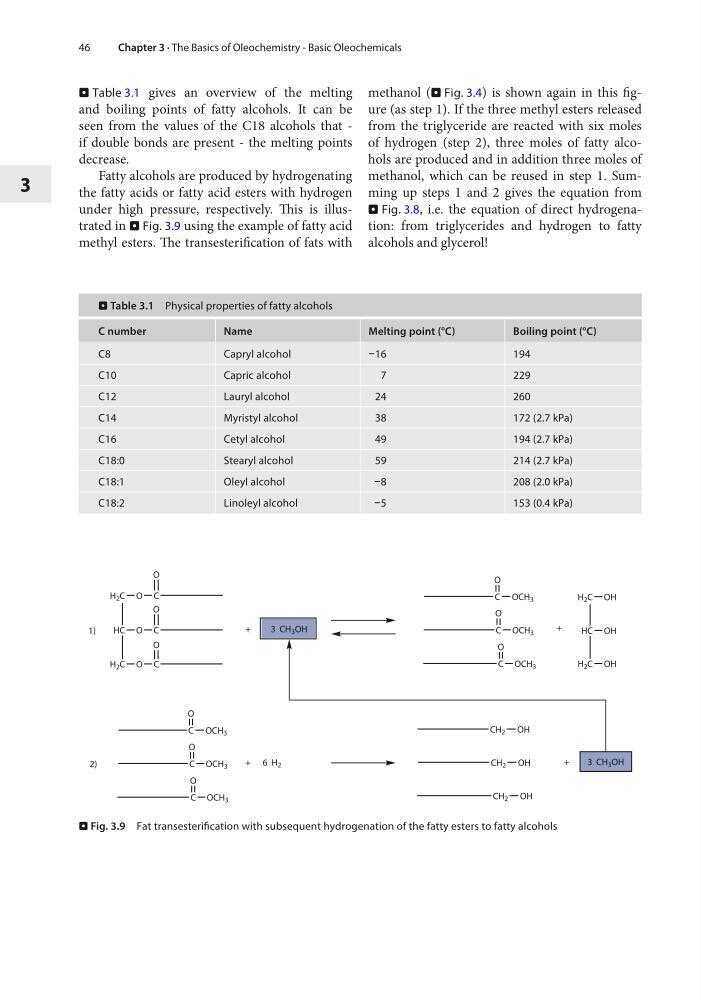
methanol (. Fig. 3.4) is shown again in this figure (as step 1). If the three methyl esters released
from the triglyceride are reacted with six moles
of hydrogen (step 2), three moles of fatty alcohols are produced and in addition three moles of
methanol, which can be reused in step 1. Summing up steps 1 and 2 gives the equation from
. Fig. 3.8, i.e. the equation of direct hydrogenation: from triglycerides and hydrogen to fatty
alcohols and glycerol!
. Table 3.1 gives an overview of the melting
and boiling points of fatty alcohols. It can be
seen from the values of the C18 alcohols that -
if double bonds are present - the melting points
decrease.
Fatty alcohols are produced by hydrogenating
the fatty acids or fatty acid esters with hydrogen
under high pressure, respectively. This is illustrated in . Fig. 3.9 using the example of fatty acid
methyl esters. The transesterification of fats with
H 2 C O C
O
HC O C
O
H 2 C O C
O
H 2 C OH
HC OH
H 2 C OH
+
+ 6 H 2
CH 2 OH
CH 2 OH
CH 2 OH
+
3 CH 3 OH
+
3 CH 3 OH
1)
2)
C OCH 3
C OCH 3
C OCH 3
O
O
O
C OCH 3
C OCH 3
C OCH 3
O
O
O
. Fig. 3.9 Fat transesterification with subsequent hydrogenation of the fatty esters to fatty alcohols
. Table 3.1 Physical properties of fatty alcohols
C number
Name
Melting point (°C)
Boiling point (°C)
C8
Capryl alcohol
−16
194
C10
Capric alcohol
7
229
C12
Lauryl alcohol
24
260
C14
Myristyl alcohol
38
172 (2.7 kPa)
C16
Cetyl alcohol
49
194 (2.7 kPa)
C18:0
Stearyl alcohol
59
214 (2.7 kPa)
C18:1
Oleyl alcohol
−8
208 (2.0 kPa)
C18:2
Linoleyl alcohol
−5
153 (0.4 kPa)
Chapter 3 · The Basics of Oleochemistry - Basic Oleochemicals
3
methanol (. Fig. 3.4) is shown again in this figure (as step 1). If the three methyl esters released
from the triglyceride are reacted with six moles
of hydrogen (step 2), three moles of fatty alcohols are produced and in addition three moles of
methanol, which can be reused in step 1. Summing up steps 1 and 2 gives the equation from
. Fig. 3.8, i.e. the equation of direct hydrogenation: from triglycerides and hydrogen to fatty
alcohols and glycerol!
. Table 3.1 gives an overview of the melting
and boiling points of fatty alcohols. It can be
seen from the values of the C18 alcohols that -
if double bonds are present - the melting points
decrease.
Fatty alcohols are produced by hydrogenating
the fatty acids or fatty acid esters with hydrogen
under high pressure, respectively. This is illustrated in . Fig. 3.9 using the example of fatty acid
methyl esters. The transesterification of fats with
H 2 C O C
O
HC O C
O
H 2 C O C
O
H 2 C OH
HC OH
H 2 C OH
+
+ 6 H 2
CH 2 OH
CH 2 OH
CH 2 OH
+
3 CH 3 OH
+
3 CH 3 OH
1)
2)
C OCH 3
C OCH 3
C OCH 3
O
O
O
C OCH 3
C OCH 3
C OCH 3
O
O
O
. Fig. 3.9 Fat transesterification with subsequent hydrogenation of the fatty esters to fatty alcohols
. Table 3.1 Physical properties of fatty alcohols
C number
Name
Melting point (°C)
Boiling point (°C)
C8
Capryl alcohol
−16
194
C10
Capric alcohol
7
229
C12
Lauryl alcohol
24
260
C14
Myristyl alcohol
38
172 (2.7 kPa)
C16
Cetyl alcohol
49
194 (2.7 kPa)
C18:0
Stearyl alcohol
59
214 (2.7 kPa)
C18:1
Oleyl alcohol
−8
208 (2.0 kPa)
C18:2
Linoleyl alcohol
−5
153 (0.4 kPa)