

42
Chapter 3 · The Basics of Oleochemistry - Basic Oleochemicals
3
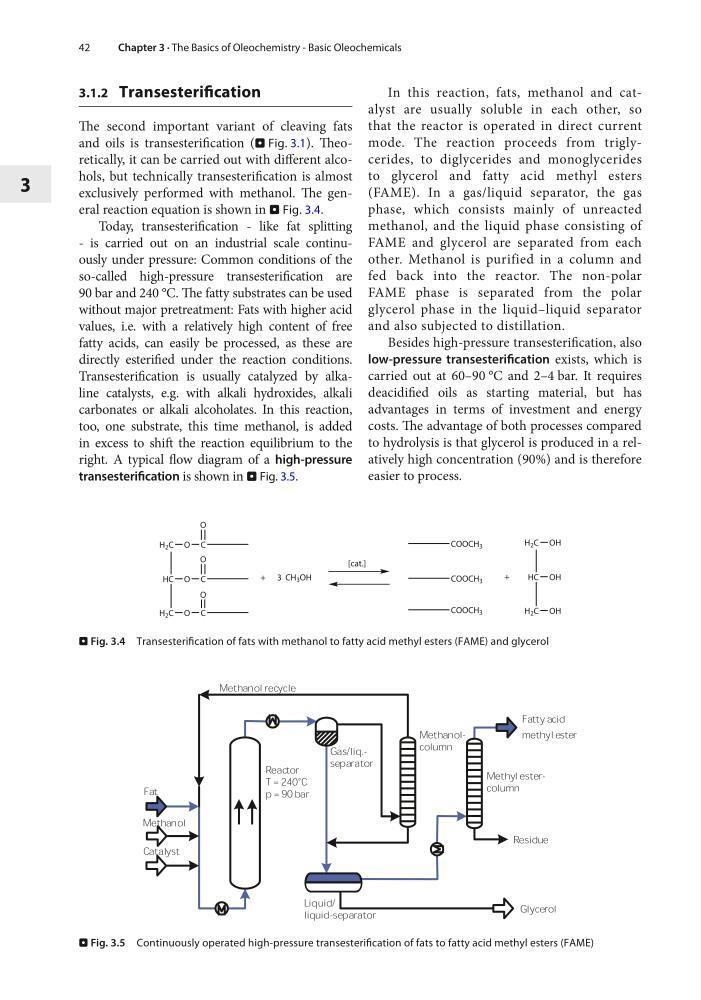
In this reaction, fats, methanol and catalyst are usually soluble in each other, so
that the reactor is operated in direct current
mode. The reaction proceeds from triglycerides, to diglycerides and monoglycerides
to glycerol and fatty acid methyl esters
(FAME). In a gas/liquid separator, the gas
phase, which consists mainly of unreacted
methanol, and the liquid phase consisting of
FAME and glycerol are separated from each
other. Methanol is purified in a column and
fed back into the reactor. The non-polar
FAME phase is separated from the polar
glycerol phase in the liquid–liquid separator
and also subjected to distillation.
Besides high-pressure transesterification, also
low-pressure transesterification exists, which is
carried out at 60–90 °C and 2–4 bar. It requires
deacidified oils as starting material, but has
advantages in terms of investment and energy
costs. The advantage of both processes compared
to hydrolysis is that glycerol is produced in a relatively high concentration (90%) and is therefore
easier to process.
3.1.2 Transesterification
The second important variant of cleaving fats
and oils is transesterification (. Fig. 3.1). Theoretically, it can be carried out with different alcohols, but technically transesterification is almost
exclusively performed with methanol. The general reaction equation is shown in . Fig. 3.4.
Today, transesterification - like fat splitting
- is carried out on an industrial scale continuously under pressure: Common conditions of the
so-called high-pressure transesterification are
90 bar and 240 °C. The fatty substrates can be used
without major pretreatment: Fats with higher acid
values, i.e. with a relatively high content of free
fatty acids, can easily be processed, as these are
directly esterified under the reaction conditions.
Transesterification is usually catalyzed by alkaline catalysts, e.g. with alkali hydroxides, alkali
carbonates or alkali alcoholates. In this reaction,
too, one substrate, this time methanol, is added
in excess to shift the reaction equilibrium to the
right. A typical flow diagram of a high-pressure
transesterification is shown in . Fig. 3.5.
H 2 C O C
O
HC O C
O
H 2 C O C
O
+ 3 CH 3 OH
H 2 C OH
HC OH
H 2 C OH
[cat.]
+
COOCH 3
COOCH 3
COOCH 3
. Fig. 3.4 Transesterification of fats with methanol to fatty acid methyl esters (FAME) and glycerol
. Fig. 3.5 Continuously operated high-pressure transesterification of fats to fatty acid methyl esters (FAME)
Chapter 3 · The Basics of Oleochemistry - Basic Oleochemicals
3
In this reaction, fats, methanol and catalyst are usually soluble in each other, so
that the reactor is operated in direct current
mode. The reaction proceeds from triglycerides, to diglycerides and monoglycerides
to glycerol and fatty acid methyl esters
(FAME). In a gas/liquid separator, the gas
phase, which consists mainly of unreacted
methanol, and the liquid phase consisting of
FAME and glycerol are separated from each
other. Methanol is purified in a column and
fed back into the reactor. The non-polar
FAME phase is separated from the polar
glycerol phase in the liquid–liquid separator
and also subjected to distillation.
Besides high-pressure transesterification, also
low-pressure transesterification exists, which is
carried out at 60–90 °C and 2–4 bar. It requires
deacidified oils as starting material, but has
advantages in terms of investment and energy
costs. The advantage of both processes compared
to hydrolysis is that glycerol is produced in a relatively high concentration (90%) and is therefore
easier to process.
3.1.2 Transesterification
The second important variant of cleaving fats
and oils is transesterification (. Fig. 3.1). Theoretically, it can be carried out with different alcohols, but technically transesterification is almost
exclusively performed with methanol. The general reaction equation is shown in . Fig. 3.4.
Today, transesterification - like fat splitting
- is carried out on an industrial scale continuously under pressure: Common conditions of the
so-called high-pressure transesterification are
90 bar and 240 °C. The fatty substrates can be used
without major pretreatment: Fats with higher acid
values, i.e. with a relatively high content of free
fatty acids, can easily be processed, as these are
directly esterified under the reaction conditions.
Transesterification is usually catalyzed by alkaline catalysts, e.g. with alkali hydroxides, alkali
carbonates or alkali alcoholates. In this reaction,
too, one substrate, this time methanol, is added
in excess to shift the reaction equilibrium to the
right. A typical flow diagram of a high-pressure
transesterification is shown in . Fig. 3.5.
H 2 C O C
O
HC O C
O
H 2 C O C
O
+ 3 CH 3 OH
H 2 C OH
HC OH
H 2 C OH
[cat.]
+
COOCH 3
COOCH 3
COOCH 3
. Fig. 3.4 Transesterification of fats with methanol to fatty acid methyl esters (FAME) and glycerol
. Fig. 3.5 Continuously operated high-pressure transesterification of fats to fatty acid methyl esters (FAME)