

39
3
5 These disadvantages can be avoided by
working at high temperatures and under
pressure to accelerate the reaction during fat
splitting without using a catalyst. Therefore,
discontinuous pressure processes were
developed which operate at temperatures of
200–240 °C and pressures of 25–30 bar. After
a reaction time of 4 h, a hydrolysis conversion
of 90–96% can be achieved, which is sufficient for most purposes. If a higher turnover
is desired, the reactor is depressurized, the
water/glycerol phase is replaced by fresh
water and the operation is repeated: Turnovers of up to 98% can be achieved.
5 The most economical and therefore exclusively used process in large plants today is the
continuous pressure process developed in
the years 1938–1942, which is described in
more detail in . Fig. 3.2.
The continuous pressure process is operated at
pressures of 30–40 bar and temperatures around
240–260 °C, similar to the discontinuous pressure process. The splitting water is fed in with
a pressure pump just below the head of the
The substrate water is present in large excess;
the formed product glycerol is water-soluble and migrates from the fatty phase into
the water phase during its formation, thus
moving away from the equilibrium in the
organic phase. The catalysts, mostly sulfonated
naphthenic acids, are readily soluble in the fat
phase and can therefore become active right
from the start. As soon as the splitting starts,
di- and monoglycerides are formed, which
increase the water solubility in the fat phase
and thus contribute to a better turnover. The
increased temperature of, e.g., 100 °C also
causes more water to dissolve in the fat phase
and simultaneously increases the reaction rate.
5 To make the process more economical, a continuous Twitchell process was developed, consisting of a cascade of three reactors, in which
the aqueous sulfuric acid solution that absorbs
the glycerol was conducted in countercurrent
flow. The reaction time could be reduced to
4–5 h. A further disadvantage was that the
neutralization and treatment of the water phase
remained very costly and that undesirable
soaps were produced during the neutralization.
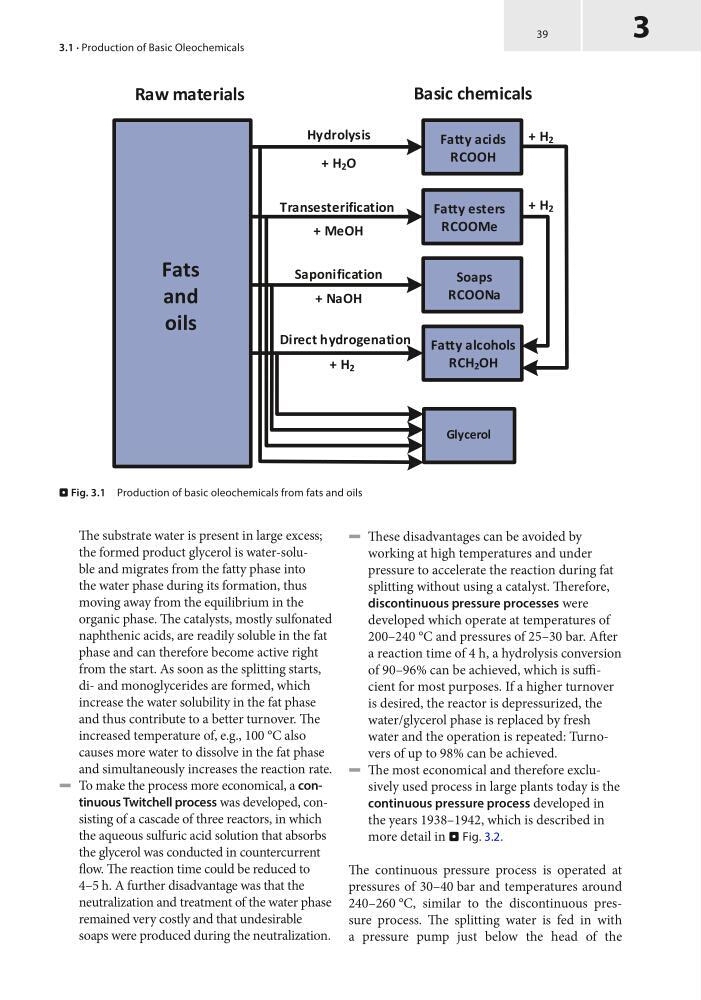
. Fig. 3.1 Production of basic oleochemicals from fats and oils
3.1 · Production of Basic Oleochemicals
3
5 These disadvantages can be avoided by
working at high temperatures and under
pressure to accelerate the reaction during fat
splitting without using a catalyst. Therefore,
discontinuous pressure processes were
developed which operate at temperatures of
200–240 °C and pressures of 25–30 bar. After
a reaction time of 4 h, a hydrolysis conversion
of 90–96% can be achieved, which is sufficient for most purposes. If a higher turnover
is desired, the reactor is depressurized, the
water/glycerol phase is replaced by fresh
water and the operation is repeated: Turnovers of up to 98% can be achieved.
5 The most economical and therefore exclusively used process in large plants today is the
continuous pressure process developed in
the years 1938–1942, which is described in
more detail in . Fig. 3.2.
The continuous pressure process is operated at
pressures of 30–40 bar and temperatures around
240–260 °C, similar to the discontinuous pressure process. The splitting water is fed in with
a pressure pump just below the head of the
The substrate water is present in large excess;
the formed product glycerol is water-soluble and migrates from the fatty phase into
the water phase during its formation, thus
moving away from the equilibrium in the
organic phase. The catalysts, mostly sulfonated
naphthenic acids, are readily soluble in the fat
phase and can therefore become active right
from the start. As soon as the splitting starts,
di- and monoglycerides are formed, which
increase the water solubility in the fat phase
and thus contribute to a better turnover. The
increased temperature of, e.g., 100 °C also
causes more water to dissolve in the fat phase
and simultaneously increases the reaction rate.
5 To make the process more economical, a continuous Twitchell process was developed, consisting of a cascade of three reactors, in which
the aqueous sulfuric acid solution that absorbs
the glycerol was conducted in countercurrent
flow. The reaction time could be reduced to
4–5 h. A further disadvantage was that the
neutralization and treatment of the water phase
remained very costly and that undesirable
soaps were produced during the neutralization.
. Fig. 3.1 Production of basic oleochemicals from fats and oils
3.1 · Production of Basic Oleochemicals