

30
Chapter 2 · The Raw Materials of Oleochemistry - Oil Plants
2
BOX: An Oil that Is not an Oil at All
The jojoba plant (Simmondsia
chinensis) with its gray-green,
leathery leaves also loves the
sun: It comes from the Sonora
desert between California and
Mexico and is now also native in
dry locations in Argentina, South
Africa and South Australia. The
jojoba plant can be planted - like
jatropha - on land that is no longer
suitable for food production. By
the way, the name is of Indian
origin and should actually be
pronounced “Ho–Ho-Ba”.
The yellowish oil obtained from
the seeds of the evergreen
jojoba bush is by our definition
not an oil at all, but a wax!
Oils are defined as triesters of
glycerol (. Fig. 2.1), but waxes
are monoesters of fatty acids
with primary alcohols. However,
since jojoba oil is a wax with a
very low melting point (7 °C),
it is still often included in the
list of oils. Jojoba oil consists
of esters of the unsaturated
fatty acids eicosenoic acid
(C20:1) and docosenoic acid
(C22:1) with unsaturated C11
and C12 alcohols. It is thus very
similar to sperm oil, which was
formerly obtained from the
sperm whale. However, since
whaling has been severely
restricted, sperm oil is hardly
available today.
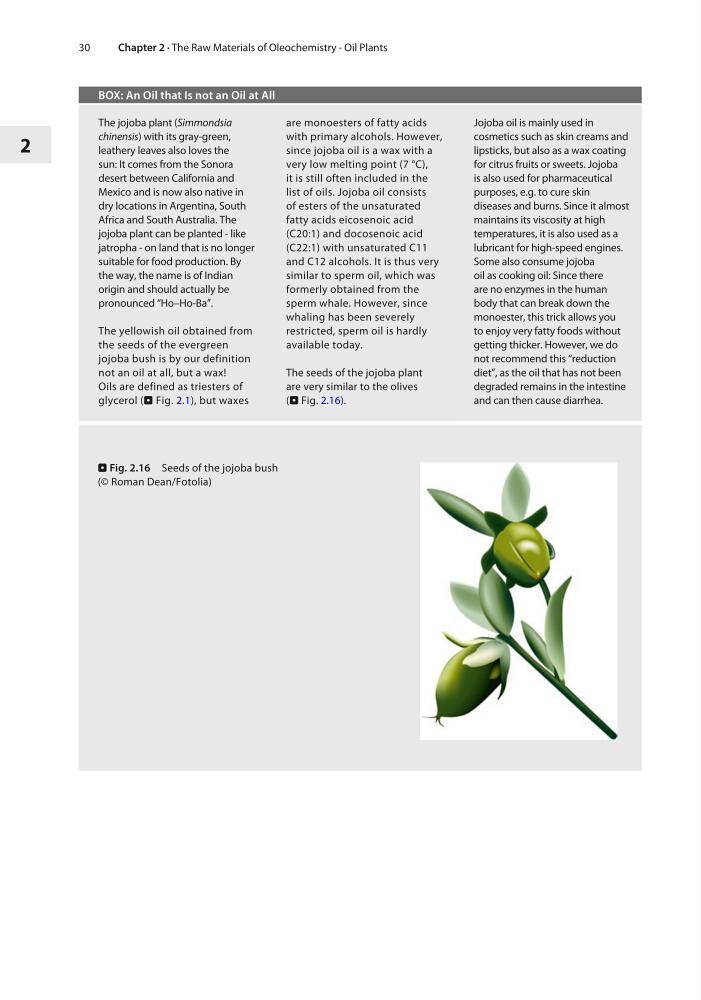
The seeds of the jojoba plant
are very similar to the olives
(. Fig. 2.16).
Jojoba oil is mainly used in
cosmetics such as skin creams and
lipsticks, but also as a wax coating
for citrus fruits or sweets. Jojoba
is also used for pharmaceutical
purposes, e.g. to cure skin
diseases and burns. Since it almost
maintains its viscosity at high
temperatures, it is also used as a
lubricant for high-speed engines.
Some also consume jojoba
oil as cooking oil: Since there
are no enzymes in the human
body that can break down the
monoester, this trick allows you
to enjoy very fatty foods without
getting thicker. However, we do
not recommend this “reduction
diet”, as the oil that has not been
degraded remains in the intestine
and can then cause diarrhea.
. Fig. 2.16 Seeds of the jojoba bush
(© Roman Dean/Fotolia)
Chapter 2 · The Raw Materials of Oleochemistry - Oil Plants
2
BOX: An Oil that Is not an Oil at All
The jojoba plant (Simmondsia
chinensis) with its gray-green,
leathery leaves also loves the
sun: It comes from the Sonora
desert between California and
Mexico and is now also native in
dry locations in Argentina, South
Africa and South Australia. The
jojoba plant can be planted - like
jatropha - on land that is no longer
suitable for food production. By
the way, the name is of Indian
origin and should actually be
pronounced “Ho–Ho-Ba”.
The yellowish oil obtained from
the seeds of the evergreen
jojoba bush is by our definition
not an oil at all, but a wax!
Oils are defined as triesters of
glycerol (. Fig. 2.1), but waxes
are monoesters of fatty acids
with primary alcohols. However,
since jojoba oil is a wax with a
very low melting point (7 °C),
it is still often included in the
list of oils. Jojoba oil consists
of esters of the unsaturated
fatty acids eicosenoic acid
(C20:1) and docosenoic acid
(C22:1) with unsaturated C11
and C12 alcohols. It is thus very
similar to sperm oil, which was
formerly obtained from the
sperm whale. However, since
whaling has been severely
restricted, sperm oil is hardly
available today.
The seeds of the jojoba plant
are very similar to the olives
(. Fig. 2.16).
Jojoba oil is mainly used in
cosmetics such as skin creams and
lipsticks, but also as a wax coating
for citrus fruits or sweets. Jojoba
is also used for pharmaceutical
purposes, e.g. to cure skin
diseases and burns. Since it almost
maintains its viscosity at high
temperatures, it is also used as a
lubricant for high-speed engines.
Some also consume jojoba
oil as cooking oil: Since there
are no enzymes in the human
body that can break down the
monoester, this trick allows you
to enjoy very fatty foods without
getting thicker. However, we do
not recommend this “reduction
diet”, as the oil that has not been
degraded remains in the intestine
and can then cause diarrhea.
. Fig. 2.16 Seeds of the jojoba bush
(© Roman Dean/Fotolia)