

28
Chapter 2 · The Raw Materials of Oleochemistry - Oil Plants
2
2.2.8 Olive Oil
The olive tree (Olea europaea) has also been
native in our culture for a long time: It has been
known to the Sumerians and Egyptians for about
5000 years and was planted in Homer’s time in
Greece. The ancient medium-high shrub forms
a tree that can grow up to 20 m high and whose
trunk can grow up to 4 m thick. Due to its intensive root system, the olive tree is very undemanding and requires only little water. The stone fruits,
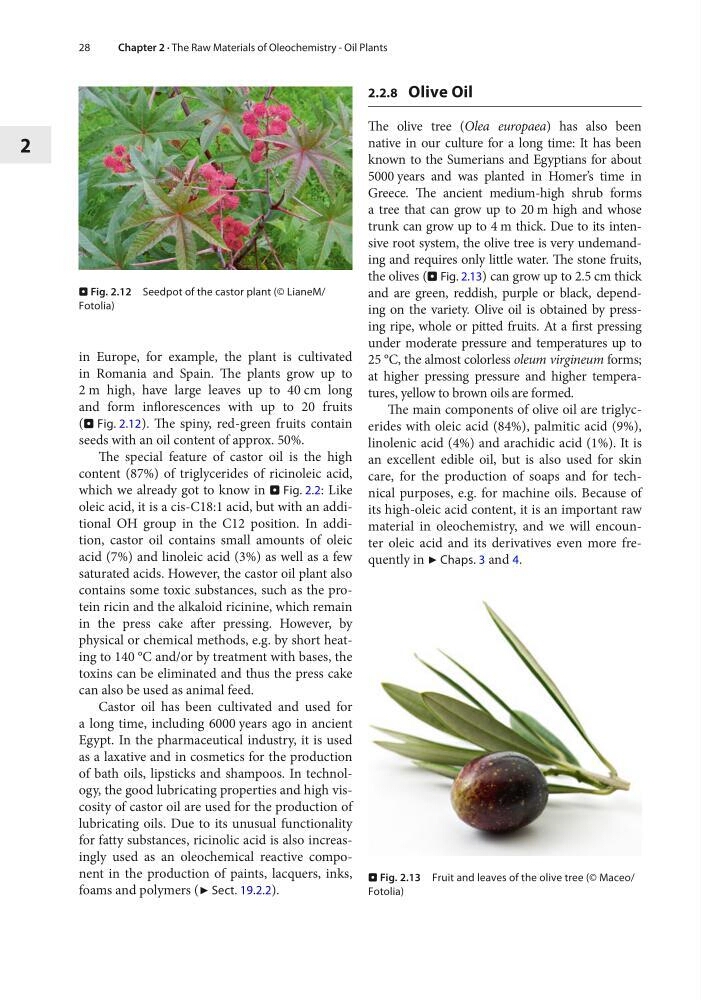
the olives (. Fig. 2.13) can grow up to 2.5 cm thick
and are green, reddish, purple or black, depending on the variety. Olive oil is obtained by pressing ripe, whole or pitted fruits. At a first pressing
under moderate pressure and temperatures up to
25 °C, the almost colorless oleum virgineum forms;
at higher pressing pressure and higher temperatures, yellow to brown oils are formed.
The main components of olive oil are triglycerides with oleic acid (84%), palmitic acid (9%),
linolenic acid (4%) and arachidic acid (1%). It is
an excellent edible oil, but is also used for skin
care, for the production of soaps and for technical purposes, e.g. for machine oils. Because of
its high-oleic acid content, it is an important raw
material in oleochemistry, and we will encounter oleic acid and its derivatives even more frequently in 7 Chaps. 3 and 4.
in Europe, for example, the plant is cultivated
in Romania and Spain. The plants grow up to
2 m high, have large leaves up to 40 cm long
and form inflorescences with up to 20 fruits
(. Fig. 2.12). The spiny, red-green fruits contain
seeds with an oil content of approx. 50%.
The special feature of castor oil is the high
content (87%) of triglycerides of ricinoleic acid,
which we already got to know in . Fig. 2.2: Like
oleic acid, it is a cis-C18:1 acid, but with an additional OH group in the C12 position. In addition, castor oil contains small amounts of oleic
acid (7%) and linoleic acid (3%) as well as a few
saturated acids. However, the castor oil plant also
contains some toxic substances, such as the protein ricin and the alkaloid ricinine, which remain
in the press cake after pressing. However, by
physical or chemical methods, e.g. by short heating to 140 °C and/or by treatment with bases, the
toxins can be eliminated and thus the press cake
can also be used as animal feed.
Castor oil has been cultivated and used for
a long time, including 6000 years ago in ancient
Egypt. In the pharmaceutical industry, it is used
as a laxative and in cosmetics for the production
of bath oils, lipsticks and shampoos. In technology, the good lubricating properties and high viscosity of castor oil are used for the production of
lubricating oils. Due to its unusual functionality
for fatty substances, ricinolic acid is also increasingly used as an oleochemical reactive component in the production of paints, lacquers, inks,
foams and polymers (7 Sect. 19.2.2).
. Fig. 2.12 Seedpot of the castor plant (© LianeM/
Fotolia)
. Fig. 2.13 Fruit and leaves of the olive tree (© Maceo/
Fotolia)
Chapter 2 · The Raw Materials of Oleochemistry - Oil Plants
2
2.2.8 Olive Oil
The olive tree (Olea europaea) has also been
native in our culture for a long time: It has been
known to the Sumerians and Egyptians for about
5000 years and was planted in Homer’s time in
Greece. The ancient medium-high shrub forms
a tree that can grow up to 20 m high and whose
trunk can grow up to 4 m thick. Due to its intensive root system, the olive tree is very undemanding and requires only little water. The stone fruits,
the olives (. Fig. 2.13) can grow up to 2.5 cm thick
and are green, reddish, purple or black, depending on the variety. Olive oil is obtained by pressing ripe, whole or pitted fruits. At a first pressing
under moderate pressure and temperatures up to
25 °C, the almost colorless oleum virgineum forms;
at higher pressing pressure and higher temperatures, yellow to brown oils are formed.
The main components of olive oil are triglycerides with oleic acid (84%), palmitic acid (9%),
linolenic acid (4%) and arachidic acid (1%). It is
an excellent edible oil, but is also used for skin
care, for the production of soaps and for technical purposes, e.g. for machine oils. Because of
its high-oleic acid content, it is an important raw
material in oleochemistry, and we will encounter oleic acid and its derivatives even more frequently in 7 Chaps. 3 and 4.
in Europe, for example, the plant is cultivated
in Romania and Spain. The plants grow up to
2 m high, have large leaves up to 40 cm long
and form inflorescences with up to 20 fruits
(. Fig. 2.12). The spiny, red-green fruits contain
seeds with an oil content of approx. 50%.
The special feature of castor oil is the high
content (87%) of triglycerides of ricinoleic acid,
which we already got to know in . Fig. 2.2: Like
oleic acid, it is a cis-C18:1 acid, but with an additional OH group in the C12 position. In addition, castor oil contains small amounts of oleic
acid (7%) and linoleic acid (3%) as well as a few
saturated acids. However, the castor oil plant also
contains some toxic substances, such as the protein ricin and the alkaloid ricinine, which remain
in the press cake after pressing. However, by
physical or chemical methods, e.g. by short heating to 140 °C and/or by treatment with bases, the
toxins can be eliminated and thus the press cake
can also be used as animal feed.
Castor oil has been cultivated and used for
a long time, including 6000 years ago in ancient
Egypt. In the pharmaceutical industry, it is used
as a laxative and in cosmetics for the production
of bath oils, lipsticks and shampoos. In technology, the good lubricating properties and high viscosity of castor oil are used for the production of
lubricating oils. Due to its unusual functionality
for fatty substances, ricinolic acid is also increasingly used as an oleochemical reactive component in the production of paints, lacquers, inks,
foams and polymers (7 Sect. 19.2.2).
. Fig. 2.12 Seedpot of the castor plant (© LianeM/
Fotolia)
. Fig. 2.13 Fruit and leaves of the olive tree (© Maceo/
Fotolia)