

26
Chapter 2 · The Raw Materials of Oleochemistry - Oil Plants
2
2.2.5 Soybean Oil
The soy plant (glycine max) belongs to the legume family and was planted in China as early
as 1000 BC. It was not until the nineteenth century that it reached Europe and America. The soy
plant produces soybeans, which contain both the
oil (20%) and larger amounts of protein (40%).
On the outside, the plant resembles the bush
bean: It is heavily hairy and grows in the form of
shrubs up to 80 cm high (. Fig. 2.10).
The soy oil is obtained by extraction and contains approx. 50% linoleic acid, 30% oleic acid
and between 3 and 11% linolenic acid, which
is also responsible for the slight rancidity of the
soy oil (. Table 2.3). In Germany, it is used for
margarine production, in the USA also for the
production of edible oils. Soy oil contains up to
3% lecithins, which are used as emulsifiers in the
food sector as well as for technical purposes. The
press cake produced during soy oil extraction,
soy meal, contains almost all proteins and carboBOX: MUFA or PUFA?
MUFA and PUFA are not sea
monsters, but only common
abbreviations used by
oleochemists and nutritionists:
5 MUFA are monounsaturated
fatty acids, e.g. the frequently
occurring oleic acid.
5 PUFA are polyunsaturated
fatty acids. These include
linoleic acid (C18:2),
linolenic acid (C18:3),
eicosapentaenoic
acid C20:5 (Δ5, 8, 11,
14, 17/all c., EPA) and
docosahexaenoic acid
C22:6 (Δ4, 7, 10, 13, 16,
19/all c., DHA). EPA is a
precursor of prostaglandins
and thus has important
pharmacological properties.
The polyunsaturated
fatty acids belong to the
essential fatty acids, which
must be supplied to the
human body with food,
since it cannot produce
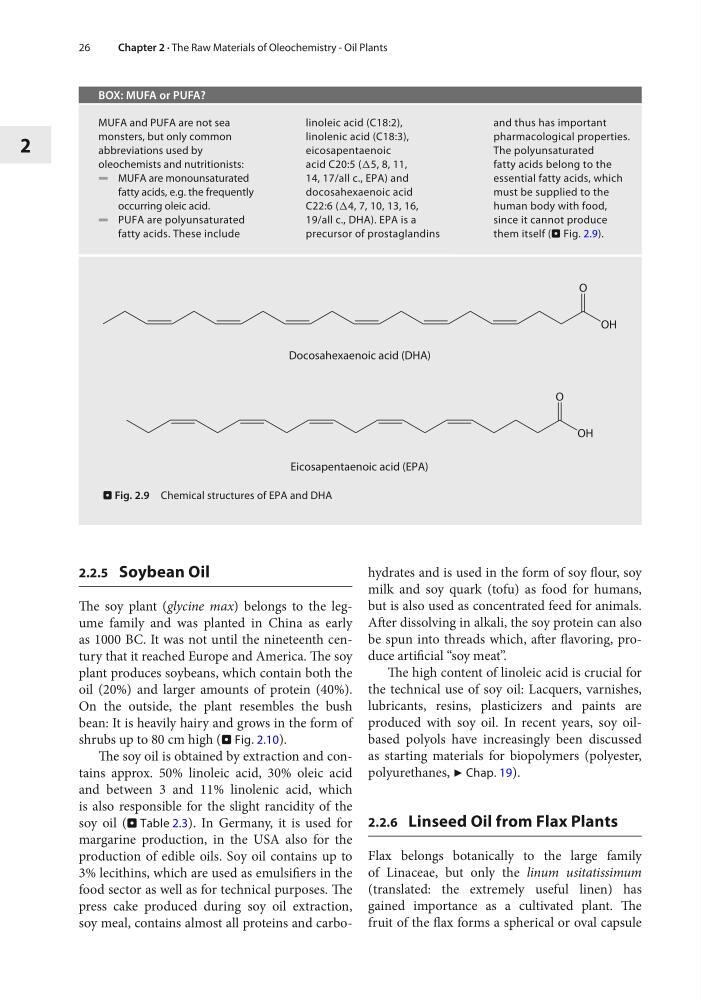
them itself (. Fig. 2.9).
O
OH
Docosahexaenoic acid (DHA)
O
OH
Eicosapentaenoic acid (EPA)
. Fig. 2.9 Chemical structures of EPA and DHA
hydrates and is used in the form of soy flour, soy
milk and soy quark (tofu) as food for humans,
but is also used as concentrated feed for animals.
After dissolving in alkali, the soy protein can also
be spun into threads which, after flavoring, produce artificial “soy meat”.
The high content of linoleic acid is crucial for
the technical use of soy oil: Lacquers, varnishes,
lubricants, resins, plasticizers and paints are
produced with soy oil. In recent years, soy oilbased polyols have increasingly been discussed
as starting materials for biopolymers (polyester,
polyurethanes, 7 Chap. 19).
2.2.6 Linseed Oil from Flax Plants
Flax belongs botanically to the large family
of Linaceae, but only the linum usitatissimum
(translated: the extremely useful linen) has
gained importance as a cultivated plant. The
fruit of the flax forms a spherical or oval capsule
Chapter 2 · The Raw Materials of Oleochemistry - Oil Plants
2
2.2.5 Soybean Oil
The soy plant (glycine max) belongs to the legume family and was planted in China as early
as 1000 BC. It was not until the nineteenth century that it reached Europe and America. The soy
plant produces soybeans, which contain both the
oil (20%) and larger amounts of protein (40%).
On the outside, the plant resembles the bush
bean: It is heavily hairy and grows in the form of
shrubs up to 80 cm high (. Fig. 2.10).
The soy oil is obtained by extraction and contains approx. 50% linoleic acid, 30% oleic acid
and between 3 and 11% linolenic acid, which
is also responsible for the slight rancidity of the
soy oil (. Table 2.3). In Germany, it is used for
margarine production, in the USA also for the
production of edible oils. Soy oil contains up to
3% lecithins, which are used as emulsifiers in the
food sector as well as for technical purposes. The
press cake produced during soy oil extraction,
soy meal, contains almost all proteins and carboBOX: MUFA or PUFA?
MUFA and PUFA are not sea
monsters, but only common
abbreviations used by
oleochemists and nutritionists:
5 MUFA are monounsaturated
fatty acids, e.g. the frequently
occurring oleic acid.
5 PUFA are polyunsaturated
fatty acids. These include
linoleic acid (C18:2),
linolenic acid (C18:3),
eicosapentaenoic
acid C20:5 (Δ5, 8, 11,
14, 17/all c., EPA) and
docosahexaenoic acid
C22:6 (Δ4, 7, 10, 13, 16,
19/all c., DHA). EPA is a
precursor of prostaglandins
and thus has important
pharmacological properties.
The polyunsaturated
fatty acids belong to the
essential fatty acids, which
must be supplied to the
human body with food,
since it cannot produce
them itself (. Fig. 2.9).
O
OH
Docosahexaenoic acid (DHA)
O
OH
Eicosapentaenoic acid (EPA)
. Fig. 2.9 Chemical structures of EPA and DHA
hydrates and is used in the form of soy flour, soy
milk and soy quark (tofu) as food for humans,
but is also used as concentrated feed for animals.
After dissolving in alkali, the soy protein can also
be spun into threads which, after flavoring, produce artificial “soy meat”.
The high content of linoleic acid is crucial for
the technical use of soy oil: Lacquers, varnishes,
lubricants, resins, plasticizers and paints are
produced with soy oil. In recent years, soy oilbased polyols have increasingly been discussed
as starting materials for biopolymers (polyester,
polyurethanes, 7 Chap. 19).
2.2.6 Linseed Oil from Flax Plants
Flax belongs botanically to the large family
of Linaceae, but only the linum usitatissimum
(translated: the extremely useful linen) has
gained importance as a cultivated plant. The
fruit of the flax forms a spherical or oval capsule