

351
20
BOX: Bioethanol Production in Brazil
The production of bioethanol
from sugar cane has a very
long history in Brazil, initially
mainly for the production of
drinkable alcohol. However,
at an early stage, it was also
worked on using bioethanol as
a fuel for the automotive sector.
As early as the mid-1970s, after
the first major oil crisis, the
Brazilian government launched
a program aimed at reducing
dependence on oil for fuel
production and promoting
domestic bioethanol from sugar
cane. With success: Today,
petrol is mixed with bioethanol
at all filling stations in Brazil
(so-called blends), typically with
25% ethanol content (E25).
However, there are a number of
other blends, and pure ethanol
(E100) can also be used. This
has led to the development of
so-called flex cars, which can be
operated with all these different
fuels. However, it must be
pointed out that the increased
the cultivation of crops such
as sugar cane must not lead to
the destruction of huge parts of
the rainforest. The cultivation
of crops and the protection of
nature must be brought into a
reasonable balance.
This success and the desired
independence from oil imports
for the automotive sector is
based on the superior framework
parameters for the cultivation
of sugar cane in Brazil: There is
nowhere else in the world where
cultivation is so industrialized,
the available land so large,
productivity so high and the
required energy input so low.
44% of the sugar cane grown
is used for sugar production,
55% for ethanol and only about
1% for alcoholic beverages.
In modern production plants,
the entire value chain is
represented, including all usable
material flows from the sugar
cane delivered to the finished
products sugar and ethanol
for the fuel, chemicals and
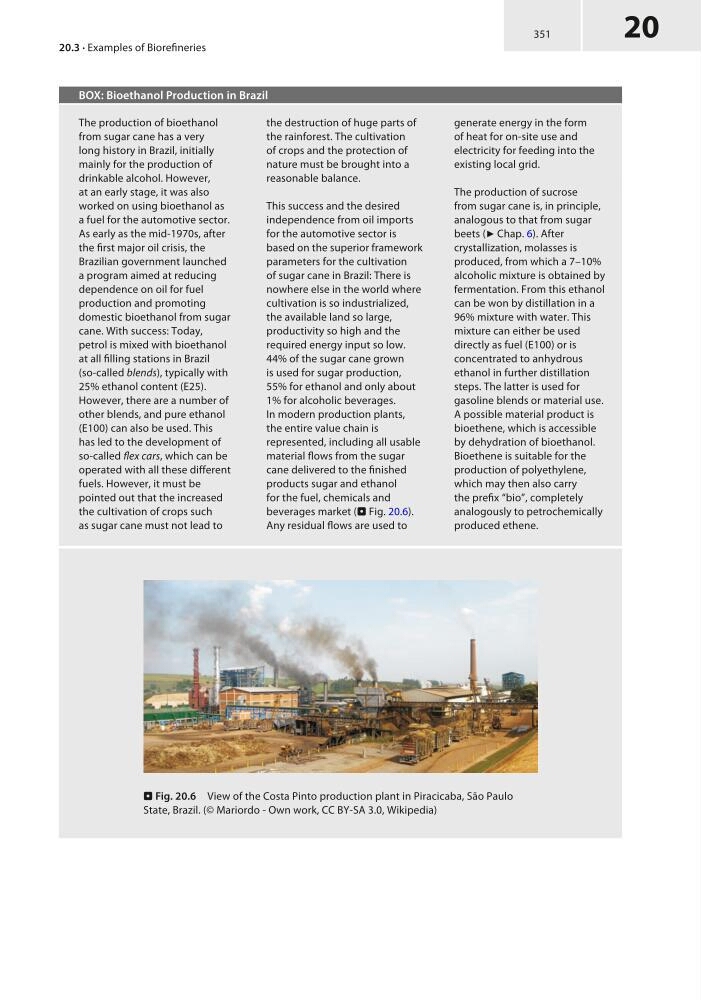
beverages market (. Fig. 20.6).
Any residual flows are used to
generate energy in the form
of heat for on-site use and
electricity for feeding into the
existing local grid.
The production of sucrose
from sugar cane is, in principle,
analogous to that from sugar
beets (7 Chap. 6). After
crystallization, molasses is
produced, from which a 7–10%
alcoholic mixture is obtained by
fermentation. From this ethanol
can be won by distillation in a
96% mixture with water. This
mixture can either be used
directly as fuel (E100) or is
concentrated to anhydrous
ethanol in further distillation
steps. The latter is used for
gasoline blends or material use.
A possible material product is
bioethene, which is accessible
by dehydration of bioethanol.
Bioethene is suitable for the
production of polyethylene,
which may then also carry
the prefix “bio”, completely
analogously to petrochemically
produced ethene.
. Fig. 20.6 View of the Costa Pinto production plant in Piracicaba, São Paulo
State, Brazil. (© Mariordo - Own work, CC BY-SA 3.0, Wikipedia)
20.3 · Examples of Biorefineries
20
BOX: Bioethanol Production in Brazil
The production of bioethanol
from sugar cane has a very
long history in Brazil, initially
mainly for the production of
drinkable alcohol. However,
at an early stage, it was also
worked on using bioethanol as
a fuel for the automotive sector.
As early as the mid-1970s, after
the first major oil crisis, the
Brazilian government launched
a program aimed at reducing
dependence on oil for fuel
production and promoting
domestic bioethanol from sugar
cane. With success: Today,
petrol is mixed with bioethanol
at all filling stations in Brazil
(so-called blends), typically with
25% ethanol content (E25).
However, there are a number of
other blends, and pure ethanol
(E100) can also be used. This
has led to the development of
so-called flex cars, which can be
operated with all these different
fuels. However, it must be
pointed out that the increased
the cultivation of crops such
as sugar cane must not lead to
the destruction of huge parts of
the rainforest. The cultivation
of crops and the protection of
nature must be brought into a
reasonable balance.
This success and the desired
independence from oil imports
for the automotive sector is
based on the superior framework
parameters for the cultivation
of sugar cane in Brazil: There is
nowhere else in the world where
cultivation is so industrialized,
the available land so large,
productivity so high and the
required energy input so low.
44% of the sugar cane grown
is used for sugar production,
55% for ethanol and only about
1% for alcoholic beverages.
In modern production plants,
the entire value chain is
represented, including all usable
material flows from the sugar
cane delivered to the finished
products sugar and ethanol
for the fuel, chemicals and
beverages market (. Fig. 20.6).
Any residual flows are used to
generate energy in the form
of heat for on-site use and
electricity for feeding into the
existing local grid.
The production of sucrose
from sugar cane is, in principle,
analogous to that from sugar
beets (7 Chap. 6). After
crystallization, molasses is
produced, from which a 7–10%
alcoholic mixture is obtained by
fermentation. From this ethanol
can be won by distillation in a
96% mixture with water. This
mixture can either be used
directly as fuel (E100) or is
concentrated to anhydrous
ethanol in further distillation
steps. The latter is used for
gasoline blends or material use.
A possible material product is
bioethene, which is accessible
by dehydration of bioethanol.
Bioethene is suitable for the
production of polyethylene,
which may then also carry
the prefix “bio”, completely
analogously to petrochemically
produced ethene.
. Fig. 20.6 View of the Costa Pinto production plant in Piracicaba, São Paulo
State, Brazil. (© Mariordo - Own work, CC BY-SA 3.0, Wikipedia)
20.3 · Examples of Biorefineries