

349
20
sulfite processes and 7 Chap. 11: Organosolv
process), pulp is obtained from the wood chips
during paper production, whereby hemicelluloses and lignin are produced as by-products. In
connection with biorefineries, this procedure can
be understood as primary refining in which the
three platform intermediates of the lignocellulose
biorefinery - cellulose, hemicellulose and lignin
- are obtained. If the hemicelluloses and lignin
are processed further, a complete lignocellulose
biorefinery could be built around a paper production plant (. Fig. 20.5).
In addition to the use of cellulose as pulp
for paper production, it can also be chemically
processed (7 Sect. 7.3). By hydrolyzing the
glycosidic bonds, either glucose or a mixture
of fermentable sugars can be produced. In
7 Sect. 6.2, we have already learned many conversions of glucose as a platform chemical to
achieve a variety of different compounds. From
the fermentation of sugar, bioethanol can finally
be produced, which in turn can be used as fuel
or as a material for the production of various
chemicals, such as ethene and finally polyethylene (BOX: Bioethanol production in Brazil). The
slurry remaining after fermentation is a possible
substrate in a biogas biorefinery or is used as a
fertilizer.
20.3 Examples of Biorefineries
In this section, some important and promising
concepts of the biorefineries will be presented as
examples in order to illustrate the overall concept
and to mention essential keywords.
The lignocellulose biorefinery is the most
promising, albeit not yet commercially implemented, Phase-III-biorefinery, which not only
features a variety of processes and main products but which is also based on a variety of raw
materials. The term lignocellulose describes the
collective term already introduced in 7 Chap. 7
for plant residues such as wheat straw or wood in
which lignin (7 Chap. 11) - as well as hemicelluloses and cellulose (7 Chap. 7) - occur together.
The lignocellulose biorefinery is particularly
remarkable because it does not compete with
food production (BOX: Grass-Green Biorefinery).
Biorefineries are of great interest if they are based
on waste products from food production or if
they use raw materials that are not suitable as
food, such as wheat straw, residues from plant oil
biorefineries or wood residues and green waste.
Using wood as an example, we have already
learnt how a primary refinery in a lignocellulose biorefinery could in principle look like:
By means of digestions (7 Chap. 7: Sulfate and
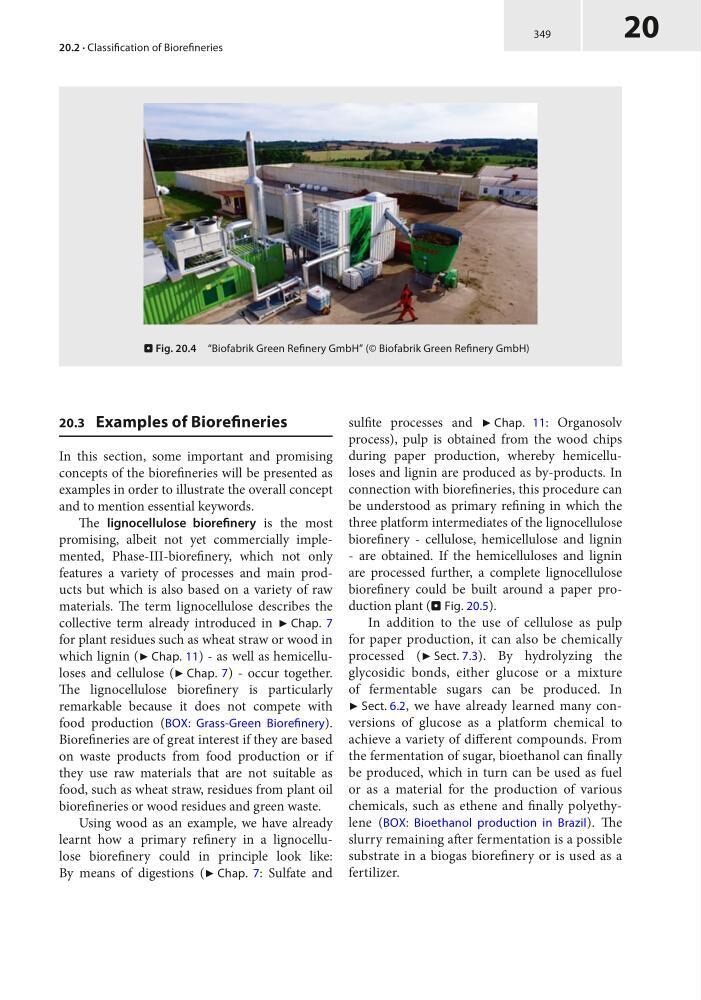
. Fig. 20.4 “Biofabrik Green Refinery GmbH” (© Biofabrik Green Refinery GmbH)
20.2 · Classification of Biorefineries
20
sulfite processes and 7 Chap. 11: Organosolv
process), pulp is obtained from the wood chips
during paper production, whereby hemicelluloses and lignin are produced as by-products. In
connection with biorefineries, this procedure can
be understood as primary refining in which the
three platform intermediates of the lignocellulose
biorefinery - cellulose, hemicellulose and lignin
- are obtained. If the hemicelluloses and lignin
are processed further, a complete lignocellulose
biorefinery could be built around a paper production plant (. Fig. 20.5).
In addition to the use of cellulose as pulp
for paper production, it can also be chemically
processed (7 Sect. 7.3). By hydrolyzing the
glycosidic bonds, either glucose or a mixture
of fermentable sugars can be produced. In
7 Sect. 6.2, we have already learned many conversions of glucose as a platform chemical to
achieve a variety of different compounds. From
the fermentation of sugar, bioethanol can finally
be produced, which in turn can be used as fuel
or as a material for the production of various
chemicals, such as ethene and finally polyethylene (BOX: Bioethanol production in Brazil). The
slurry remaining after fermentation is a possible
substrate in a biogas biorefinery or is used as a
fertilizer.
20.3 Examples of Biorefineries
In this section, some important and promising
concepts of the biorefineries will be presented as
examples in order to illustrate the overall concept
and to mention essential keywords.
The lignocellulose biorefinery is the most
promising, albeit not yet commercially implemented, Phase-III-biorefinery, which not only
features a variety of processes and main products but which is also based on a variety of raw
materials. The term lignocellulose describes the
collective term already introduced in 7 Chap. 7
for plant residues such as wheat straw or wood in
which lignin (7 Chap. 11) - as well as hemicelluloses and cellulose (7 Chap. 7) - occur together.
The lignocellulose biorefinery is particularly
remarkable because it does not compete with
food production (BOX: Grass-Green Biorefinery).
Biorefineries are of great interest if they are based
on waste products from food production or if
they use raw materials that are not suitable as
food, such as wheat straw, residues from plant oil
biorefineries or wood residues and green waste.
Using wood as an example, we have already
learnt how a primary refinery in a lignocellulose biorefinery could in principle look like:
By means of digestions (7 Chap. 7: Sulfate and
. Fig. 20.4 “Biofabrik Green Refinery GmbH” (© Biofabrik Green Refinery GmbH)
20.2 · Classification of Biorefineries