

337
19
ε-caprolactam by fermentation, the monomer for
the production of the bulk plastic nylon-6. This
is the “formal” reversal reaction of the large-scale
synthesis of the feed additive lysine on the basis of
petrochemically obtained ε-caprolactam.
Summary (Take-Home Messages)
5 Biopolymer is a term from the plastics
industry and can be interpreted in several
ways since it is not defined consistently.
5 Biopolymers can be defined as
“classical” polymers from nature, i.e.
those that already occur in nature as
macromolecules. These include cellulose
and starch derivatives, for example, but
also natural rubber and lignin.
5 A second class of biopolymers are those
that are synthetically produced from
biogenic monomers. These include
An important diol for the polymer industry is glycol (1,2-ethanediol), which is used, for
example, for the production of polyethylene terephthalate (PET) for beverage bottles and fibers.
Glycol is accessible from the dehydration of
bioethanol to bioethene and subsequent conventional industrial route. The latter can also be used
to produce biopolyethylene (PE). Both PET made
from biobased glycol and bio-PE replace conventional petrochemically produced polymers and
do not differ in any way in their properties and
applications. The fermentation of sugar for the
production of bioethanol and bioethylene that is
synthesized from it is discussed in more detail in
7 Chap. 20 “Biorefinery”.
It is also possible to use biogenic diamines
for the production of polyamides. The only technically relevant diamine is 1,5-pentamethylene
diamine, which can be produced by fermentation from the amino acid lysine (7 Chap. 14).
Work is also underway to convert lysine into
Ricinoleic acid
Oleic acid
Methyl
ricinoleate
Base
cleavage
Ozonolysis
Pyrolysis
HO
OH
O
O
OH
+
Sebacic acid
HO
OH
O
O
HO
O
Azelaic acid
+
O
+
O
O
Methyl 10-undecenoate
HO
NH 2
O
11-Aminoundecanoic acid
Nylon-11
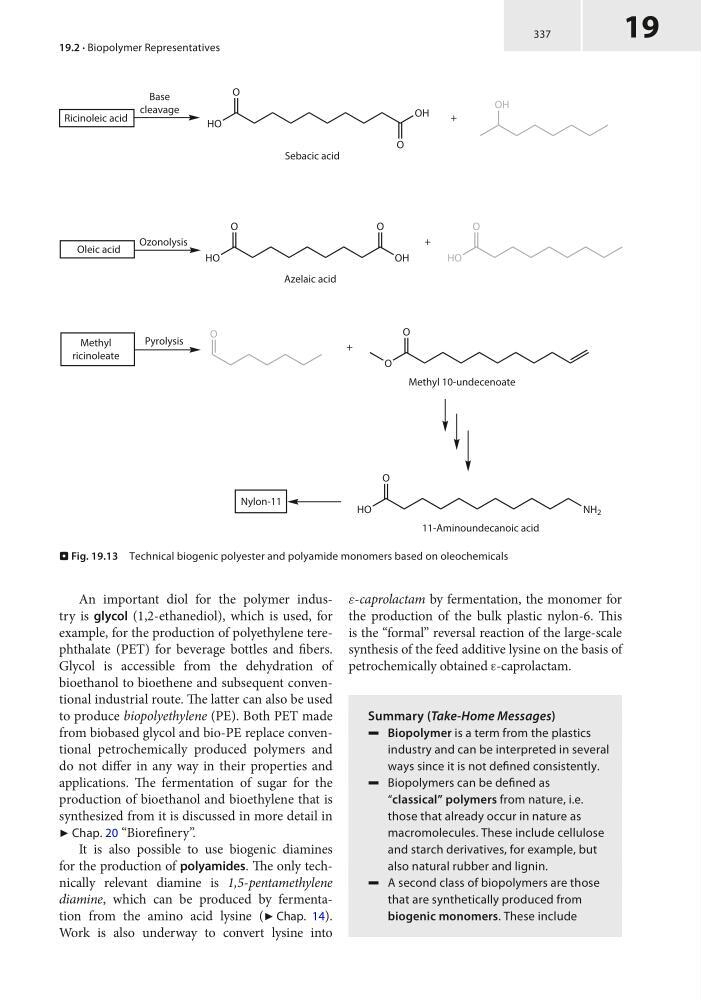
. Fig. 19.13 Technical biogenic polyester and polyamide monomers based on oleochemicals
19.2 · Biopolymer Representatives
19
ε-caprolactam by fermentation, the monomer for
the production of the bulk plastic nylon-6. This
is the “formal” reversal reaction of the large-scale
synthesis of the feed additive lysine on the basis of
petrochemically obtained ε-caprolactam.
Summary (Take-Home Messages)
5 Biopolymer is a term from the plastics
industry and can be interpreted in several
ways since it is not defined consistently.
5 Biopolymers can be defined as
“classical” polymers from nature, i.e.
those that already occur in nature as
macromolecules. These include cellulose
and starch derivatives, for example, but
also natural rubber and lignin.
5 A second class of biopolymers are those
that are synthetically produced from
biogenic monomers. These include
An important diol for the polymer industry is glycol (1,2-ethanediol), which is used, for
example, for the production of polyethylene terephthalate (PET) for beverage bottles and fibers.
Glycol is accessible from the dehydration of
bioethanol to bioethene and subsequent conventional industrial route. The latter can also be used
to produce biopolyethylene (PE). Both PET made
from biobased glycol and bio-PE replace conventional petrochemically produced polymers and
do not differ in any way in their properties and
applications. The fermentation of sugar for the
production of bioethanol and bioethylene that is
synthesized from it is discussed in more detail in
7 Chap. 20 “Biorefinery”.
It is also possible to use biogenic diamines
for the production of polyamides. The only technically relevant diamine is 1,5-pentamethylene
diamine, which can be produced by fermentation from the amino acid lysine (7 Chap. 14).
Work is also underway to convert lysine into
Ricinoleic acid
Oleic acid
Methyl
ricinoleate
Base
cleavage
Ozonolysis
Pyrolysis
HO
OH
O
O
OH
+
Sebacic acid
HO
OH
O
O
HO
O
Azelaic acid
+
O
+
O
O
Methyl 10-undecenoate
HO
NH 2
O
11-Aminoundecanoic acid
Nylon-11
. Fig. 19.13 Technical biogenic polyester and polyamide monomers based on oleochemicals
19.2 · Biopolymer Representatives