

330
Chapter 19 · Plastics from Nature - Biopolymers
19
scales of reptiles. They are formed by keratinization in the epidermis, a process in which animate
matter dies and keratinizes through a growth
process and targeted water loss. In principle, the
composition of keratins is comparable with other
proteins; only their sulfur content is increased
due to increased cysteine (Cys) content. They
form an inherent composite structure consisting of crystalline regions embedded in a matrix
of amorphous chain segments. When compared with other composite materials (cf. wood,
7 Chap. 7), the particular feature of the composite
structure of keratins is that it consists exclusively
of proteins.
The most important natural polymer among
keratins for humans is the wool of sheep
(so-called virgin wool), which has been used for
about 6000 years and is thus one of the oldest
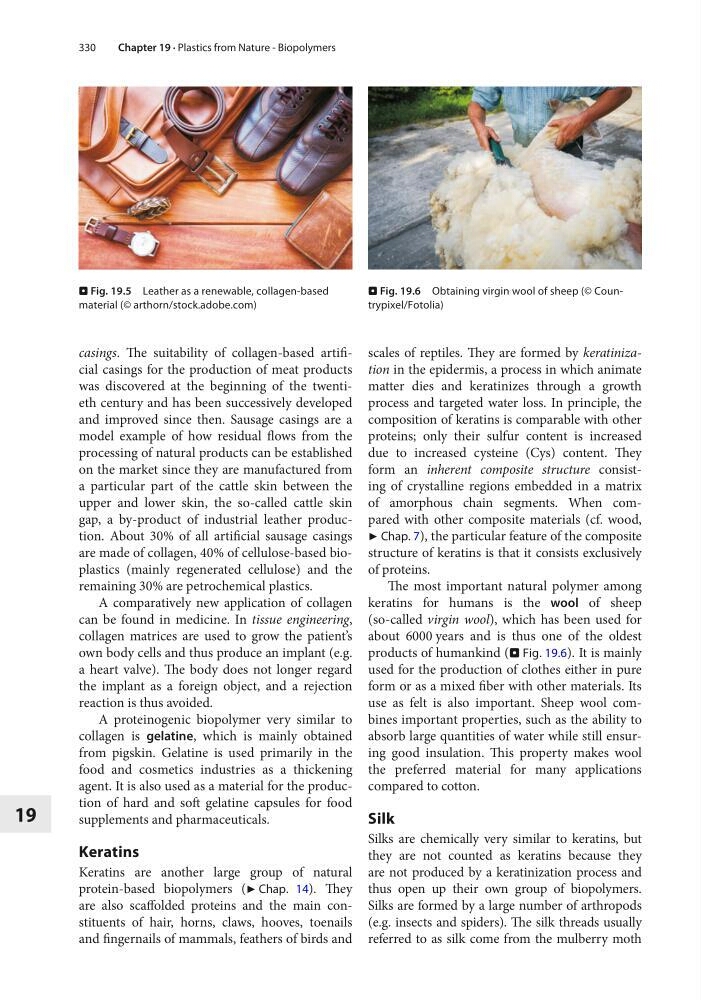
products of humankind (. Fig. 19.6). It is mainly
used for the production of clothes either in pure
form or as a mixed fiber with other materials. Its
use as felt is also important. Sheep wool combines important properties, such as the ability to
absorb large quantities of water while still ensuring good insulation. This property makes wool
the preferred material for many applications
compared to cotton.
Silk
Silks are chemically very similar to keratins, but
they are not counted as keratins because they
are not produced by a keratinization process and
thus open up their own group of biopolymers.
Silks are formed by a large number of arthropods
(e.g. insects and spiders). The silk threads usually
referred to as silk come from the mulberry moth
casings. The suitability of collagen-based artificial casings for the production of meat products
was discovered at the beginning of the twentieth century and has been successively developed
and improved since then. Sausage casings are a
model example of how residual flows from the
processing of natural products can be established
on the market since they are manufactured from
a particular part of the cattle skin between the
upper and lower skin, the so-called cattle skin
gap, a by-product of industrial leather production. About 30% of all artificial sausage casings
are made of collagen, 40% of cellulose-based bioplastics (mainly regenerated cellulose) and the
remaining 30% are petrochemical plastics.
A comparatively new application of collagen
can be found in medicine. In tissue engineering,
collagen matrices are used to grow the patient’s
own body cells and thus produce an implant (e.g.
a heart valve). The body does not longer regard
the implant as a foreign object, and a rejection
reaction is thus avoided.
A proteinogenic biopolymer very similar to
collagen is gelatine, which is mainly obtained
from pigskin. Gelatine is used primarily in the
food and cosmetics industries as a thickening
agent. It is also used as a material for the production of hard and soft gelatine capsules for food
supplements and pharmaceuticals.
Keratins
Keratins are another large group of natural
protein-based biopolymers (7 Chap. 14). They
are also scaffolded proteins and the main constituents of hair, horns, claws, hooves, toenails
and fingernails of mammals, feathers of birds and
. Fig. 19.6 Obtaining virgin wool of sheep (© Countrypixel/Fotolia)
. Fig. 19.5 Leather as a renewable, collagen-based
material (© arthorn/stock.adobe.com)
Chapter 19 · Plastics from Nature - Biopolymers
19
scales of reptiles. They are formed by keratinization in the epidermis, a process in which animate
matter dies and keratinizes through a growth
process and targeted water loss. In principle, the
composition of keratins is comparable with other
proteins; only their sulfur content is increased
due to increased cysteine (Cys) content. They
form an inherent composite structure consisting of crystalline regions embedded in a matrix
of amorphous chain segments. When compared with other composite materials (cf. wood,
7 Chap. 7), the particular feature of the composite
structure of keratins is that it consists exclusively
of proteins.
The most important natural polymer among
keratins for humans is the wool of sheep
(so-called virgin wool), which has been used for
about 6000 years and is thus one of the oldest
products of humankind (. Fig. 19.6). It is mainly
used for the production of clothes either in pure
form or as a mixed fiber with other materials. Its
use as felt is also important. Sheep wool combines important properties, such as the ability to
absorb large quantities of water while still ensuring good insulation. This property makes wool
the preferred material for many applications
compared to cotton.
Silk
Silks are chemically very similar to keratins, but
they are not counted as keratins because they
are not produced by a keratinization process and
thus open up their own group of biopolymers.
Silks are formed by a large number of arthropods
(e.g. insects and spiders). The silk threads usually
referred to as silk come from the mulberry moth
casings. The suitability of collagen-based artificial casings for the production of meat products
was discovered at the beginning of the twentieth century and has been successively developed
and improved since then. Sausage casings are a
model example of how residual flows from the
processing of natural products can be established
on the market since they are manufactured from
a particular part of the cattle skin between the
upper and lower skin, the so-called cattle skin
gap, a by-product of industrial leather production. About 30% of all artificial sausage casings
are made of collagen, 40% of cellulose-based bioplastics (mainly regenerated cellulose) and the
remaining 30% are petrochemical plastics.
A comparatively new application of collagen
can be found in medicine. In tissue engineering,
collagen matrices are used to grow the patient’s
own body cells and thus produce an implant (e.g.
a heart valve). The body does not longer regard
the implant as a foreign object, and a rejection
reaction is thus avoided.
A proteinogenic biopolymer very similar to
collagen is gelatine, which is mainly obtained
from pigskin. Gelatine is used primarily in the
food and cosmetics industries as a thickening
agent. It is also used as a material for the production of hard and soft gelatine capsules for food
supplements and pharmaceuticals.
Keratins
Keratins are another large group of natural
protein-based biopolymers (7 Chap. 14). They
are also scaffolded proteins and the main constituents of hair, horns, claws, hooves, toenails
and fingernails of mammals, feathers of birds and
. Fig. 19.6 Obtaining virgin wool of sheep (© Countrypixel/Fotolia)
. Fig. 19.5 Leather as a renewable, collagen-based
material (© arthorn/stock.adobe.com)