

324
Chapter 19 · Plastics from Nature - Biopolymers
19
are chemically polymerized afterward. Another
aspect that is often considered in the literature
for bioplastics is the biodegradability of a plastic, regardless of the origin of the polymer. Since
the use of the terms biopolymer and bioplastics
is not uniform and many different classifications
are used, an overview is given here, which is
explained with typical examples.
The European Standardization Panel has recommended a specific terminology in its Technical
Report CEN/TR 15932 to use the term bioplastics
for three different groups of substances:
5 Biogenic plastics, i.e. plastics originating from
biological sources,
5 Biodegradable, i.e. compostable plastics,
5 Biocompatible plastics, e.g. for use in medicine.
The endeavor to produce plastics based on natural and renewable sources (biogenic plastics) is
based on the preservation of fossil resources. On
the other hand, climate change, which is associated with the emission of carbon dioxide, plays
a role. Combustion or composting of biogenic
plastics only releases as much CO 2 as the organism has previously taken from the air; the plastic
is “CO 2 -neutral”.
For this reason, science and the chemical industry refer in particular to the question
of whether the carbon atoms in polymers are
biogenic, i.e. whether they come from natural
sources (BOX: Radiocarbon dating). In principle,
there are two possibilities for the synthesis of
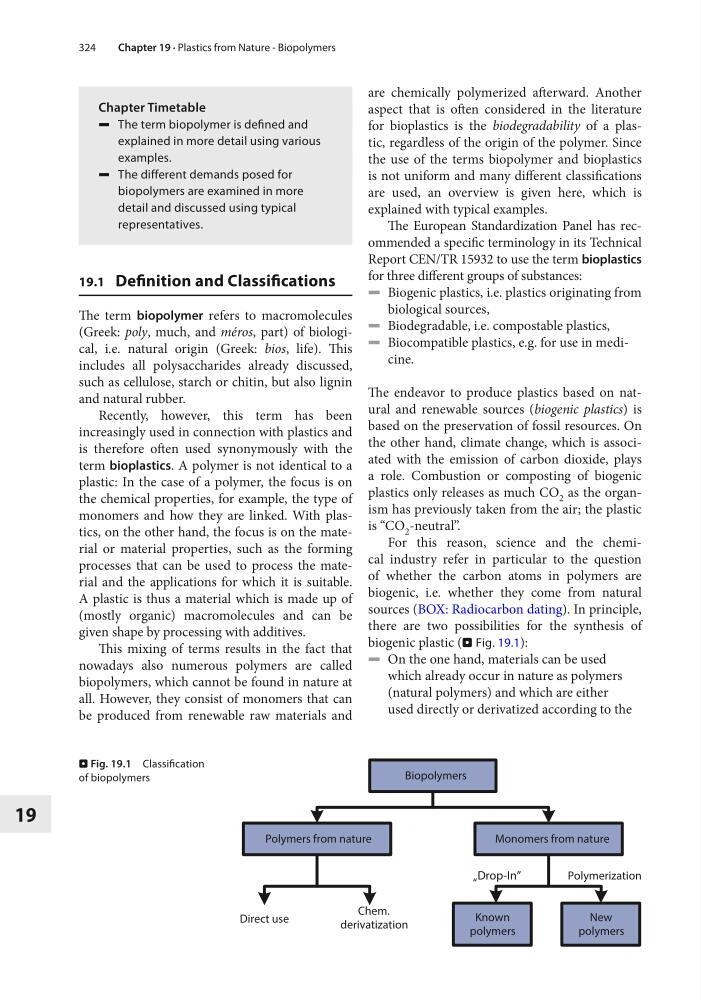
biogenic plastic (. Fig. 19.1):
5 On the one hand, materials can be used
which already occur in nature as polymers
(natural polymers) and which are either
used directly or derivatized according to the
Chapter Timetable
5 The term biopolymer is defined and
explained in more detail using various
examples.
5 The different demands posed for
biopolymers are examined in more
detail and discussed using typical
representatives.
19.1 Definition and Classifications
The term biopolymer refers to macromolecules
(Greek: poly, much, and méros, part) of biological, i.e. natural origin (Greek: bios, life). This
includes all polysaccharides already discussed,
such as cellulose, starch or chitin, but also lignin
and natural rubber.
Recently, however, this term has been
increasingly used in connection with plastics and
is therefore often used synonymously with the
term bioplastics. A polymer is not identical to a
plastic: In the case of a polymer, the focus is on
the chemical properties, for example, the type of
monomers and how they are linked. With plastics, on the other hand, the focus is on the material or material properties, such as the forming
processes that can be used to process the material and the applications for which it is suitable.
A plastic is thus a material which is made up of
(mostly organic) macromolecules and can be
given shape by processing with additives.
This mixing of terms results in the fact that
nowadays also numerous polymers are called
biopolymers, which cannot be found in nature at
all. However, they consist of monomers that can
be produced from renewable raw materials and
. Fig. 19.1 Classification
of biopolymers
Biopolymers
Polymers from nature
Monomers from nature
Chem.
derivatization
Direct use
Known
polymers
New
polymers
Drop-In”
“
Polymerization
Chapter 19 · Plastics from Nature - Biopolymers
19
are chemically polymerized afterward. Another
aspect that is often considered in the literature
for bioplastics is the biodegradability of a plastic, regardless of the origin of the polymer. Since
the use of the terms biopolymer and bioplastics
is not uniform and many different classifications
are used, an overview is given here, which is
explained with typical examples.
The European Standardization Panel has recommended a specific terminology in its Technical
Report CEN/TR 15932 to use the term bioplastics
for three different groups of substances:
5 Biogenic plastics, i.e. plastics originating from
biological sources,
5 Biodegradable, i.e. compostable plastics,
5 Biocompatible plastics, e.g. for use in medicine.
The endeavor to produce plastics based on natural and renewable sources (biogenic plastics) is
based on the preservation of fossil resources. On
the other hand, climate change, which is associated with the emission of carbon dioxide, plays
a role. Combustion or composting of biogenic
plastics only releases as much CO 2 as the organism has previously taken from the air; the plastic
is “CO 2 -neutral”.
For this reason, science and the chemical industry refer in particular to the question
of whether the carbon atoms in polymers are
biogenic, i.e. whether they come from natural
sources (BOX: Radiocarbon dating). In principle,
there are two possibilities for the synthesis of
biogenic plastic (. Fig. 19.1):
5 On the one hand, materials can be used
which already occur in nature as polymers
(natural polymers) and which are either
used directly or derivatized according to the
Chapter Timetable
5 The term biopolymer is defined and
explained in more detail using various
examples.
5 The different demands posed for
biopolymers are examined in more
detail and discussed using typical
representatives.
19.1 Definition and Classifications
The term biopolymer refers to macromolecules
(Greek: poly, much, and méros, part) of biological, i.e. natural origin (Greek: bios, life). This
includes all polysaccharides already discussed,
such as cellulose, starch or chitin, but also lignin
and natural rubber.
Recently, however, this term has been
increasingly used in connection with plastics and
is therefore often used synonymously with the
term bioplastics. A polymer is not identical to a
plastic: In the case of a polymer, the focus is on
the chemical properties, for example, the type of
monomers and how they are linked. With plastics, on the other hand, the focus is on the material or material properties, such as the forming
processes that can be used to process the material and the applications for which it is suitable.
A plastic is thus a material which is made up of
(mostly organic) macromolecules and can be
given shape by processing with additives.
This mixing of terms results in the fact that
nowadays also numerous polymers are called
biopolymers, which cannot be found in nature at
all. However, they consist of monomers that can
be produced from renewable raw materials and
. Fig. 19.1 Classification
of biopolymers
Biopolymers
Polymers from nature
Monomers from nature
Chem.
derivatization
Direct use
Known
polymers
New
polymers
Drop-In”
“
Polymerization