

317
18
BOX: The Taste of Vanilla
Vanilla has been used as an
aromatic plant for thousands of
years in the regions of Central
and South America. In Europe,
on the other hand, vanilla has
only been known since the
sixteenth century and has been
used in many ways as a flavoring
substance, e.g. in chocolates. In
1858, N.-T. Gobley succeeded
for the first time in isolating
very pure vanillin from vanilla
extracts. In the late nineteenth
century, the first synthetic
production of vanillin was
achieved, first from natural raw
materials (coniferine, eugenol)
and then from petrochemical
raw materials.
The “oldest” product for
flavoring foods and cosmetics
with vanilla is still the most
popular today, although by
far the most expensive: Vanilla
extracts (. Fig. 18.6) are made
from natural vanilla pods and
contain up to 200 different
substances in addition to
vanillin. In food, they may be
declared as “vanilla extract”.
If up to 5% of other natural
flavors are added, they may
still be referred to as “natural
vanilla flavors”. Only a very small
part of the vanillin is isolated
from these products. Synthetic
processes are much cheaper and
synthetic vanillin can be offered
at prices of about 10–15 € kg −1 .
Vanillin from vanilla pods costs
approx. 100 times as much,
since from the cultivation of
1500–2000 t vanilla pods only
approx. 20–40 t vanillin are
obtained. It is estimated that the
annual demand for vanillin as a
fragrance and flavor component
is around 15,000 tons. Thus,
the proportion of vanillin from
vanilla pods is only a fraction of
approx. 0.3%.
Natural sources for the
production of vanillin are, as
already discussed in 7 Chap. 11,
the sulfite waste liquors of pulp
production from wood. Vanillin
can also be produced from
eugenol, a phenylpropanoid
contained in clove oil. Since
these materials are of natural
origin, this vanillin can be
declared also natural flavor in
food preparations.
In addition to the production
from natural substrates,
vanillin can also be produced
synthetically from petrochemical
raw materials. Nowadays,
vanillin is mostly synthesized
from guaiacol (ortho-methoxyphenol). The vanillin
obtained in this way is referred
to as “aroma”, in former times
the addition “nature identical”
was still in use.
Ethylvanillin (4-hydroxy3-ethoxybenzaldehyde) is
an example of an artificial
flavoring substance that is used
to create a vanilla flavor, but
does not occur in nature itself.
It is derived from the vanillin
structure in which the methoxy
group is substituted by an
ethoxy group. It is produced
exclusively synthetically and
has a vanilla aroma about 2–4
times more intense than vanillin
itself.
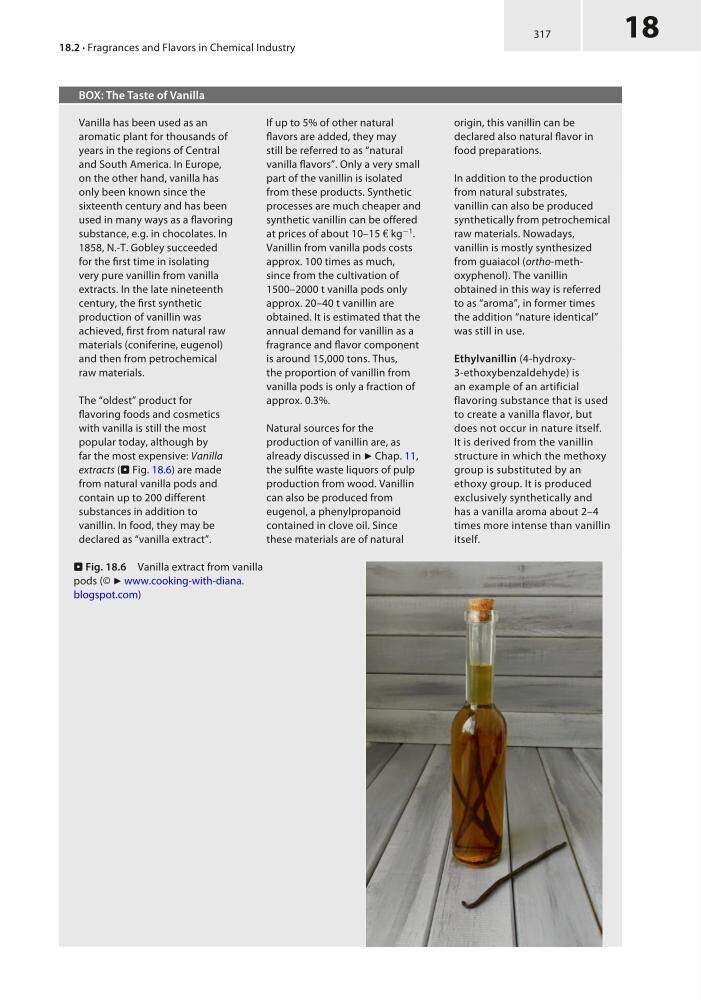
. Fig. 18.6 Vanilla extract from vanilla
pods (© 7 www.cooking-with-diana.
blogspot.com)
18.2 · Fragrances and Flavors in Chemical Industry
18
BOX: The Taste of Vanilla
Vanilla has been used as an
aromatic plant for thousands of
years in the regions of Central
and South America. In Europe,
on the other hand, vanilla has
only been known since the
sixteenth century and has been
used in many ways as a flavoring
substance, e.g. in chocolates. In
1858, N.-T. Gobley succeeded
for the first time in isolating
very pure vanillin from vanilla
extracts. In the late nineteenth
century, the first synthetic
production of vanillin was
achieved, first from natural raw
materials (coniferine, eugenol)
and then from petrochemical
raw materials.
The “oldest” product for
flavoring foods and cosmetics
with vanilla is still the most
popular today, although by
far the most expensive: Vanilla
extracts (. Fig. 18.6) are made
from natural vanilla pods and
contain up to 200 different
substances in addition to
vanillin. In food, they may be
declared as “vanilla extract”.
If up to 5% of other natural
flavors are added, they may
still be referred to as “natural
vanilla flavors”. Only a very small
part of the vanillin is isolated
from these products. Synthetic
processes are much cheaper and
synthetic vanillin can be offered
at prices of about 10–15 € kg −1 .
Vanillin from vanilla pods costs
approx. 100 times as much,
since from the cultivation of
1500–2000 t vanilla pods only
approx. 20–40 t vanillin are
obtained. It is estimated that the
annual demand for vanillin as a
fragrance and flavor component
is around 15,000 tons. Thus,
the proportion of vanillin from
vanilla pods is only a fraction of
approx. 0.3%.
Natural sources for the
production of vanillin are, as
already discussed in 7 Chap. 11,
the sulfite waste liquors of pulp
production from wood. Vanillin
can also be produced from
eugenol, a phenylpropanoid
contained in clove oil. Since
these materials are of natural
origin, this vanillin can be
declared also natural flavor in
food preparations.
In addition to the production
from natural substrates,
vanillin can also be produced
synthetically from petrochemical
raw materials. Nowadays,
vanillin is mostly synthesized
from guaiacol (ortho-methoxyphenol). The vanillin
obtained in this way is referred
to as “aroma”, in former times
the addition “nature identical”
was still in use.
Ethylvanillin (4-hydroxy3-ethoxybenzaldehyde) is
an example of an artificial
flavoring substance that is used
to create a vanilla flavor, but
does not occur in nature itself.
It is derived from the vanillin
structure in which the methoxy
group is substituted by an
ethoxy group. It is produced
exclusively synthetically and
has a vanilla aroma about 2–4
times more intense than vanillin
itself.
. Fig. 18.6 Vanilla extract from vanilla
pods (© 7 www.cooking-with-diana.
blogspot.com)
18.2 · Fragrances and Flavors in Chemical Industry