

315
18
The classification into natural and synthetic
substances is particularly important for flavoring substances, as these require authorization as
food additives and must be declared on the list
of ingredients. For use as fragrances in cosmetics, detergents and perfumes, for example, exact
labeling is not necessary, although in high-priced
products natural ingredients are often advertised.
Essential oils are isolated from vegetable
raw materials and used directly in perfumes as
a mixture of a wide variety of chemical compounds. It should be noted that, unlike fatty oils
(7 Chap. 2–4, Oleochemistry), essential oils do
not contain triglycerides; they therefore differ
significantly in their chemical structure and have
only their natural origin in common. Essential
oils contain most of the flavors and aromas specific to the characteristic scent of the plant. In
contrast to fatty oils, they evaporate residue-free.
Individual components are only isolated in
exceptional cases, e.g. if a compound occurs in
high proportions (e.g. menthol from peppermint
oil, eugenol from clove oil or citral from lemongrass oil, 7 Chap. 12). For use in perfumes, for
example, the essential oils of certain flowers such
as roses, lilies or violets and those of citrus fruits
such as orange, bergamot and lemon are important. Flavorings include the essential oils of certain spices such as cloves, aniseed, cinnamon
and vanilla.
Flavorings are also produced biotechnologically from natural products that have nothing to
do with the flavor to be achieved: Certain mold
cultures are used to produce aroma substances
that taste like strawberries, even if the biotechnologically produced strawberry aroma is chemically unrelated to the “real” aroma components
of strawberries.
Germany. The latter goes back to the chemists
W. Haarmann and K. Reimer and their company
Haarmann & Reimer, founded in 1876, who produced synthetic vanillin on a commercial scale
for the first time. . Figure 18.3 shows the ten
most important flavor and fragrance manufacturers with their respective market shares. The
most important markets for fragrances and flavors in 2017 are shown in . Fig. 18.4.
18.2 Fragrances and Flavors
in Chemical Industry
In the flavor and fragrance industry, there are
basically two categories of fragrance compounds
which differ in the origin of the substances used:
5 Natural fragrances and flavors are produced
from natural sources using legally defined
processes. These include, for example, essential oils obtained by distillation or extraction
from vegetable or animal raw materials.
However, enzymatically or microbiologically
(with yeasts) produced products from natural
sources also fall into this category.
5 Synthetic fragrances and flavors are
produced using synthetic processes, i.e.
mostly starting from fossil raw materials.
Synthetic fragrances and flavors can be
further divided into nature-identical and
artificial compounds.
Plant sources for the isolation of fragrances
and flavors may be, for example, fruits, seeds,
leaves, flowers or bark of specific plants. Animal
sources, especially for fragrances in high-priced
perfumes, are the secretions of the musk animal,
the civet cat, the muskrat and the excrements of
the sperm whale called ambergris.
O
H
H
OH
OH
OMe
O
O
(-)-Ambrox
(-)-Menthol
Vanillin
-Ionone
β
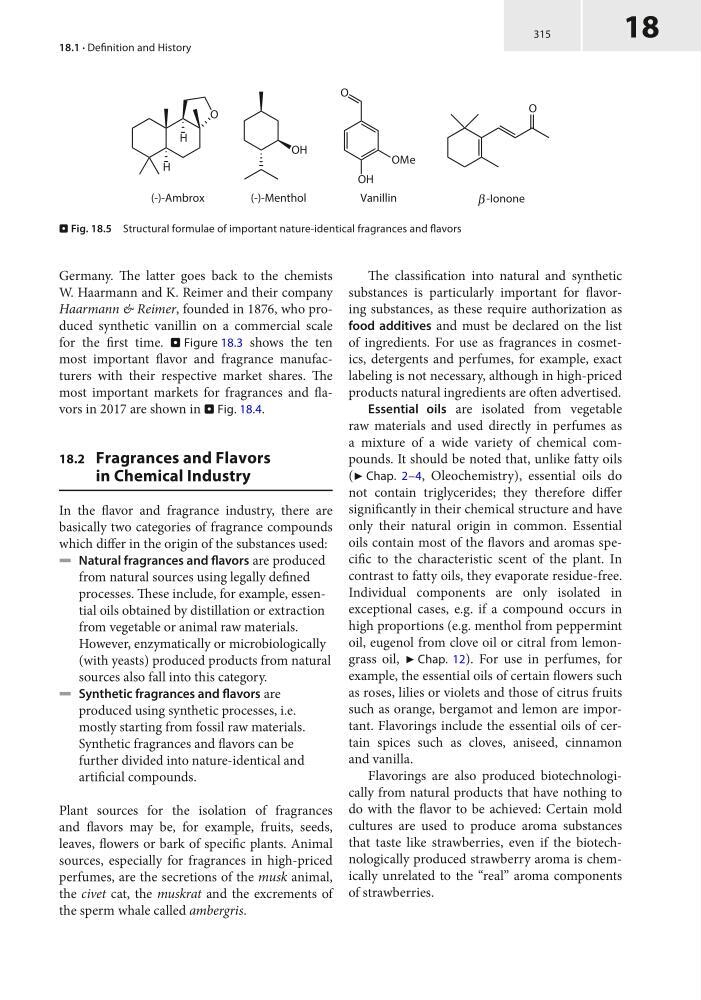
. Fig. 18.5 Structural formulae of important nature-identical fragrances and flavors
18.1 · Definition and History
18
The classification into natural and synthetic
substances is particularly important for flavoring substances, as these require authorization as
food additives and must be declared on the list
of ingredients. For use as fragrances in cosmetics, detergents and perfumes, for example, exact
labeling is not necessary, although in high-priced
products natural ingredients are often advertised.
Essential oils are isolated from vegetable
raw materials and used directly in perfumes as
a mixture of a wide variety of chemical compounds. It should be noted that, unlike fatty oils
(7 Chap. 2–4, Oleochemistry), essential oils do
not contain triglycerides; they therefore differ
significantly in their chemical structure and have
only their natural origin in common. Essential
oils contain most of the flavors and aromas specific to the characteristic scent of the plant. In
contrast to fatty oils, they evaporate residue-free.
Individual components are only isolated in
exceptional cases, e.g. if a compound occurs in
high proportions (e.g. menthol from peppermint
oil, eugenol from clove oil or citral from lemongrass oil, 7 Chap. 12). For use in perfumes, for
example, the essential oils of certain flowers such
as roses, lilies or violets and those of citrus fruits
such as orange, bergamot and lemon are important. Flavorings include the essential oils of certain spices such as cloves, aniseed, cinnamon
and vanilla.
Flavorings are also produced biotechnologically from natural products that have nothing to
do with the flavor to be achieved: Certain mold
cultures are used to produce aroma substances
that taste like strawberries, even if the biotechnologically produced strawberry aroma is chemically unrelated to the “real” aroma components
of strawberries.
Germany. The latter goes back to the chemists
W. Haarmann and K. Reimer and their company
Haarmann & Reimer, founded in 1876, who produced synthetic vanillin on a commercial scale
for the first time. . Figure 18.3 shows the ten
most important flavor and fragrance manufacturers with their respective market shares. The
most important markets for fragrances and flavors in 2017 are shown in . Fig. 18.4.
18.2 Fragrances and Flavors
in Chemical Industry
In the flavor and fragrance industry, there are
basically two categories of fragrance compounds
which differ in the origin of the substances used:
5 Natural fragrances and flavors are produced
from natural sources using legally defined
processes. These include, for example, essential oils obtained by distillation or extraction
from vegetable or animal raw materials.
However, enzymatically or microbiologically
(with yeasts) produced products from natural
sources also fall into this category.
5 Synthetic fragrances and flavors are
produced using synthetic processes, i.e.
mostly starting from fossil raw materials.
Synthetic fragrances and flavors can be
further divided into nature-identical and
artificial compounds.
Plant sources for the isolation of fragrances
and flavors may be, for example, fruits, seeds,
leaves, flowers or bark of specific plants. Animal
sources, especially for fragrances in high-priced
perfumes, are the secretions of the musk animal,
the civet cat, the muskrat and the excrements of
the sperm whale called ambergris.
O
H
H
OH
OH
OMe
O
O
(-)-Ambrox
(-)-Menthol
Vanillin
-Ionone
β
. Fig. 18.5 Structural formulae of important nature-identical fragrances and flavors
18.1 · Definition and History