

313
18
At the end of the nineteenth century, the first
perfumes with synthetic fragrances came onto
the market, allowing completely new odor compositions for the first time. In 1882, it was Fougère
Royale by Houbigant (a company from the aforementioned town of Grasse) as the first perfume
with synthetic coumarin, and in 1889 the perfume
Jicky® by Aimé Guerlain, which contained synthetic fragrances such as vanillin and coumarin
instead of natural essential oils. The predominance
of fragrances based exclusively on essential oils in
the perfume market was broken. Another milestone in fragrance history was the still very popular perfume Chanel No 5, which in 1921 was the
first perfume to use artificial fragrances without
any natural model as a flavor component, i.e. linear aliphatic aldehydes with 10, 11 and 12 carbon
atoms. Since then, attempts have been made not
only to synthetically produce nature-identical fragrances, but also to find completely new artificial
substances that have a familiar smell and thus imitate natural fragrances (7 Sect. 18.2).
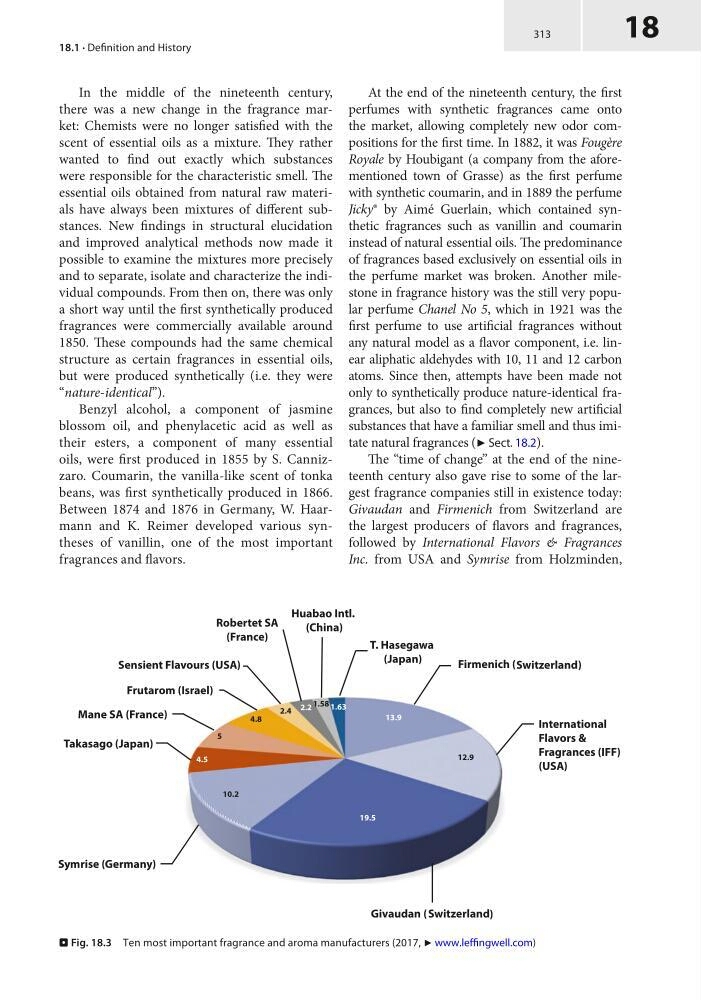
The “time of change” at the end of the nineteenth century also gave rise to some of the largest fragrance companies still in existence today:
Givaudan and Firmenich from Switzerland are
the largest producers of flavors and fragrances,
followed by International Flavors & Fragrances
Inc. from USA and Symrise from Holzminden,
In the middle of the nineteenth century,
there was a new change in the fragrance market: Chemists were no longer satisfied with the
scent of essential oils as a mixture. They rather
wanted to find out exactly which substances
were responsible for the characteristic smell. The
essential oils obtained from natural raw materials have always been mixtures of different substances. New findings in structural elucidation
and improved analytical methods now made it
possible to examine the mixtures more precisely
and to separate, isolate and characterize the individual compounds. From then on, there was only
a short way until the first synthetically produced
fragrances were commercially available around
1850. These compounds had the same chemical
structure as certain fragrances in essential oils,
but were produced synthetically (i.e. they were
“nature-identical”).
Benzyl alcohol, a component of jasmine
blossom oil, and phenylacetic acid as well as
their esters, a component of many essential
oils, were first produced in 1855 by S. Cannizzaro. Coumarin, the vanilla-like scent of tonka
beans, was first synthetically produced in 1866.
Between 1874 and 1876 in Germany, W. Haarmann and K. Reimer developed various syntheses of vanillin, one of the most important
fragrances and flavors.
13.9
12.9
19.5
10.2
4.5
5
4.8
2.4 2.2 1.58 1.63
Takasago (Japan)
Mane SA (France)
Frutarom (Israel)
Sensient Flavours (USA)
Robertet SA
(France)
Symrise (Germany)
T. Hasegawa
(Japan)
Givaudan (Switzerland)
International
Flavors &
Fragrances (IFF)
(USA)
Firmenich (Switzerland)
Huabao Intl.
(China)
. Fig. 18.3 Ten most important fragrance and aroma manufacturers (2017, 7 www.leffingwell.com)
18.1 · Definition and History
18
At the end of the nineteenth century, the first
perfumes with synthetic fragrances came onto
the market, allowing completely new odor compositions for the first time. In 1882, it was Fougère
Royale by Houbigant (a company from the aforementioned town of Grasse) as the first perfume
with synthetic coumarin, and in 1889 the perfume
Jicky® by Aimé Guerlain, which contained synthetic fragrances such as vanillin and coumarin
instead of natural essential oils. The predominance
of fragrances based exclusively on essential oils in
the perfume market was broken. Another milestone in fragrance history was the still very popular perfume Chanel No 5, which in 1921 was the
first perfume to use artificial fragrances without
any natural model as a flavor component, i.e. linear aliphatic aldehydes with 10, 11 and 12 carbon
atoms. Since then, attempts have been made not
only to synthetically produce nature-identical fragrances, but also to find completely new artificial
substances that have a familiar smell and thus imitate natural fragrances (7 Sect. 18.2).
The “time of change” at the end of the nineteenth century also gave rise to some of the largest fragrance companies still in existence today:
Givaudan and Firmenich from Switzerland are
the largest producers of flavors and fragrances,
followed by International Flavors & Fragrances
Inc. from USA and Symrise from Holzminden,
In the middle of the nineteenth century,
there was a new change in the fragrance market: Chemists were no longer satisfied with the
scent of essential oils as a mixture. They rather
wanted to find out exactly which substances
were responsible for the characteristic smell. The
essential oils obtained from natural raw materials have always been mixtures of different substances. New findings in structural elucidation
and improved analytical methods now made it
possible to examine the mixtures more precisely
and to separate, isolate and characterize the individual compounds. From then on, there was only
a short way until the first synthetically produced
fragrances were commercially available around
1850. These compounds had the same chemical
structure as certain fragrances in essential oils,
but were produced synthetically (i.e. they were
“nature-identical”).
Benzyl alcohol, a component of jasmine
blossom oil, and phenylacetic acid as well as
their esters, a component of many essential
oils, were first produced in 1855 by S. Cannizzaro. Coumarin, the vanilla-like scent of tonka
beans, was first synthetically produced in 1866.
Between 1874 and 1876 in Germany, W. Haarmann and K. Reimer developed various syntheses of vanillin, one of the most important
fragrances and flavors.
13.9
12.9
19.5
10.2
4.5
5
4.8
2.4 2.2 1.58 1.63
Takasago (Japan)
Mane SA (France)
Frutarom (Israel)
Sensient Flavours (USA)
Robertet SA
(France)
Symrise (Germany)
T. Hasegawa
(Japan)
Givaudan (Switzerland)
International
Flavors &
Fragrances (IFF)
(USA)
Firmenich (Switzerland)
Huabao Intl.
(China)
. Fig. 18.3 Ten most important fragrance and aroma manufacturers (2017, 7 www.leffingwell.com)
18.1 · Definition and History