

301
17
It was only in 1754 that the British ship’s doctor
James Lind discovered in a systematic study that
the juice of citrus fruits could cure and eliminate
the disease. As a result, James Cook took orange
and lemon juice with him on his first circumnavigation of the world in 1768.
In the 1930s, the active substance was finally
identified: The Hungarian scientist Albert von
Szent-Györgyi isolated the substance from the
adrenal gland, from orange juice and white cabbage. In 1933, the British chemist Walter Norman Haworth proved the structure of vitamin
C through a chemical synthesis. The substance
was recognized as a γ-lactone of a ketohexonic
acid whose keto group is in the enol form. This
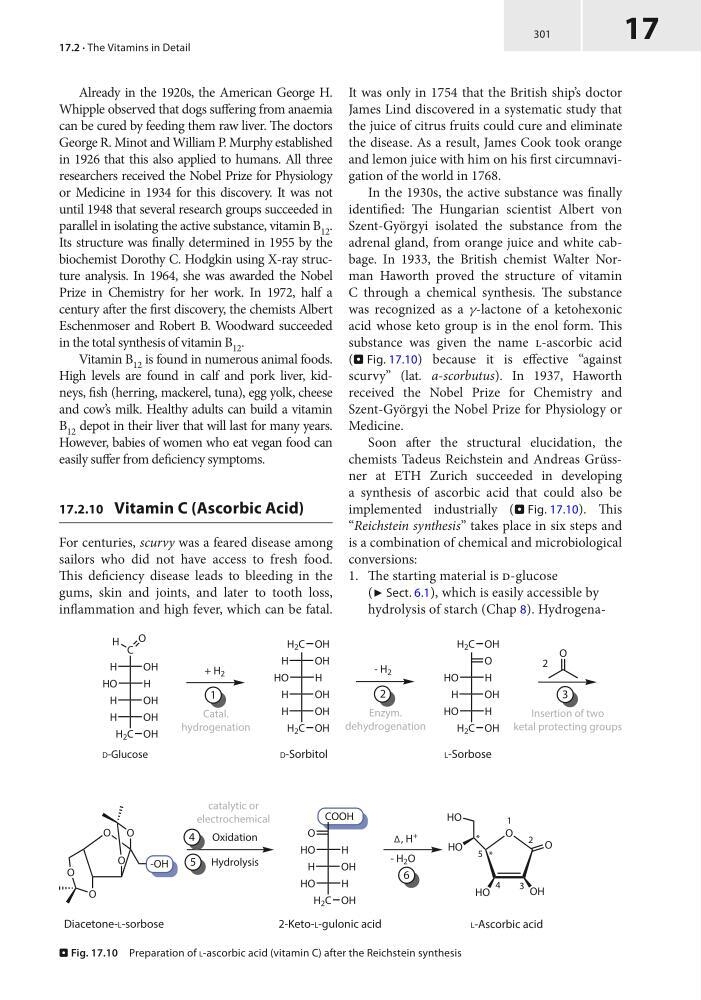
substance was given the name l-ascorbic acid
(. Fig. 17.10) because it is effective “against
scurvy” (lat. a-scorbutus). In 1937, Haworth
received the Nobel Prize for Chemistry and
Szent-Györgyi the Nobel Prize for Physiology or
Medicine.
Soon after the structural elucidation, the
chemists Tadeus Reichstein and Andreas Grüssner at ETH Zurich succeeded in developing
a synthesis of ascorbic acid that could also be
implemented industrially (. Fig. 17.10). This
“Reichstein synthesis” takes place in six steps and
is a combination of chemical and microbiological
conversions:
1. The starting material is d-glucose
(7 Sect. 6.1), which is easily accessible by
hydrolysis of starch (Chap 8). HydrogenaAlready in the 1920s, the American George H.
Whipple observed that dogs suffering from anaemia
can be cured by feeding them raw liver. The doctors
George R. Minot and William P. Murphy established
in 1926 that this also applied to humans. All three
researchers received the Nobel Prize for Physiology
or Medicine in 1934 for this discovery. It was not
until 1948 that several research groups succeeded in
parallel in isolating the active substance, vitamin B 12 .
Its structure was finally determined in 1955 by the
biochemist Dorothy C. Hodgkin using X-ray structure analysis. In 1964, she was awarded the Nobel
Prize in Chemistry for her work. In 1972, half a
century after the first discovery, the chemists Albert
Eschenmoser and Robert B. Woodward succeeded
in the total synthesis of vitamin B 12 .
Vitamin B 12 is found in numerous animal foods.
High levels are found in calf and pork liver, kidneys, fish (herring, mackerel, tuna), egg yolk, cheese
and cow’s milk. Healthy adults can build a vitamin
B 12 depot in their liver that will last for many years.
However, babies of women who eat vegan food can
easily suffer from deficiency symptoms.
17.2.10 Vitamin C (Ascorbic Acid)
For centuries, scurvy was a feared disease among
sailors who did not have access to fresh food.
This deficiency disease leads to bleeding in the
gums, skin and joints, and later to tooth loss,
inflammation and high fever, which can be fatal.
C
H
OH
HO
H
H
OH
H
OH
H 2 C OH
O
H
H 2 C
H
OH
HO
H
H
OH
H
OH
H 2 C OH
OH
+ H 2
Catal.
hydrogenation
Enzym.
dehydrogenation
- H 2
H 2 C
O
HO
H
H
OH
HO
H
H 2 C OH
OH
Insertion of two
ketal protecting groups
D-Glucose
D-Sorbitol
L-Sorbose
O
2
O
O
O
O
O
catalytic or
electrochemical
Oxidation
Hydrolysis
Diacetone-L-sorbose
COOH
O
HO
H
H
OH
HO
H 2 C OH
H
2-Keto-L-gulonic acid
, H
Δ +
- H 2 O
O
HO
OH
O
HO
HO
*
*
1
2
3
4
5
L-Ascorbic acid
4
5
6
1
2
3
-OH
. Fig. 17.10 Preparation of l-ascorbic acid (vitamin C) after the Reichstein synthesis
17.2 · The Vitamins in Detail
17
It was only in 1754 that the British ship’s doctor
James Lind discovered in a systematic study that
the juice of citrus fruits could cure and eliminate
the disease. As a result, James Cook took orange
and lemon juice with him on his first circumnavigation of the world in 1768.
In the 1930s, the active substance was finally
identified: The Hungarian scientist Albert von
Szent-Györgyi isolated the substance from the
adrenal gland, from orange juice and white cabbage. In 1933, the British chemist Walter Norman Haworth proved the structure of vitamin
C through a chemical synthesis. The substance
was recognized as a γ-lactone of a ketohexonic
acid whose keto group is in the enol form. This
substance was given the name l-ascorbic acid
(. Fig. 17.10) because it is effective “against
scurvy” (lat. a-scorbutus). In 1937, Haworth
received the Nobel Prize for Chemistry and
Szent-Györgyi the Nobel Prize for Physiology or
Medicine.
Soon after the structural elucidation, the
chemists Tadeus Reichstein and Andreas Grüssner at ETH Zurich succeeded in developing
a synthesis of ascorbic acid that could also be
implemented industrially (. Fig. 17.10). This
“Reichstein synthesis” takes place in six steps and
is a combination of chemical and microbiological
conversions:
1. The starting material is d-glucose
(7 Sect. 6.1), which is easily accessible by
hydrolysis of starch (Chap 8). HydrogenaAlready in the 1920s, the American George H.
Whipple observed that dogs suffering from anaemia
can be cured by feeding them raw liver. The doctors
George R. Minot and William P. Murphy established
in 1926 that this also applied to humans. All three
researchers received the Nobel Prize for Physiology
or Medicine in 1934 for this discovery. It was not
until 1948 that several research groups succeeded in
parallel in isolating the active substance, vitamin B 12 .
Its structure was finally determined in 1955 by the
biochemist Dorothy C. Hodgkin using X-ray structure analysis. In 1964, she was awarded the Nobel
Prize in Chemistry for her work. In 1972, half a
century after the first discovery, the chemists Albert
Eschenmoser and Robert B. Woodward succeeded
in the total synthesis of vitamin B 12 .
Vitamin B 12 is found in numerous animal foods.
High levels are found in calf and pork liver, kidneys, fish (herring, mackerel, tuna), egg yolk, cheese
and cow’s milk. Healthy adults can build a vitamin
B 12 depot in their liver that will last for many years.
However, babies of women who eat vegan food can
easily suffer from deficiency symptoms.
17.2.10 Vitamin C (Ascorbic Acid)
For centuries, scurvy was a feared disease among
sailors who did not have access to fresh food.
This deficiency disease leads to bleeding in the
gums, skin and joints, and later to tooth loss,
inflammation and high fever, which can be fatal.
C
H
OH
HO
H
H
OH
H
OH
H 2 C OH
O
H
H 2 C
H
OH
HO
H
H
OH
H
OH
H 2 C OH
OH
+ H 2
Catal.
hydrogenation
Enzym.
dehydrogenation
- H 2
H 2 C
O
HO
H
H
OH
HO
H
H 2 C OH
OH
Insertion of two
ketal protecting groups
D-Glucose
D-Sorbitol
L-Sorbose
O
2
O
O
O
O
O
catalytic or
electrochemical
Oxidation
Hydrolysis
Diacetone-L-sorbose
COOH
O
HO
H
H
OH
HO
H 2 C OH
H
2-Keto-L-gulonic acid
, H
Δ +
- H 2 O
O
HO
OH
O
HO
HO
*
*
1
2
3
4
5
L-Ascorbic acid
4
5
6
1
2
3
-OH
. Fig. 17.10 Preparation of l-ascorbic acid (vitamin C) after the Reichstein synthesis
17.2 · The Vitamins in Detail