

290
Chapter 16 · Nature’s Pharmacy - Natural Pharmaceuticals
16
carbohydrate metabolism in the body and
thus belong to the vital substances in the
organism.
Since the 1950s, steroids have been used to
develop birth control pills (contraceptives) which
inhibit ovulation. A difference is made between
two types:
5 Combination products consist of an estrogen
and a gestagen component.
5 Monopreparations (“mini pills”) contain only
one gestagen component. They are taken
daily in low doses.
As early as 1919, the Austrian physiologist
Ludwig Haberlandt hypothesized that the
female body could be “faked” of pregnancy
by the selective application of hormones. In
1951, Carl Djerassi synthesized the first oral
contraceptive, the gestagen norethisterone
(. Fig. 16.21). Gregory Pincus developed
the first combination product, which was
launched on the American market in 1960. In
the field of contraceptives, there are now four
“generations”:
Sex hormones are divided into male sex hormones (androgens) and female sex hormones
(estrogens and gestagens).
5 An important androgen is testosterone
(. Fig. 16.20), which was first extracted from
bull testicles in 1935. It promotes the development of secondary sexual characteristics in
men, stimulates libido and increases protein
build-up, i.e. it has an anabolic effect.
5 The most effective estrogen is 17β-estradiol,
which was first isolated from the urine
of pregnant women. In all estrogens, the
ring A is aromatic, so that the hydroxyl
group at C atom 3 has a phenolic character
(. Fig. 16.20).
5 An important gestagen is progesterone. It is
formed in the body from cholesterol by degradation of the side chain at the C-atom 17
to an acetyl group (. Fig. 16.20). It stimulates
the growth of the uterine mucous membrane
and prevents the fertilization of further eggs
after fertilization of one egg.
5 Cortisol (hydrocortisone, . Fig. 16.20)
belongs to the corticoids. The corticoids
influence the mineral balance and the
HO
HO
HO
HO
Cholesterol
Ergosterol
Stigmasterol
Cholecalciferol
(Vitamin D 3 )
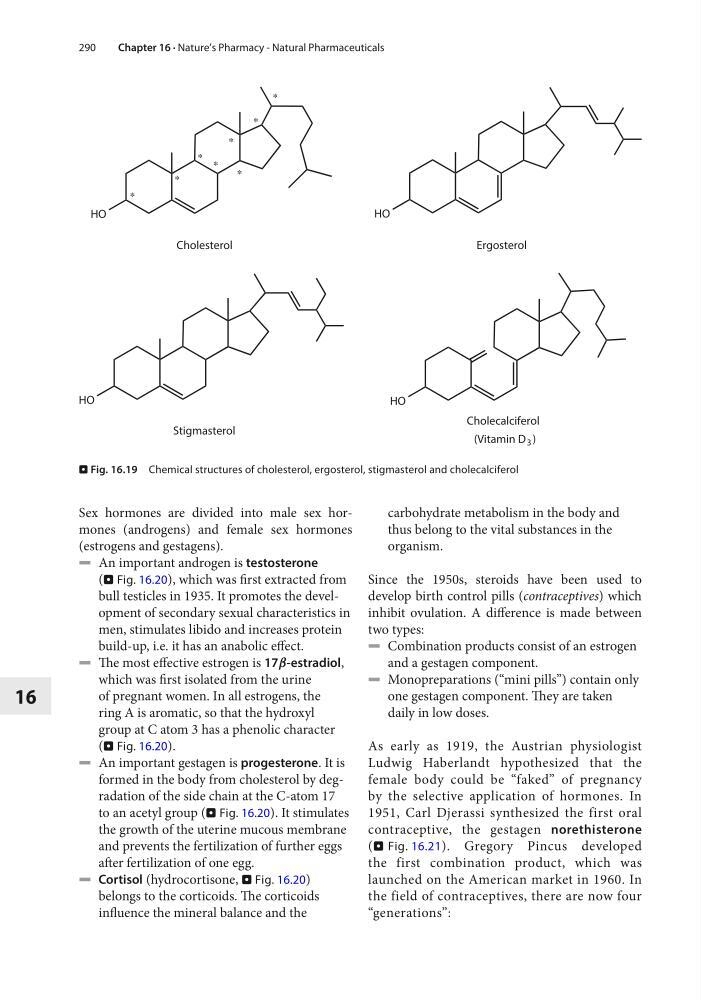
. Fig. 16.19 Chemical structures of cholesterol, ergosterol, stigmasterol and cholecalciferol
Chapter 16 · Nature’s Pharmacy - Natural Pharmaceuticals
16
carbohydrate metabolism in the body and
thus belong to the vital substances in the
organism.
Since the 1950s, steroids have been used to
develop birth control pills (contraceptives) which
inhibit ovulation. A difference is made between
two types:
5 Combination products consist of an estrogen
and a gestagen component.
5 Monopreparations (“mini pills”) contain only
one gestagen component. They are taken
daily in low doses.
As early as 1919, the Austrian physiologist
Ludwig Haberlandt hypothesized that the
female body could be “faked” of pregnancy
by the selective application of hormones. In
1951, Carl Djerassi synthesized the first oral
contraceptive, the gestagen norethisterone
(. Fig. 16.21). Gregory Pincus developed
the first combination product, which was
launched on the American market in 1960. In
the field of contraceptives, there are now four
“generations”:
Sex hormones are divided into male sex hormones (androgens) and female sex hormones
(estrogens and gestagens).
5 An important androgen is testosterone
(. Fig. 16.20), which was first extracted from
bull testicles in 1935. It promotes the development of secondary sexual characteristics in
men, stimulates libido and increases protein
build-up, i.e. it has an anabolic effect.
5 The most effective estrogen is 17β-estradiol,
which was first isolated from the urine
of pregnant women. In all estrogens, the
ring A is aromatic, so that the hydroxyl
group at C atom 3 has a phenolic character
(. Fig. 16.20).
5 An important gestagen is progesterone. It is
formed in the body from cholesterol by degradation of the side chain at the C-atom 17
to an acetyl group (. Fig. 16.20). It stimulates
the growth of the uterine mucous membrane
and prevents the fertilization of further eggs
after fertilization of one egg.
5 Cortisol (hydrocortisone, . Fig. 16.20)
belongs to the corticoids. The corticoids
influence the mineral balance and the
HO
HO
HO
HO
Cholesterol
Ergosterol
Stigmasterol
Cholecalciferol
(Vitamin D 3 )
. Fig. 16.19 Chemical structures of cholesterol, ergosterol, stigmasterol and cholecalciferol