

288
Chapter 16 · Nature’s Pharmacy - Natural Pharmaceuticals
16
16.7 Steroids
Steroids belong to the class of lipids and are hence
mainly water-insoluble hydrocarbons. Their basic
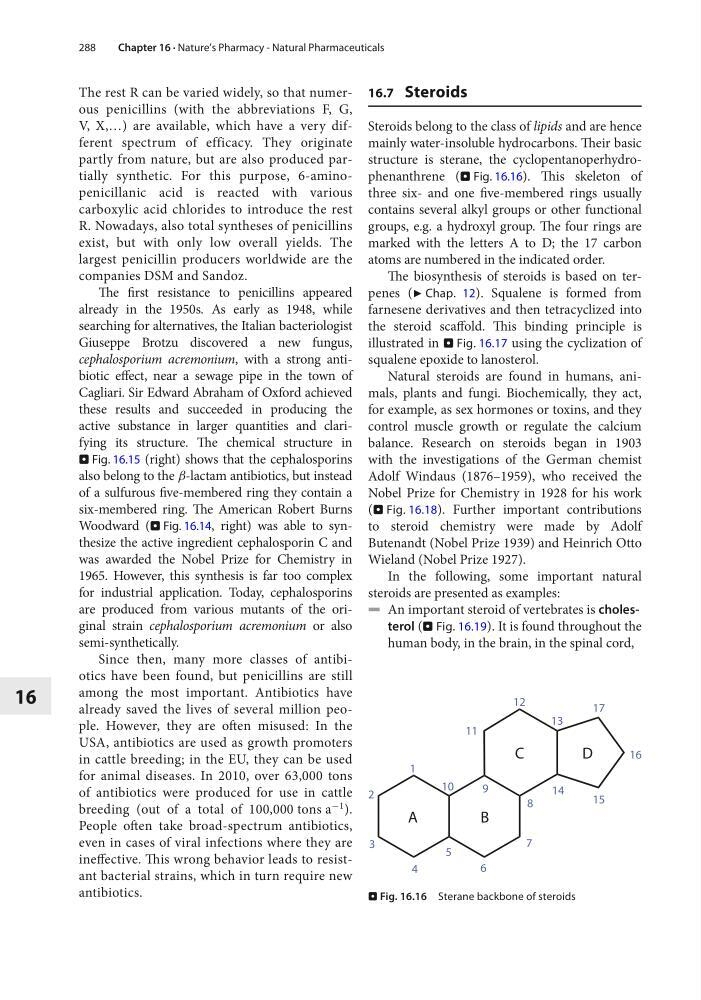
structure is sterane, the cyclopentanoperhydrophenanthrene (. Fig. 16.16). This skeleton of
three six- and one five-membered rings usually
contains several alkyl groups or other functional
groups, e.g. a hydroxyl group. The four rings are
marked with the letters A to D; the 17 carbon
atoms are numbered in the indicated order.
The biosynthesis of steroids is based on terpenes (7 Chap. 12). Squalene is formed from
farnesene derivatives and then tetracyclized into
the steroid scaffold. This binding principle is
illustrated in . Fig. 16.17 using the cyclization of
squalene epoxide to lanosterol.
Natural steroids are found in humans, animals, plants and fungi. Biochemically, they act,
for example, as sex hormones or toxins, and they
control muscle growth or regulate the calcium
balance. Research on steroids began in 1903
with the investigations of the German chemist
Adolf Windaus (1876–1959), who received the
Nobel Prize for Chemistry in 1928 for his work
(. Fig. 16.18). Further important contributions
to steroid chemistry were made by Adolf
Butenandt (Nobel Prize 1939) and Heinrich Otto
Wieland (Nobel Prize 1927).
In the following, some important natural
steroids are presented as examples:
5 An important steroid of vertebrates is cholesterol (. Fig. 16.19). It is found throughout the
human body, in the brain, in the spinal cord,
The rest R can be varied widely, so that numerous penicillins (with the abbreviations F, G,
V, X,…) are available, which have a very different spectrum of efficacy. They originate
partly from nature, but are also produced partially synthetic. For this purpose, 6-aminopenicillanic acid is reacted with various
carboxylic acid chlorides to introduce the rest
R. Nowadays, also total syntheses of penicillins
exist, but with only low overall yields. The
largest penicillin producers worldwide are the
companies DSM and Sandoz.
The first resistance to penicillins appeared
already in the 1950s. As early as 1948, while
searching for alternatives, the Italian bacteriologist
Giuseppe Brotzu discovered a new fungus,
cephalosporium acremonium, with a strong antibiotic effect, near a sewage pipe in the town of
Cagliari. Sir Edward Abraham of Oxford achieved
these results and succeeded in producing the
active substance in larger quantities and clarifying its structure. The chemical structure in
. Fig. 16.15 (right) shows that the cephalosporins
also belong to the β-lactam antibiotics, but instead
of a sulfurous five-membered ring they contain a
six-membered ring. The American Robert Burns
Woodward (. Fig. 16.14, right) was able to synthesize the active ingredient cephalosporin C and
was awarded the Nobel Prize for Chemistry in
1965. However, this synthesis is far too complex
for industrial application. Today, cephalosporins
are produced from various mutants of the original strain cephalosporium acremonium or also
semi-synthetically.
Since then, many more classes of antibiotics have been found, but penicillins are still
among the most important. Antibiotics have
already saved the lives of several million people. However, they are often misused: In the
USA, antibiotics are used as growth promoters
in cattle breeding; in the EU, they can be used
for animal diseases. In 2010, over 63,000 tons
of antibiotics were produced for use in cattle
breeding (out of a total of 100,000 tons a −1 ).
People often take broad-spectrum antibiotics,
even in cases of viral infections where they are
ineffective. This wrong behavior leads to resistant bacterial strains, which in turn require new
antibiotics.
. Fig. 16.16 Sterane backbone of steroids
1
2
3
4
5
6
7
8
9
10
11
12
13
14
15
16
17
A
B
C
D
Chapter 16 · Nature’s Pharmacy - Natural Pharmaceuticals
16
16.7 Steroids
Steroids belong to the class of lipids and are hence
mainly water-insoluble hydrocarbons. Their basic
structure is sterane, the cyclopentanoperhydrophenanthrene (. Fig. 16.16). This skeleton of
three six- and one five-membered rings usually
contains several alkyl groups or other functional
groups, e.g. a hydroxyl group. The four rings are
marked with the letters A to D; the 17 carbon
atoms are numbered in the indicated order.
The biosynthesis of steroids is based on terpenes (7 Chap. 12). Squalene is formed from
farnesene derivatives and then tetracyclized into
the steroid scaffold. This binding principle is
illustrated in . Fig. 16.17 using the cyclization of
squalene epoxide to lanosterol.
Natural steroids are found in humans, animals, plants and fungi. Biochemically, they act,
for example, as sex hormones or toxins, and they
control muscle growth or regulate the calcium
balance. Research on steroids began in 1903
with the investigations of the German chemist
Adolf Windaus (1876–1959), who received the
Nobel Prize for Chemistry in 1928 for his work
(. Fig. 16.18). Further important contributions
to steroid chemistry were made by Adolf
Butenandt (Nobel Prize 1939) and Heinrich Otto
Wieland (Nobel Prize 1927).
In the following, some important natural
steroids are presented as examples:
5 An important steroid of vertebrates is cholesterol (. Fig. 16.19). It is found throughout the
human body, in the brain, in the spinal cord,
The rest R can be varied widely, so that numerous penicillins (with the abbreviations F, G,
V, X,…) are available, which have a very different spectrum of efficacy. They originate
partly from nature, but are also produced partially synthetic. For this purpose, 6-aminopenicillanic acid is reacted with various
carboxylic acid chlorides to introduce the rest
R. Nowadays, also total syntheses of penicillins
exist, but with only low overall yields. The
largest penicillin producers worldwide are the
companies DSM and Sandoz.
The first resistance to penicillins appeared
already in the 1950s. As early as 1948, while
searching for alternatives, the Italian bacteriologist
Giuseppe Brotzu discovered a new fungus,
cephalosporium acremonium, with a strong antibiotic effect, near a sewage pipe in the town of
Cagliari. Sir Edward Abraham of Oxford achieved
these results and succeeded in producing the
active substance in larger quantities and clarifying its structure. The chemical structure in
. Fig. 16.15 (right) shows that the cephalosporins
also belong to the β-lactam antibiotics, but instead
of a sulfurous five-membered ring they contain a
six-membered ring. The American Robert Burns
Woodward (. Fig. 16.14, right) was able to synthesize the active ingredient cephalosporin C and
was awarded the Nobel Prize for Chemistry in
1965. However, this synthesis is far too complex
for industrial application. Today, cephalosporins
are produced from various mutants of the original strain cephalosporium acremonium or also
semi-synthetically.
Since then, many more classes of antibiotics have been found, but penicillins are still
among the most important. Antibiotics have
already saved the lives of several million people. However, they are often misused: In the
USA, antibiotics are used as growth promoters
in cattle breeding; in the EU, they can be used
for animal diseases. In 2010, over 63,000 tons
of antibiotics were produced for use in cattle
breeding (out of a total of 100,000 tons a −1 ).
People often take broad-spectrum antibiotics,
even in cases of viral infections where they are
ineffective. This wrong behavior leads to resistant bacterial strains, which in turn require new
antibiotics.
. Fig. 16.16 Sterane backbone of steroids
1
2
3
4
5
6
7
8
9
10
11
12
13
14
15
16
17
A
B
C
D