

272
Chapter 15 · Showing Your Colors Sustainably! - Natural Dyes
15
BOX: Indigo - Yesterday, Today and Tomorrow
In 1847, at the age of 16, the
Bavarian Löb Strauss emigrated
with his mother to New York
and from then on called himself
Levi Strauss. There he worked
in the textile trade, but moved
to San Francisco in 1853 when
the California gold rush began.
He soon realized that the gold
diggers needed particularly robust
work clothing for their work.
Finally, together with his business
partner, the tailor Jacob Davis,
he found the ideal solution: blue
jeans. The denim cotton fabric of
the jeans, dyed with indigo, was
reinforced at the corners of the
trouser pockets and at the flies
with rivets from horse harness.
In 1873, Strauss (. Fig. 15.9) and
Davis were granted a patent
on their invention. Jeans soon
became a hit and were not only
worn by gold diggers, but also
by craftsmen and farmers. Levi
Strauss and Company quickly
developed into one of the
largest producers of trousers,
and Levi’s jeans has long been
a classic in the fashion world.
Almost 150 years after being
patented, in March 2019, the
company went public on the New
York Stock Exchange. To honor
the newcomer, the “No Jeans”
regulation on the NYSE was
canceled so that stock exchange
traders could also wear a Levi’s on
the floor that day.
But indigo is now much more
than just the dye of jeans. The
chemical structure of indigo in
. Fig. 15.7 shows that indigo
belongs to the chromophores
with an extensive system of
conjugated double bonds. It
therefore has special electronic
properties and is currently being
investigated, for example, for
use in solar cells or organic
light-emitting diodes (OLED).
Researchers at the Vienna
University of Technology
(Austria) recently succeeded in
producing indigo and similar
organic dyes in the solvent
water under high pressure and
at 180 °C with particularly high
crystallinity, which significantly
improves their electronic
properties. At the University of
Linz (Austria), a semiconductor
was produced from indigo that
is stable to air and water. Due
to their good biocompatibility,
the indigo transistors can also
be used in the medical sector. As
implants in human tissue, they
will enable new applications in
bioelectronics in the near future.
Since indigo can be produced
relatively cheaply, this “blue
miracle” is suitable for future
mass applications.
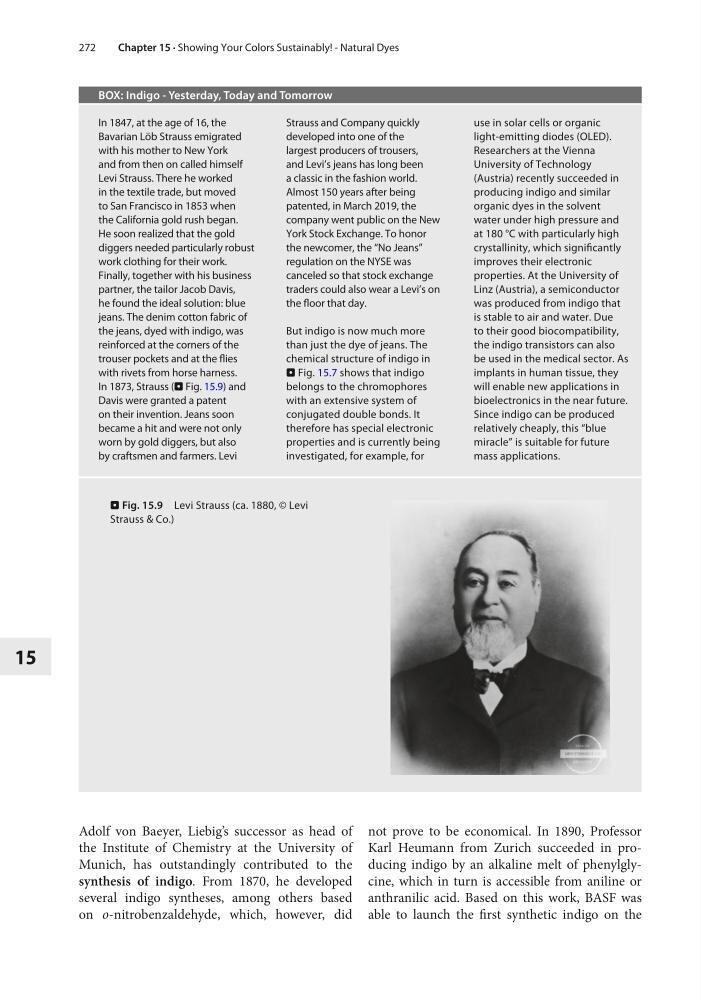
. Fig. 15.9 Levi Strauss (ca. 1880, © Levi
Strauss & Co.)
Adolf von Baeyer, Liebig’s successor as head of
the Institute of Chemistry at the University of
Munich, has outstandingly contributed to the
synthesis of indigo. From 1870, he developed
several indigo syntheses, among others based
on o-nitrobenzaldehyde, which, however, did
not prove to be economical. In 1890, Professor
Karl Heumann from Zurich succeeded in producing indigo by an alkaline melt of phenylglycine, which in turn is accessible from aniline or
anthranilic acid. Based on this work, BASF was
able to launch the first synthetic indigo on the
Chapter 15 · Showing Your Colors Sustainably! - Natural Dyes
15
BOX: Indigo - Yesterday, Today and Tomorrow
In 1847, at the age of 16, the
Bavarian Löb Strauss emigrated
with his mother to New York
and from then on called himself
Levi Strauss. There he worked
in the textile trade, but moved
to San Francisco in 1853 when
the California gold rush began.
He soon realized that the gold
diggers needed particularly robust
work clothing for their work.
Finally, together with his business
partner, the tailor Jacob Davis,
he found the ideal solution: blue
jeans. The denim cotton fabric of
the jeans, dyed with indigo, was
reinforced at the corners of the
trouser pockets and at the flies
with rivets from horse harness.
In 1873, Strauss (. Fig. 15.9) and
Davis were granted a patent
on their invention. Jeans soon
became a hit and were not only
worn by gold diggers, but also
by craftsmen and farmers. Levi
Strauss and Company quickly
developed into one of the
largest producers of trousers,
and Levi’s jeans has long been
a classic in the fashion world.
Almost 150 years after being
patented, in March 2019, the
company went public on the New
York Stock Exchange. To honor
the newcomer, the “No Jeans”
regulation on the NYSE was
canceled so that stock exchange
traders could also wear a Levi’s on
the floor that day.
But indigo is now much more
than just the dye of jeans. The
chemical structure of indigo in
. Fig. 15.7 shows that indigo
belongs to the chromophores
with an extensive system of
conjugated double bonds. It
therefore has special electronic
properties and is currently being
investigated, for example, for
use in solar cells or organic
light-emitting diodes (OLED).
Researchers at the Vienna
University of Technology
(Austria) recently succeeded in
producing indigo and similar
organic dyes in the solvent
water under high pressure and
at 180 °C with particularly high
crystallinity, which significantly
improves their electronic
properties. At the University of
Linz (Austria), a semiconductor
was produced from indigo that
is stable to air and water. Due
to their good biocompatibility,
the indigo transistors can also
be used in the medical sector. As
implants in human tissue, they
will enable new applications in
bioelectronics in the near future.
Since indigo can be produced
relatively cheaply, this “blue
miracle” is suitable for future
mass applications.
. Fig. 15.9 Levi Strauss (ca. 1880, © Levi
Strauss & Co.)
Adolf von Baeyer, Liebig’s successor as head of
the Institute of Chemistry at the University of
Munich, has outstandingly contributed to the
synthesis of indigo. From 1870, he developed
several indigo syntheses, among others based
on o-nitrobenzaldehyde, which, however, did
not prove to be economical. In 1890, Professor
Karl Heumann from Zurich succeeded in producing indigo by an alkaline melt of phenylglycine, which in turn is accessible from aniline or
anthranilic acid. Based on this work, BASF was
able to launch the first synthetic indigo on the