

262
Chapter 14 · Building Blocks of Life - Amino Acids
14
BOX: Can Milk Proteins Replace Plastic?
One liter of cow’s milk
contains up to 29 g of casein,
which can be precipitated
by acids or rennet enzymes.
The remaining liquid,
whey, contains a further
5 g of whey proteins with a
different composition. The
casein can be processed into
a film with special properties:
5 It can be used as a food
packaging film that
is 500 times better at
keeping oxygen out than
polyethylene.
5 The film is hydrophilic
and therefore ideal for
packaging fatty foods such
as sausages or cheese (see
. Fig. 14.10).
5 The film is biodegradable
and even edible: there will
be no waste.
5 The protein film can be
made water stable by adding
additives, e.g. vegetable
pectins from citrus fruits.
In hot water, however, it is
quickly soluble. This effect
can be used, for example,
to package soluble coffee
or instant soups: You simply
put the bag into boiling
water and immediately have
a cup of hot coffee or a plate
of soup available.
But you can also imagine other
applications of milk proteins: If
cornflakes are poured into milk,
they soften quickly and are no
longer crispy. To prevent this,
they are usually sprayed with a
layer of sugar, which obviously
contains a lot of calories. The
alternative is a spray of milk
proteins: The casein has the
same effect as the sugar and
the crunchy cornflakes are
significantly lower in calories.
Will we soon find these protein
products in our supermarkets?
The properties are currently
being further optimized, but we
can certainly expect these new
alternatives in the coming years.
In the future, they may help to at
least slightly reduce our plastic
waste mountains.
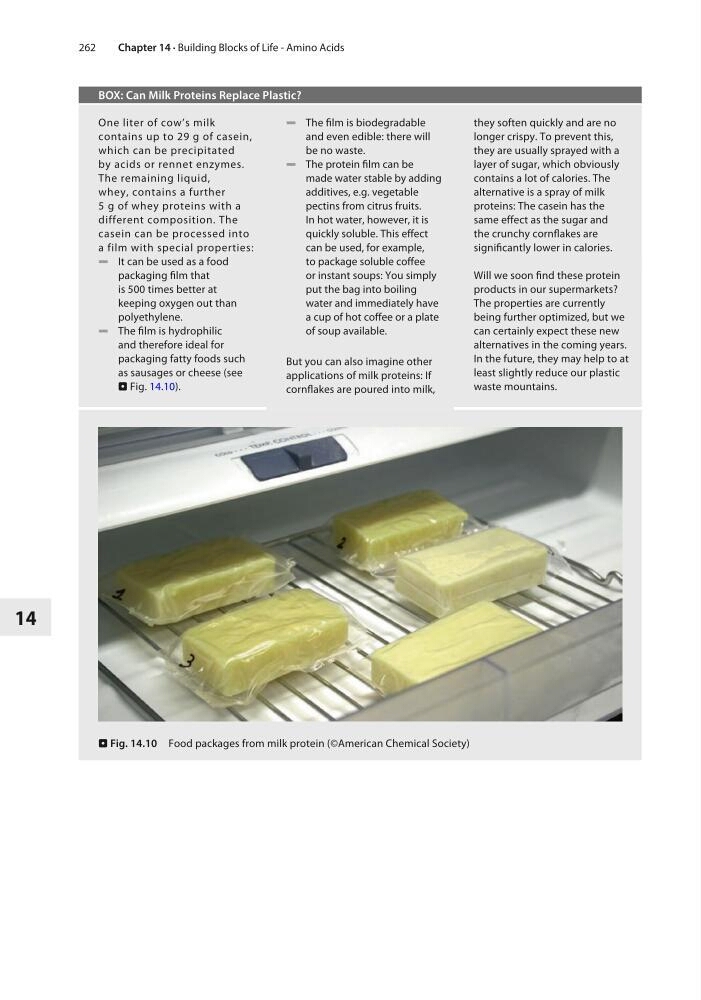
. Fig. 14.10 Food packages from milk protein (©American Chemical Society)
Chapter 14 · Building Blocks of Life - Amino Acids
14
BOX: Can Milk Proteins Replace Plastic?
One liter of cow’s milk
contains up to 29 g of casein,
which can be precipitated
by acids or rennet enzymes.
The remaining liquid,
whey, contains a further
5 g of whey proteins with a
different composition. The
casein can be processed into
a film with special properties:
5 It can be used as a food
packaging film that
is 500 times better at
keeping oxygen out than
polyethylene.
5 The film is hydrophilic
and therefore ideal for
packaging fatty foods such
as sausages or cheese (see
. Fig. 14.10).
5 The film is biodegradable
and even edible: there will
be no waste.
5 The protein film can be
made water stable by adding
additives, e.g. vegetable
pectins from citrus fruits.
In hot water, however, it is
quickly soluble. This effect
can be used, for example,
to package soluble coffee
or instant soups: You simply
put the bag into boiling
water and immediately have
a cup of hot coffee or a plate
of soup available.
But you can also imagine other
applications of milk proteins: If
cornflakes are poured into milk,
they soften quickly and are no
longer crispy. To prevent this,
they are usually sprayed with a
layer of sugar, which obviously
contains a lot of calories. The
alternative is a spray of milk
proteins: The casein has the
same effect as the sugar and
the crunchy cornflakes are
significantly lower in calories.
Will we soon find these protein
products in our supermarkets?
The properties are currently
being further optimized, but we
can certainly expect these new
alternatives in the coming years.
In the future, they may help to at
least slightly reduce our plastic
waste mountains.
. Fig. 14.10 Food packages from milk protein (©American Chemical Society)