

225
12
Bicyclic monoterpenes also form an extensive
group. In . Fig. 12.7, some examples of the most
important basic skeletons are presented:
5 Caranes and thujanes with a three- and a
six-membered ring (upper row),
5 Pinanes with a four- and a six-membered ring
(middle row),
5 Camphanes and fenchanes with a five- and a
six-membered ring (lower row).
The hydrocarbon 3-carene is a major component (30–40%) of turpentine oil. It is also found
in citrus trees, firs and junipers. It is contained
to approx. 35% in black pepper and has a pleasant sweet smell. Chamic acid, an example of a
occurs in caraway and dill oils and smells intensively of caraway, is listed as a representative of
ketones. The enantiomeric (−)-carvone occurs in
spearmint oils and has a mint-like aroma.
The easily accessible limonene is an important platform chemical for the production of
numerous derivatives (. Fig. 12.6):
5 The isomeric terpineoles are obtained by
hydration.
5 By isomerization, terpinols and isomeric
terpinenes are accessible.
5 Dehydrogenation and simultaneous aromatization lead to para-cymene.
5 Epoxidation produces limonene oxide, which
can be further rearranged to dihydrocarvone.
OH
OH
O
Nerol/Geraniol
Citronellol
Citronellal
O
Citral
O
O
OH
OH
Pseudoionone
-Ionone
Isopulegol
Menthol
Hydrogenation
C O
Hydrogenation
C C
C O
Hydrogenation
C C
Condenzation
with acetone
Cyclization
Cyclization
C C
Hydrogenation
Hydrogenation
β
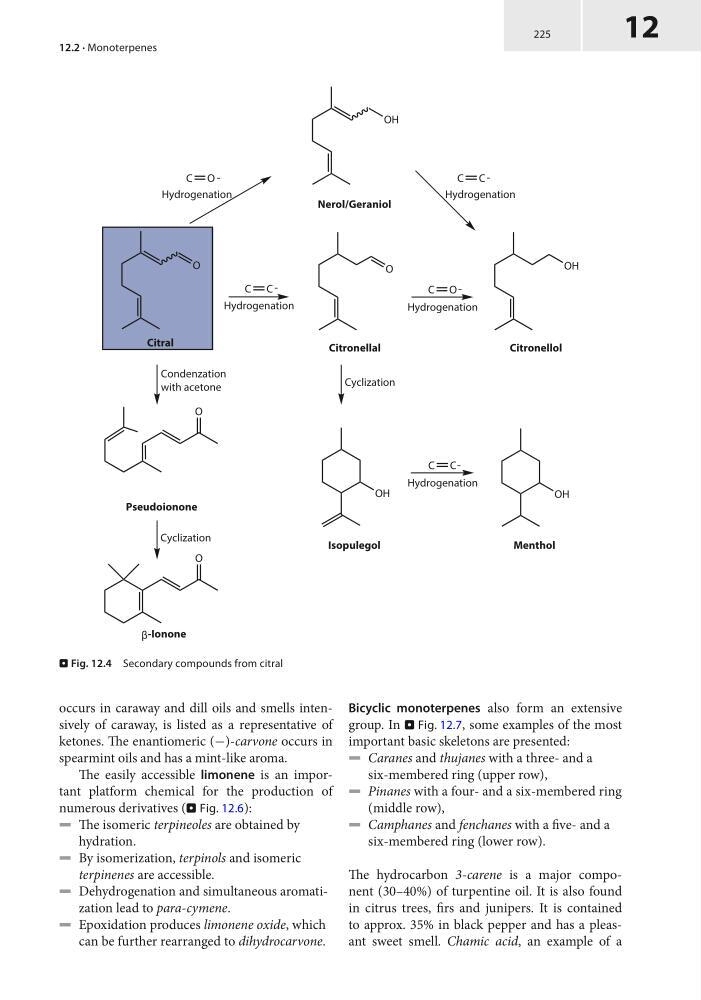
. Fig. 12.4 Secondary compounds from citral
12.2 · Monoterpenes
12
Bicyclic monoterpenes also form an extensive
group. In . Fig. 12.7, some examples of the most
important basic skeletons are presented:
5 Caranes and thujanes with a three- and a
six-membered ring (upper row),
5 Pinanes with a four- and a six-membered ring
(middle row),
5 Camphanes and fenchanes with a five- and a
six-membered ring (lower row).
The hydrocarbon 3-carene is a major component (30–40%) of turpentine oil. It is also found
in citrus trees, firs and junipers. It is contained
to approx. 35% in black pepper and has a pleasant sweet smell. Chamic acid, an example of a
occurs in caraway and dill oils and smells intensively of caraway, is listed as a representative of
ketones. The enantiomeric (−)-carvone occurs in
spearmint oils and has a mint-like aroma.
The easily accessible limonene is an important platform chemical for the production of
numerous derivatives (. Fig. 12.6):
5 The isomeric terpineoles are obtained by
hydration.
5 By isomerization, terpinols and isomeric
terpinenes are accessible.
5 Dehydrogenation and simultaneous aromatization lead to para-cymene.
5 Epoxidation produces limonene oxide, which
can be further rearranged to dihydrocarvone.
OH
OH
O
Nerol/Geraniol
Citronellol
Citronellal
O
Citral
O
O
OH
OH
Pseudoionone
-Ionone
Isopulegol
Menthol
Hydrogenation
C O
Hydrogenation
C C
C O
Hydrogenation
C C
Condenzation
with acetone
Cyclization
Cyclization
C C
Hydrogenation
Hydrogenation
β
. Fig. 12.4 Secondary compounds from citral
12.2 · Monoterpenes