

208
Chapter 11 · The “Wood-Stuff” - Lignin
11
yields similar to those of the Kraft process
(7 Chap. 7), but results in a product with
poorer mechanical properties.
5 The Alcell process uses an aqueous ethanol
solution with an ethanol content between
40 and 60% and runs at temperatures in
the range of 180–210 °C and pressures of
20–35 bar. In several stages, the wood is contacted with an increasingly cleaner solvent
in a cross-flow extraction manner. The pulp
obtained and bleached is comparable to that
of the Kraft process. One advantage is that
both the hemicelluloses and the lignin are
obtained in high yields (approx. 18% yield of
lignin in relation to the raw material input). It
can be precipitated from the waste liquor by
dilution with water and adjustment of the
pH value to approx. 3 at a temperature of
95 °C and is available in powder form after
drying. The solvent ethanol is recovered and
recycled using flash evaporators and steam
condensers.
The goal was a more environmentally friendly
pulp production by solubilizing the secondary
components lignin and hemicellulose in organic
solvents. The most commonly used aqueous
solutions are short-chain alcohols such as methanol and ethanol or short-chain carboxylic acids
such as formic acid and acetic acid. The various
processes developed are summarized under the
collective term Organosolv process. They differ
in principle in the number of stages and in the
solvents used. They have several advantages over
classical disintegration processes:
5 The recovery of organic solvents is easy
due to their low boiling point. This leads to
energy savings and less pollution of the waste
water.
5 An almost completely closed chemical cycle
can be guaranteed, which means that even
smaller plants with lower capacity are economical.
5 The odor caused by the use of sulfur compounds is eliminated. The aim is also to avoid
bleaching of the pulp.
5 By maintaining high-quality lignin as a
by-product, an additional value is achieved.
However, these processes are today insignificant
for the production of pulp. One reason, however,
is that not every type of wood can be processed
with the same efficiency. More important is the
fact that lignin is preserved in an almost native
form, thus opening up a new source for potential
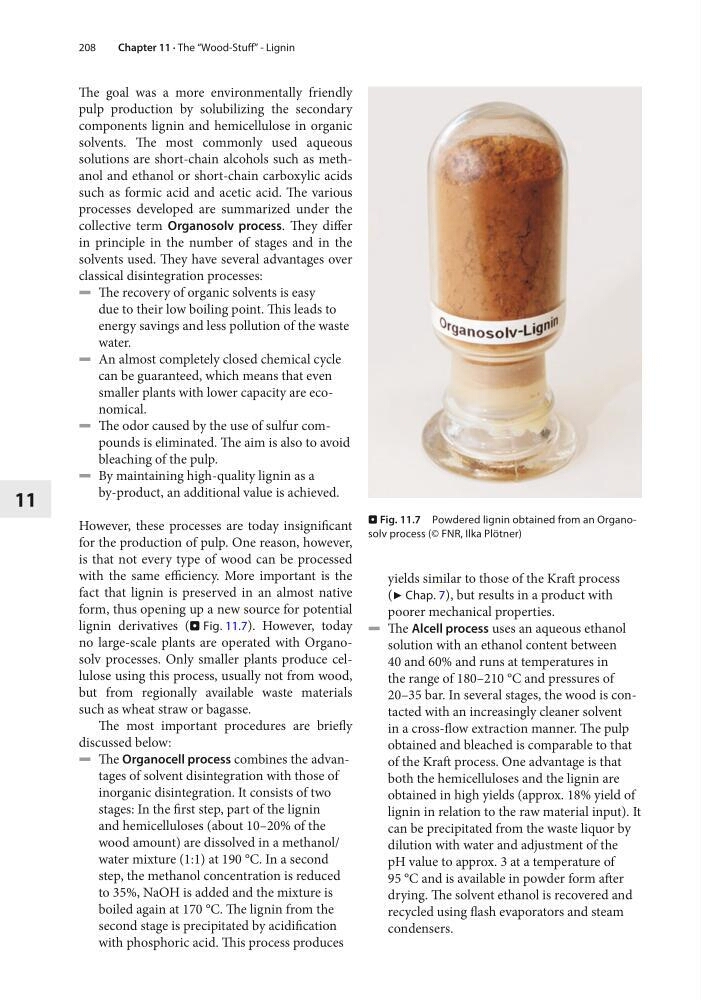
lignin derivatives (. Fig. 11.7). However, today
no large-scale plants are operated with Organosolv processes. Only smaller plants produce cellulose using this process, usually not from wood,
but from regionally available waste materials
such as wheat straw or bagasse.
The most important procedures are briefly
discussed below:
5 The Organocell process combines the advantages of solvent disintegration with those of
inorganic disintegration. It consists of two
stages: In the first step, part of the lignin
and hemicelluloses (about 10–20% of the
wood amount) are dissolved in a methanol/
water mixture (1:1) at 190 °C. In a second
step, the methanol concentration is reduced
to 35%, NaOH is added and the mixture is
boiled again at 170 °C. The lignin from the
second stage is precipitated by acidification
with phosphoric acid. This process produces
. Fig. 11.7 Powdered lignin obtained from an Organosolv process (© FNR, Ilka Plötner)
Chapter 11 · The “Wood-Stuff” - Lignin
11
yields similar to those of the Kraft process
(7 Chap. 7), but results in a product with
poorer mechanical properties.
5 The Alcell process uses an aqueous ethanol
solution with an ethanol content between
40 and 60% and runs at temperatures in
the range of 180–210 °C and pressures of
20–35 bar. In several stages, the wood is contacted with an increasingly cleaner solvent
in a cross-flow extraction manner. The pulp
obtained and bleached is comparable to that
of the Kraft process. One advantage is that
both the hemicelluloses and the lignin are
obtained in high yields (approx. 18% yield of
lignin in relation to the raw material input). It
can be precipitated from the waste liquor by
dilution with water and adjustment of the
pH value to approx. 3 at a temperature of
95 °C and is available in powder form after
drying. The solvent ethanol is recovered and
recycled using flash evaporators and steam
condensers.
The goal was a more environmentally friendly
pulp production by solubilizing the secondary
components lignin and hemicellulose in organic
solvents. The most commonly used aqueous
solutions are short-chain alcohols such as methanol and ethanol or short-chain carboxylic acids
such as formic acid and acetic acid. The various
processes developed are summarized under the
collective term Organosolv process. They differ
in principle in the number of stages and in the
solvents used. They have several advantages over
classical disintegration processes:
5 The recovery of organic solvents is easy
due to their low boiling point. This leads to
energy savings and less pollution of the waste
water.
5 An almost completely closed chemical cycle
can be guaranteed, which means that even
smaller plants with lower capacity are economical.
5 The odor caused by the use of sulfur compounds is eliminated. The aim is also to avoid
bleaching of the pulp.
5 By maintaining high-quality lignin as a
by-product, an additional value is achieved.
However, these processes are today insignificant
for the production of pulp. One reason, however,
is that not every type of wood can be processed
with the same efficiency. More important is the
fact that lignin is preserved in an almost native
form, thus opening up a new source for potential
lignin derivatives (. Fig. 11.7). However, today
no large-scale plants are operated with Organosolv processes. Only smaller plants produce cellulose using this process, usually not from wood,
but from regionally available waste materials
such as wheat straw or bagasse.
The most important procedures are briefly
discussed below:
5 The Organocell process combines the advantages of solvent disintegration with those of
inorganic disintegration. It consists of two
stages: In the first step, part of the lignin
and hemicelluloses (about 10–20% of the
wood amount) are dissolved in a methanol/
water mixture (1:1) at 190 °C. In a second
step, the methanol concentration is reduced
to 35%, NaOH is added and the mixture is
boiled again at 170 °C. The lignin from the
second stage is precipitated by acidification
with phosphoric acid. This process produces
. Fig. 11.7 Powdered lignin obtained from an Organosolv process (© FNR, Ilka Plötner)