

206
Chapter 11 · The “Wood-Stuff” - Lignin
11
11.2.3 Composition of Lignin
Different plants have different lignin compositions. Lignin can also be composed differently
in different parts of the same plant. The composition also changes with the age of the plant. As
a result, it is impossible to give an exact structure for the lignin of a particular plant. However, it is possible to indicate the frequency of
occurrence of both the different monolignols
and the linkage types, so that the lignin of a
particular plant can be characterized on the
basis of this data.
Coniferous wood has a high content of
coniferyl alcohol (about 90%). Hardwoods contain an increased proportion of sinapyl alcohol,
so that on average about 1.2–1.5 methoxy groups
per phenylpropane unit are found. Grasses, on
the other hand, have an increased content of
cumaryl alcohol in lignin with 15–35%. Also the
occurrence and the ratios of the different binding
patterns in lignin are often specific for the type of
wood. For example, spruce lignin has many ether
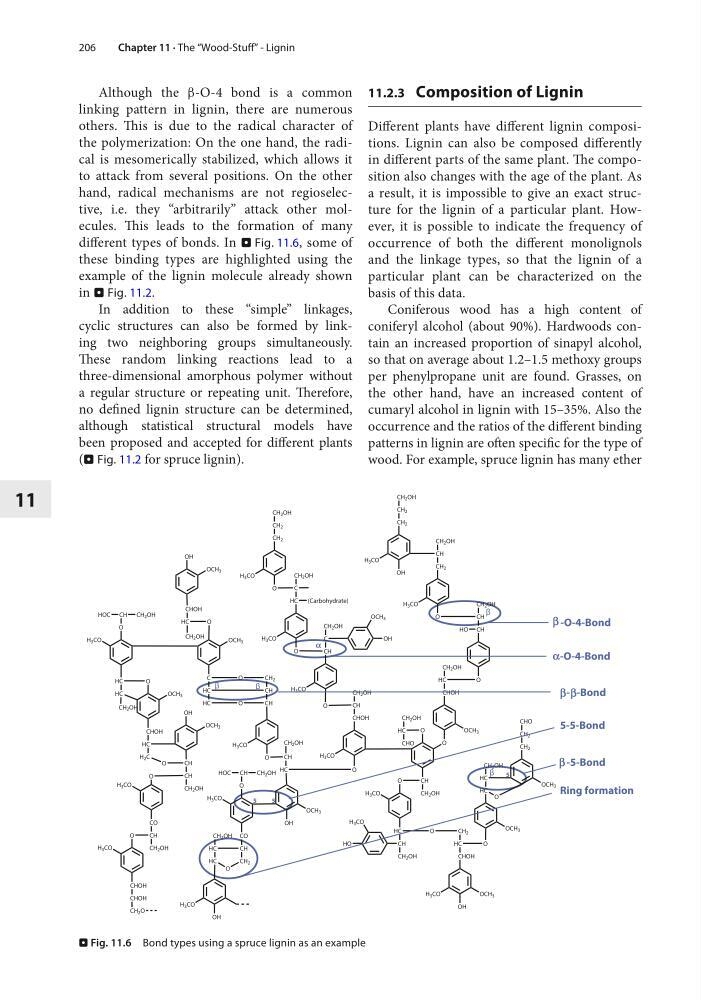
Although the β-O-4 bond is a common
linking pattern in lignin, there are numerous
others. This is due to the radical character of
the polymerization: On the one hand, the radical is mesomerically stabilized, which allows it
to attack from several positions. On the other
hand, radical mechanisms are not regioselective, i.e. they “arbitrarily” attack other molecules. This leads to the formation of many
different types of bonds. In . Fig. 11.6, some of
these binding types are highlighted using the
example of the lignin molecule already shown
in . Fig. 11.2.
In addition to these “simple” linkages,
cyclic structures can also be formed by linking two neighboring groups simultaneously.
These random linking reactions lead to a
three-dimensional amorphous polymer without
a regular structure or repeating unit. Therefore,
no defined lignin structure can be determined,
although statistical structural models have
been proposed and accepted for different plants
(. Fig. 11.2 for spruce lignin).
O
H3CO
HC
CH
HOC
CH2OH
HC
CH2OH
O
OCH3
CHOH
HC
H2C
O
CH
CH
O
CH2OH
H3CO
CO
CH
O
CH2OH
H3CO
CHOH
CHOH
CH2O
O
HC
CHOH
CH2OH
OH
OCH3
OCH3
OH
OCH3
C
HC
HC
O
O
CH2
CH
CH
H3CO
O
CH
CH2OH
HC
O
OH
OCH3
O
CH
HOC
CH2OH
H3CO
CO
CH
CH2
HC
CH2OH
HC
O
H3CO
OH
H3CO
CHOH
CH
CH2OH
O
H3CO
HC
O
C
CH2OH
H3CO
CH2
CH2
CH2OH
(Carbohydrate)
O
H3CO
CH
C
CH2OH
OCH3
OH
O
HC
CHO
CH2OH
CH
O
CH2OH
H3CO
HC
CH
CH2OH
HO
H3CO
O
CH2
HC
CHOH
OH
OCH3
O
OCH3
HC
HC
CH2OH
O
OCH3
CH2
CH2
CHO
O
OCH3
CHOH
HC
CH2OH
O
CH
HO
CH
CH2OH
O
H3CO
CH2
CH
CH2OH
OH
H3CO
CH2
CH2
CH2OH
-O-4-Bond
5
5
5
-O-4-Bond
- -Bond
5-5-Bond
-5-Bond
Ring formation
H3CO
. Fig. 11.6 Bond types using a spruce lignin as an example
Chapter 11 · The “Wood-Stuff” - Lignin
11
11.2.3 Composition of Lignin
Different plants have different lignin compositions. Lignin can also be composed differently
in different parts of the same plant. The composition also changes with the age of the plant. As
a result, it is impossible to give an exact structure for the lignin of a particular plant. However, it is possible to indicate the frequency of
occurrence of both the different monolignols
and the linkage types, so that the lignin of a
particular plant can be characterized on the
basis of this data.
Coniferous wood has a high content of
coniferyl alcohol (about 90%). Hardwoods contain an increased proportion of sinapyl alcohol,
so that on average about 1.2–1.5 methoxy groups
per phenylpropane unit are found. Grasses, on
the other hand, have an increased content of
cumaryl alcohol in lignin with 15–35%. Also the
occurrence and the ratios of the different binding
patterns in lignin are often specific for the type of
wood. For example, spruce lignin has many ether
Although the β-O-4 bond is a common
linking pattern in lignin, there are numerous
others. This is due to the radical character of
the polymerization: On the one hand, the radical is mesomerically stabilized, which allows it
to attack from several positions. On the other
hand, radical mechanisms are not regioselective, i.e. they “arbitrarily” attack other molecules. This leads to the formation of many
different types of bonds. In . Fig. 11.6, some of
these binding types are highlighted using the
example of the lignin molecule already shown
in . Fig. 11.2.
In addition to these “simple” linkages,
cyclic structures can also be formed by linking two neighboring groups simultaneously.
These random linking reactions lead to a
three-dimensional amorphous polymer without
a regular structure or repeating unit. Therefore,
no defined lignin structure can be determined,
although statistical structural models have
been proposed and accepted for different plants
(. Fig. 11.2 for spruce lignin).
O
H3CO
HC
CH
HOC
CH2OH
HC
CH2OH
O
OCH3
CHOH
HC
H2C
O
CH
CH
O
CH2OH
H3CO
CO
CH
O
CH2OH
H3CO
CHOH
CHOH
CH2O
O
HC
CHOH
CH2OH
OH
OCH3
OCH3
OH
OCH3
C
HC
HC
O
O
CH2
CH
CH
H3CO
O
CH
CH2OH
HC
O
OH
OCH3
O
CH
HOC
CH2OH
H3CO
CO
CH
CH2
HC
CH2OH
HC
O
H3CO
OH
H3CO
CHOH
CH
CH2OH
O
H3CO
HC
O
C
CH2OH
H3CO
CH2
CH2
CH2OH
(Carbohydrate)
O
H3CO
CH
C
CH2OH
OCH3
OH
O
HC
CHO
CH2OH
CH
O
CH2OH
H3CO
HC
CH
CH2OH
HO
H3CO
O
CH2
HC
CHOH
OH
OCH3
O
OCH3
HC
HC
CH2OH
O
OCH3
CH2
CH2
CHO
O
OCH3
CHOH
HC
CH2OH
O
CH
HO
CH
CH2OH
O
H3CO
CH2
CH
CH2OH
OH
H3CO
CH2
CH2
CH2OH
-O-4-Bond
5
5
5
-O-4-Bond
- -Bond
5-5-Bond
-5-Bond
Ring formation
H3CO
. Fig. 11.6 Bond types using a spruce lignin as an example