

184
Chapter 9 · Carbohydrates from the Sea - Chitin, Chitosan and Algae
9
The fat-binding properties of chitosan are
also used in food additives. Fat from food is
intended to be bound in the body by chitosan
and then excreted together with the indigestible
chitosan. The same should also apply to cholesterol, the intake of which should be reduced by
chitosan. New studies in the USA, on the other
hand, have shown that no effect can be proven
without a simultaneous diet.
In addition to the direct application of chitosan, there are also various derivatives of chitosan which utilize the reactivity of the amino
and hydroxyl groups. For example, the hydroxyl
groups can be esterified or etherified. Cationic or
other hydroxyl functions can be introduced by
substituting the amino group. Functionalizations
of several centers can also take place. The use
of these derivatives is mainly limited to special
areas of cosmetics. . Figure 9.9 gives an overview
of chitosan derivatives for the cosmetics industry.
9.4 Other Marine Polysaccharides
9.4.1 Alginic Acid and Alginates
Alginic acid is a natural polysaccharide made
from brown algae. Here, it is a component of the
cell walls and accounts for up to 40 w% in the
dry mass.
Structurally, alginic acid is composed of
two different monosaccharides, α-l guluronic acid and β-d manuronic acid, linked via
a 1,4-glycosidic bond (. Fig. 9.10). The exact
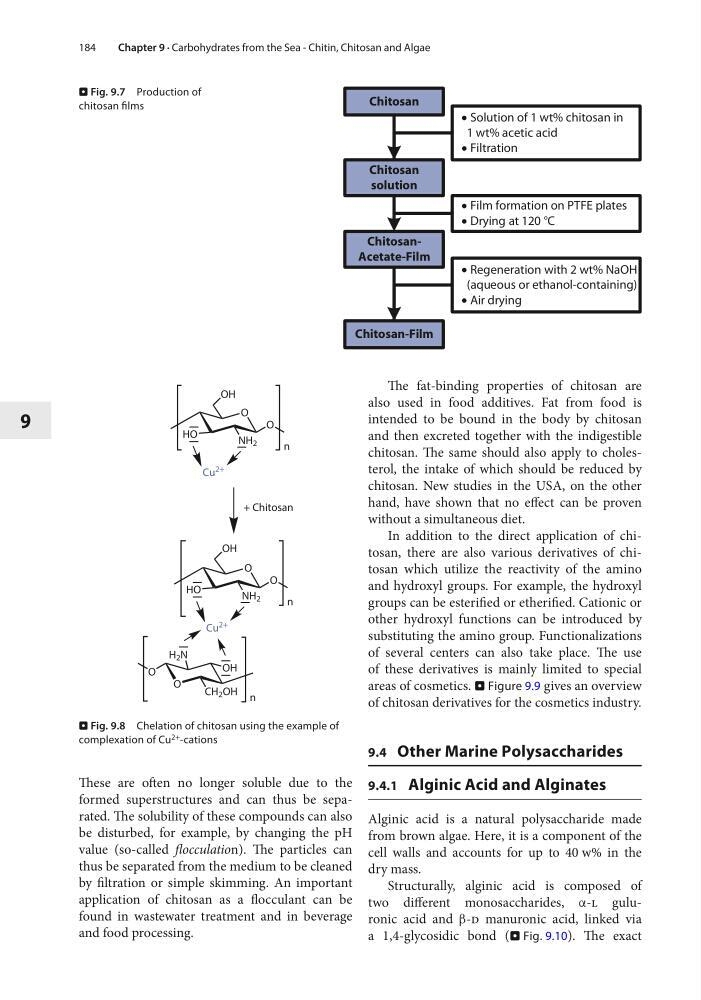
These are often no longer soluble due to the
formed superstructures and can thus be separated. The solubility of these compounds can also
be disturbed, for example, by changing the pH
value (so-called flocculation). The particles can
thus be separated from the medium to be cleaned
by filtration or simple skimming. An important
application of chitosan as a flocculant can be
found in wastewater treatment and in beverage
and food processing.
O
HO
NH 2
O
n
Cu 2+
O
HO
NH 2
O
n
Cu 2+
O
H 2 N
CH 2 OH n
O
OH
+ Chitosan
OH
OH
. Fig. 9.8 Chelation of chitosan using the example of
complexation of Cu 2+ -cations
. Fig. 9.7 Production of
chitosan films
Chitosan
Chitosan
solution
ChitosanAcetate-Film
Chitosan-Film
Solution of 1 wt% chitosan in
1 wt% acetic acid
Filtration
Film formation on PTFE plates
Drying at 120 °C
Regeneration with 2 wt% NaOH
(aqueous or ethanol-containing)
Air drying
Chapter 9 · Carbohydrates from the Sea - Chitin, Chitosan and Algae
9
The fat-binding properties of chitosan are
also used in food additives. Fat from food is
intended to be bound in the body by chitosan
and then excreted together with the indigestible
chitosan. The same should also apply to cholesterol, the intake of which should be reduced by
chitosan. New studies in the USA, on the other
hand, have shown that no effect can be proven
without a simultaneous diet.
In addition to the direct application of chitosan, there are also various derivatives of chitosan which utilize the reactivity of the amino
and hydroxyl groups. For example, the hydroxyl
groups can be esterified or etherified. Cationic or
other hydroxyl functions can be introduced by
substituting the amino group. Functionalizations
of several centers can also take place. The use
of these derivatives is mainly limited to special
areas of cosmetics. . Figure 9.9 gives an overview
of chitosan derivatives for the cosmetics industry.
9.4 Other Marine Polysaccharides
9.4.1 Alginic Acid and Alginates
Alginic acid is a natural polysaccharide made
from brown algae. Here, it is a component of the
cell walls and accounts for up to 40 w% in the
dry mass.
Structurally, alginic acid is composed of
two different monosaccharides, α-l guluronic acid and β-d manuronic acid, linked via
a 1,4-glycosidic bond (. Fig. 9.10). The exact
These are often no longer soluble due to the
formed superstructures and can thus be separated. The solubility of these compounds can also
be disturbed, for example, by changing the pH
value (so-called flocculation). The particles can
thus be separated from the medium to be cleaned
by filtration or simple skimming. An important
application of chitosan as a flocculant can be
found in wastewater treatment and in beverage
and food processing.
O
HO
NH 2
O
n
Cu 2+
O
HO
NH 2
O
n
Cu 2+
O
H 2 N
CH 2 OH n
O
OH
+ Chitosan
OH
OH
. Fig. 9.8 Chelation of chitosan using the example of
complexation of Cu 2+ -cations
. Fig. 9.7 Production of
chitosan films
Chitosan
Chitosan
solution
ChitosanAcetate-Film
Chitosan-Film
Solution of 1 wt% chitosan in
1 wt% acetic acid
Filtration
Film formation on PTFE plates
Drying at 120 °C
Regeneration with 2 wt% NaOH
(aqueous or ethanol-containing)
Air drying