

173
8
oxidation can take place at different sites leading
to different oxidation products.
If oxidation takes place under alkaline conditions (e.g. with hydrogen peroxide), oxidation
occurs at carbon atom C1, resulting in depolymerization and starch degradation, similar
to hydrolytic cleavage. This reduces the viscosity and increases the solubility of these partially
degraded starches (. Fig. 8.10, path A).
The exposed position of the primary OH
group at C6 of the glucose unit can be easily
oxidized with sodium hypochlorite (NaOCl).
Depending on the pH value, either the corresponding aldehyde or carboxylic acid is produced (. Fig. 8.10, path B).
negatively charged substrates such as cellulose,
which is why they are widely used in the paper
and textile industries.
Similar to starch esters, starch ethers can
also be modified several times, allowing their
properties to be adjusted almost arbitrarily. The
cross-linking of neighboring starch molecules
with suitable bifunctional substrates such as
phosphorus oxychloride (POCl 3 ) or epichlorohydrin is particularly noteworthy.
Oxidized Starch Products
The properties of starch can be modified very
specifically by oxidation with a wide variety
of oxidizing agents. Within the glucose unit,
Starch
OH
Alkaline activation:
+ OH
+ H 2 O
Starch
O
Modification with epoxides, e.g. with ethylene oxide:
Starch
O
+
O
Starch
O
O
Starch
O
O
+ H 2 O
Starch
O
OH
+ OH
Hydroxyethyl starch
Modification with lactones, e.g. with glycolic acid lactone:
Starch
O
+
O
O
Starch
O
Carboxymethyl starch
Modification with alkyl chlorides, e.g. with diethylaminoethyl chloride:
Starch
O
+
N
Cl
Starch
O
N
aq.
H
Diethylammonium ethyl starch
O
O
[H ]
Cl
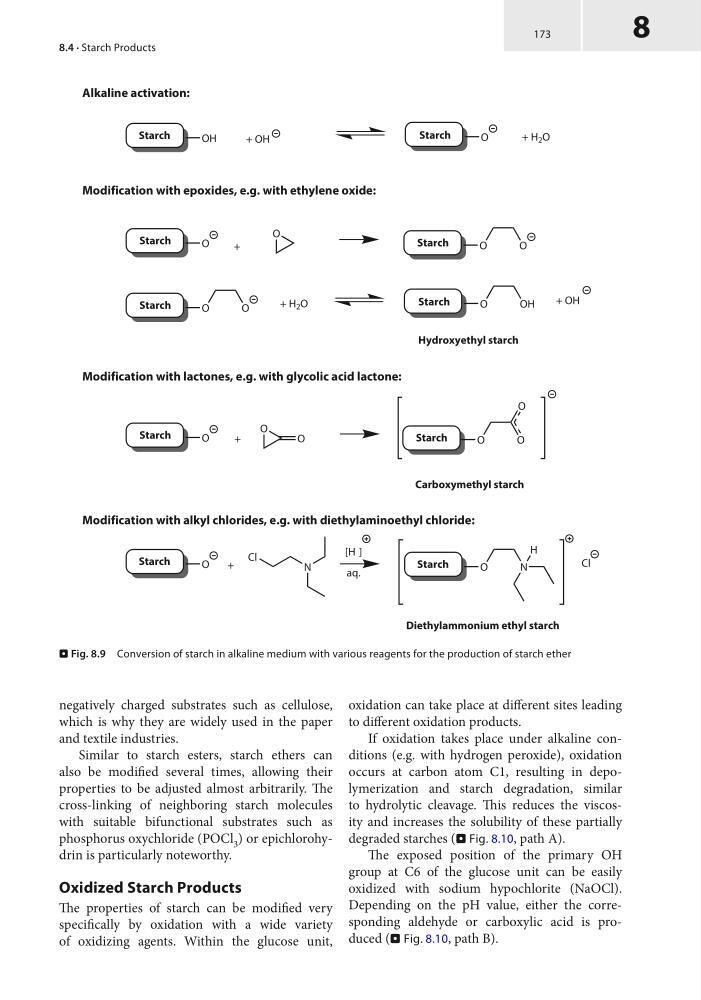
. Fig. 8.9 Conversion of starch in alkaline medium with various reagents for the production of starch ether
8.4 · Starch Products
8
oxidation can take place at different sites leading
to different oxidation products.
If oxidation takes place under alkaline conditions (e.g. with hydrogen peroxide), oxidation
occurs at carbon atom C1, resulting in depolymerization and starch degradation, similar
to hydrolytic cleavage. This reduces the viscosity and increases the solubility of these partially
degraded starches (. Fig. 8.10, path A).
The exposed position of the primary OH
group at C6 of the glucose unit can be easily
oxidized with sodium hypochlorite (NaOCl).
Depending on the pH value, either the corresponding aldehyde or carboxylic acid is produced (. Fig. 8.10, path B).
negatively charged substrates such as cellulose,
which is why they are widely used in the paper
and textile industries.
Similar to starch esters, starch ethers can
also be modified several times, allowing their
properties to be adjusted almost arbitrarily. The
cross-linking of neighboring starch molecules
with suitable bifunctional substrates such as
phosphorus oxychloride (POCl 3 ) or epichlorohydrin is particularly noteworthy.
Oxidized Starch Products
The properties of starch can be modified very
specifically by oxidation with a wide variety
of oxidizing agents. Within the glucose unit,
Starch
OH
Alkaline activation:
+ OH
+ H 2 O
Starch
O
Modification with epoxides, e.g. with ethylene oxide:
Starch
O
+
O
Starch
O
O
Starch
O
O
+ H 2 O
Starch
O
OH
+ OH
Hydroxyethyl starch
Modification with lactones, e.g. with glycolic acid lactone:
Starch
O
+
O
O
Starch
O
Carboxymethyl starch
Modification with alkyl chlorides, e.g. with diethylaminoethyl chloride:
Starch
O
+
N
Cl
Starch
O
N
aq.
H
Diethylammonium ethyl starch
O
O
[H ]
Cl
. Fig. 8.9 Conversion of starch in alkaline medium with various reagents for the production of starch ether
8.4 · Starch Products