

171
8
during recooling) due to the clarity of their solutions and their increased viscosity. The DS in
food additives is strictly regulated depending on
the country of approval, whereby uniform guidelines apply for the EU.
In order to produce distarch phosphoric acid
esters, the starch is reacted with bifunctional
phosphorus compounds. At a single phosphate
group, two starch residues are linked to each
other via an ester bond, so that cross-linking is
achieved. This can take place either intramolecularly (two glucose monomers of the same
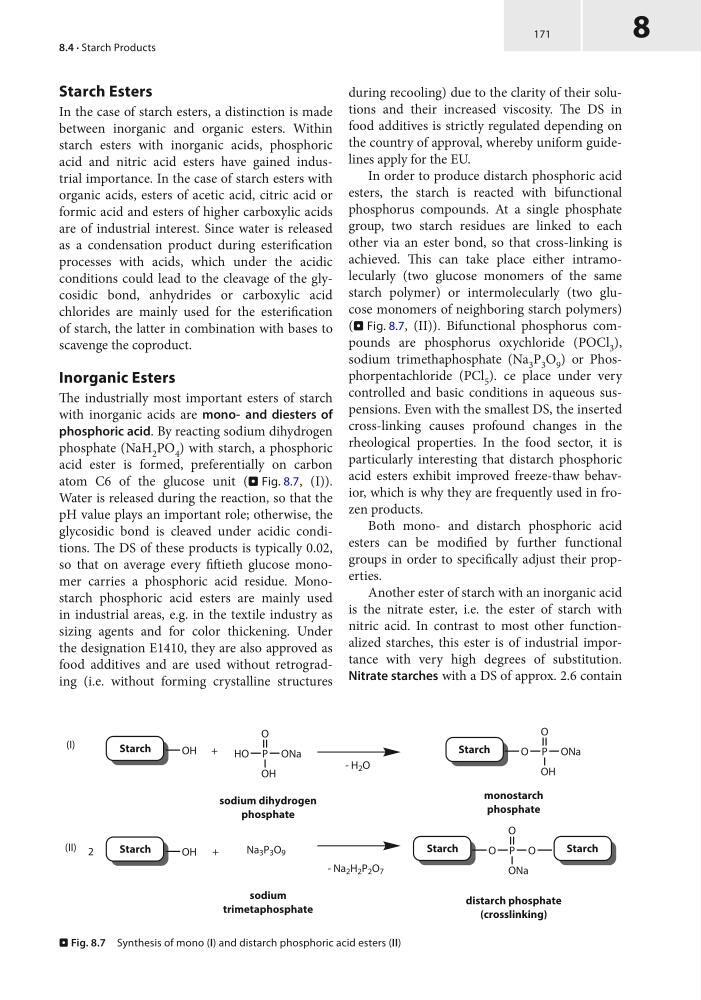
starch polymer) or intermolecularly (two glucose monomers of neighboring starch polymers)
(. Fig. 8.7, (II)). Bifunctional phosphorus compounds are phosphorus oxychloride (POCl 3 ),
sodium trimethaphosphate (Na 3 P 3 O 9 ) or Phosphorpentachloride (PCl 5 ). ce place under very
controlled and basic conditions in aqueous suspensions. Even with the smallest DS, the inserted
cross-linking causes profound changes in the
rheological properties. In the food sector, it is
particularly interesting that distarch phosphoric
acid esters exhibit improved freeze-thaw behavior, which is why they are frequently used in frozen products.
Both mono- and distarch phosphoric acid
esters can be modified by further functional
groups in order to specifically adjust their properties.
Another ester of starch with an inorganic acid
is the nitrate ester, i.e. the ester of starch with
nitric acid. In contrast to most other functionalized starches, this ester is of industrial importance with very high degrees of substitution.
Nitrate starches with a DS of approx. 2.6 contain
Starch Esters
In the case of starch esters, a distinction is made
between inorganic and organic esters. Within
starch esters with inorganic acids, phosphoric
acid and nitric acid esters have gained industrial importance. In the case of starch esters with
organic acids, esters of acetic acid, citric acid or
formic acid and esters of higher carboxylic acids
are of industrial interest. Since water is released
as a condensation product during esterification
processes with acids, which under the acidic
conditions could lead to the cleavage of the glycosidic bond, anhydrides or carboxylic acid
chlorides are mainly used for the esterification
of starch, the latter in combination with bases to
scavenge the coproduct.
Inorganic Esters
The industrially most important esters of starch
with inorganic acids are mono- and diesters of
phosphoric acid. By reacting sodium dihydrogen
phosphate (NaH 2 PO 4 ) with starch, a phosphoric
acid ester is formed, preferentially on carbon
atom C6 of the glucose unit (. Fig. 8.7, (I)).
Water is released during the reaction, so that the
pH value plays an important role; otherwise, the
glycosidic bond is cleaved under acidic conditions. The DS of these products is typically 0.02,
so that on average every fiftieth glucose monomer carries a phosphoric acid residue. Monostarch phosphoric acid esters are mainly used
in industrial areas, e.g. in the textile industry as
sizing agents and for color thickening. Under
the designation E1410, they are also approved as
food additives and are used without retrograding (i.e. without forming crystalline structures
Starch
OH +
P
O
ONa
OH
O
Starch
P
HO
ONa
OH
O
(I)
(II)
Starch
OH
2
+
Na 3 P 3 O 9
P
O
O
ONa
O
Starch
Starch
sodium dihydrogen
phosphate
sodium
trimetaphosphate
monostarch
phosphate
distarch phosphate
(crosslinking)
- H 2 O
- Na 2 H 2 P 2 O 7
. Fig. 8.7 Synthesis of mono (I) and distarch phosphoric acid esters (II)
8.4 · Starch Products
8
during recooling) due to the clarity of their solutions and their increased viscosity. The DS in
food additives is strictly regulated depending on
the country of approval, whereby uniform guidelines apply for the EU.
In order to produce distarch phosphoric acid
esters, the starch is reacted with bifunctional
phosphorus compounds. At a single phosphate
group, two starch residues are linked to each
other via an ester bond, so that cross-linking is
achieved. This can take place either intramolecularly (two glucose monomers of the same
starch polymer) or intermolecularly (two glucose monomers of neighboring starch polymers)
(. Fig. 8.7, (II)). Bifunctional phosphorus compounds are phosphorus oxychloride (POCl 3 ),
sodium trimethaphosphate (Na 3 P 3 O 9 ) or Phosphorpentachloride (PCl 5 ). ce place under very
controlled and basic conditions in aqueous suspensions. Even with the smallest DS, the inserted
cross-linking causes profound changes in the
rheological properties. In the food sector, it is
particularly interesting that distarch phosphoric
acid esters exhibit improved freeze-thaw behavior, which is why they are frequently used in frozen products.
Both mono- and distarch phosphoric acid
esters can be modified by further functional
groups in order to specifically adjust their properties.
Another ester of starch with an inorganic acid
is the nitrate ester, i.e. the ester of starch with
nitric acid. In contrast to most other functionalized starches, this ester is of industrial importance with very high degrees of substitution.
Nitrate starches with a DS of approx. 2.6 contain
Starch Esters
In the case of starch esters, a distinction is made
between inorganic and organic esters. Within
starch esters with inorganic acids, phosphoric
acid and nitric acid esters have gained industrial importance. In the case of starch esters with
organic acids, esters of acetic acid, citric acid or
formic acid and esters of higher carboxylic acids
are of industrial interest. Since water is released
as a condensation product during esterification
processes with acids, which under the acidic
conditions could lead to the cleavage of the glycosidic bond, anhydrides or carboxylic acid
chlorides are mainly used for the esterification
of starch, the latter in combination with bases to
scavenge the coproduct.
Inorganic Esters
The industrially most important esters of starch
with inorganic acids are mono- and diesters of
phosphoric acid. By reacting sodium dihydrogen
phosphate (NaH 2 PO 4 ) with starch, a phosphoric
acid ester is formed, preferentially on carbon
atom C6 of the glucose unit (. Fig. 8.7, (I)).
Water is released during the reaction, so that the
pH value plays an important role; otherwise, the
glycosidic bond is cleaved under acidic conditions. The DS of these products is typically 0.02,
so that on average every fiftieth glucose monomer carries a phosphoric acid residue. Monostarch phosphoric acid esters are mainly used
in industrial areas, e.g. in the textile industry as
sizing agents and for color thickening. Under
the designation E1410, they are also approved as
food additives and are used without retrograding (i.e. without forming crystalline structures
Starch
OH +
P
O
ONa
OH
O
Starch
P
HO
ONa
OH
O
(I)
(II)
Starch
OH
2
+
Na 3 P 3 O 9
P
O
O
ONa
O
Starch
Starch
sodium dihydrogen
phosphate
sodium
trimetaphosphate
monostarch
phosphate
distarch phosphate
(crosslinking)
- H 2 O
- Na 2 H 2 P 2 O 7
. Fig. 8.7 Synthesis of mono (I) and distarch phosphoric acid esters (II)
8.4 · Starch Products