

166
Chapter 8 · Products with a Little Twist - Starch
8
terms, corn is even more important: in 2017,
74% of the total annual production of 85 Mio.
tons of starch was produced from corn.
8.3 Use of Starch
Before discussing the use of starch, one fundamental aspect of starch as a renewable raw material should first be discussed: The distinction
between its use as food, the material use of starch
and its use in the chemical industry.
Starch is a reserve carbohydrate and is used by
plants to store energy and make it available again.
Due to the high physiological energy content of
starch-storing plants, they have always served as
food for humans and animals. The direct use of
potatoes, cereals, corn or manioc for the preparation of food represents the largest consumption
of starch and exceeds all other applications many
times. When starch is used as food, it is not
isolated from the corresponding raw materials.
If starch is obtained directly from the vegetable raw materials as such, it is called native
starch. This is only of minor importance for
industrial applications. However, it is found in
the food industry. Native starch is usually used to
thicken sauces in the household (e.g. native corn
starch marketed under various trade names).
However, this unmodified starch has unfavorable properties for industrial applications; it tends
to particle formation and gelation, for example,
and has little stability. Pastes of native starch also
have an unfavorably high viscosity.
the raw material is crushed to destroy the plant
cells and release the starch (grains). In the case
of corn, the grains are first soaked in an aqueous
solution for 30–40 h before being ground wet.
Wheat is ground directly and used as flour followed by diluting with water to produce a starch
suspension from which oils and fibers are separated by various separation processes. Since both
corn and wheat and other cereals still contain relatively large amounts of proteins (so-called gluten), this is agglomerated by mechanical agitation
on the suspension and can thus be separated with
hydrocyclones or centrifuges. For potatoes and
manioc, the tubers are first grated very small and
a starch paste is produced. Fibers also need to be
removed, for example, by filtration; however, the
removal of proteins plays a much smaller role.
Irrespective of the origin of these starch suspensions, several steps of concentration, purification and subsequent drying of the starch follow.
The starch thus obtained can then be marketed
in various forms, e.g. as powder, slurry or “lump
starch”. It is referred to as native starch.
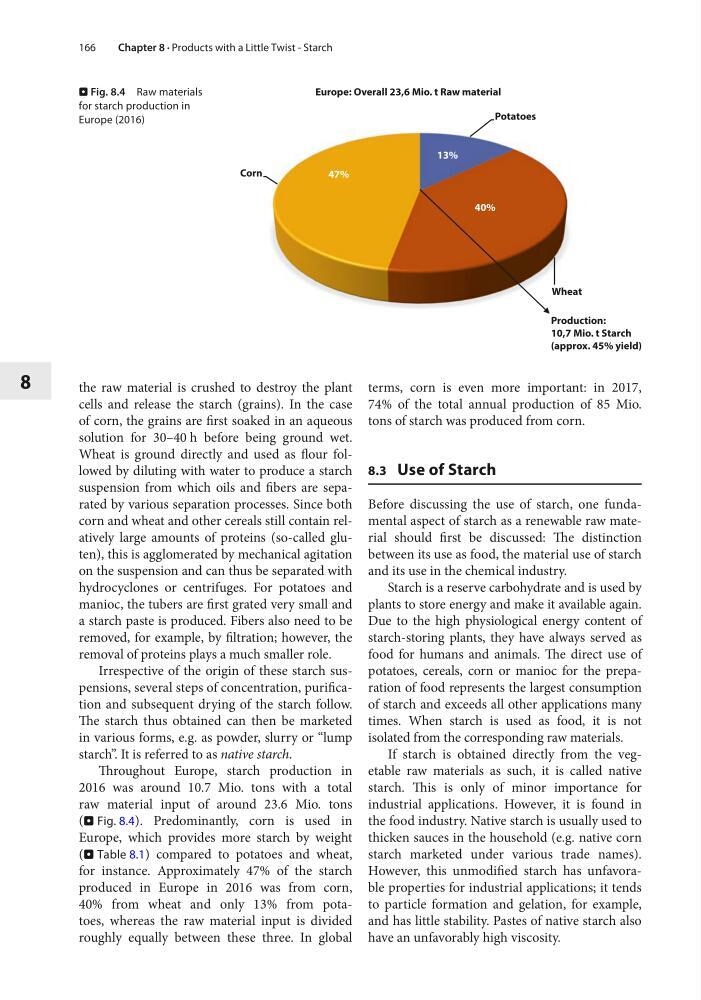
Throughout Europe, starch production in
2016 was around 10.7 Mio. tons with a total
raw material input of around 23.6 Mio. tons
(. Fig. 8.4). Predominantly, corn is used in
Europe, which provides more starch by weight
(. Table 8.1) compared to potatoes and wheat,
for instance. Approximately 47% of the starch
produced in Europe in 2016 was from corn,
40% from wheat and only 13% from potatoes, whereas the raw material input is divided
roughly equally between these three. In global
. Fig. 8.4 Raw materials
for starch production in
Europe (2016)
Potatoes
Wheat
Corn
40%
47%
Europe: Overall 23,6 Mio. t Raw material
Production:
10,7 Mio. t Starch
(approx. 45% yield)
13%
Chapter 8 · Products with a Little Twist - Starch
8
terms, corn is even more important: in 2017,
74% of the total annual production of 85 Mio.
tons of starch was produced from corn.
8.3 Use of Starch
Before discussing the use of starch, one fundamental aspect of starch as a renewable raw material should first be discussed: The distinction
between its use as food, the material use of starch
and its use in the chemical industry.
Starch is a reserve carbohydrate and is used by
plants to store energy and make it available again.
Due to the high physiological energy content of
starch-storing plants, they have always served as
food for humans and animals. The direct use of
potatoes, cereals, corn or manioc for the preparation of food represents the largest consumption
of starch and exceeds all other applications many
times. When starch is used as food, it is not
isolated from the corresponding raw materials.
If starch is obtained directly from the vegetable raw materials as such, it is called native
starch. This is only of minor importance for
industrial applications. However, it is found in
the food industry. Native starch is usually used to
thicken sauces in the household (e.g. native corn
starch marketed under various trade names).
However, this unmodified starch has unfavorable properties for industrial applications; it tends
to particle formation and gelation, for example,
and has little stability. Pastes of native starch also
have an unfavorably high viscosity.
the raw material is crushed to destroy the plant
cells and release the starch (grains). In the case
of corn, the grains are first soaked in an aqueous
solution for 30–40 h before being ground wet.
Wheat is ground directly and used as flour followed by diluting with water to produce a starch
suspension from which oils and fibers are separated by various separation processes. Since both
corn and wheat and other cereals still contain relatively large amounts of proteins (so-called gluten), this is agglomerated by mechanical agitation
on the suspension and can thus be separated with
hydrocyclones or centrifuges. For potatoes and
manioc, the tubers are first grated very small and
a starch paste is produced. Fibers also need to be
removed, for example, by filtration; however, the
removal of proteins plays a much smaller role.
Irrespective of the origin of these starch suspensions, several steps of concentration, purification and subsequent drying of the starch follow.
The starch thus obtained can then be marketed
in various forms, e.g. as powder, slurry or “lump
starch”. It is referred to as native starch.
Throughout Europe, starch production in
2016 was around 10.7 Mio. tons with a total
raw material input of around 23.6 Mio. tons
(. Fig. 8.4). Predominantly, corn is used in
Europe, which provides more starch by weight
(. Table 8.1) compared to potatoes and wheat,
for instance. Approximately 47% of the starch
produced in Europe in 2016 was from corn,
40% from wheat and only 13% from potatoes, whereas the raw material input is divided
roughly equally between these three. In global
. Fig. 8.4 Raw materials
for starch production in
Europe (2016)
Potatoes
Wheat
Corn
40%
47%
Europe: Overall 23,6 Mio. t Raw material
Production:
10,7 Mio. t Starch
(approx. 45% yield)
13%