

121
6
can be conducted with hydrogen, e.g. on
heterogeneous nickel, platinum or cobalt
catalysts.
5 Oxidation produces 2,5-furandicarboxylic
acid (FDCA). Oxidation of HMF to FDCA
is preferably carried out with oxygen in the
presence of platinum supported catalysts.
FDCA is also bifunctional and is discussed
for the large-scale production of polyesters and polyamides. FDCA could be used
instead of terephthalic acid or adipic acid.
At present, however, the prices for HMF are
still too high. Some authors describe FDCA
as a “sleeping giant” that could soon wake up
(with falling HMF prices)!
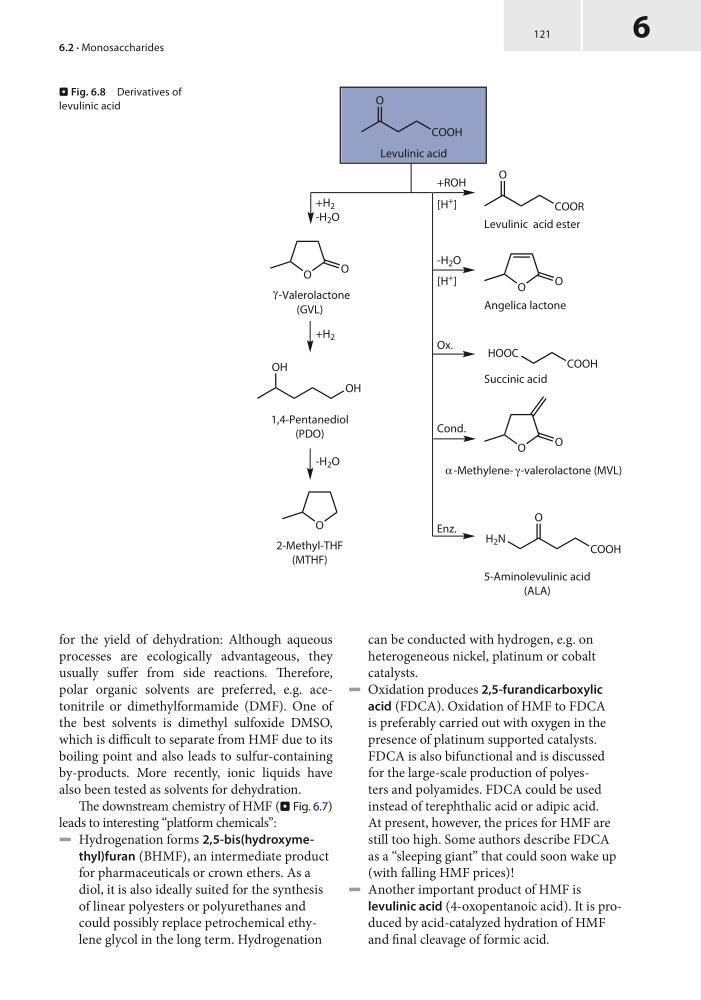
5 Another important product of HMF is
levulinic acid (4-oxopentanoic acid). It is produced by acid-catalyzed hydration of HMF
and final cleavage of formic acid.
for the yield of dehydration: Although aqueous
processes are ecologically advantageous, they
usually suffer from side reactions. Therefore,
polar organic solvents are preferred, e.g. acetonitrile or dimethylformamide (DMF). One of
the best solvents is dimethyl sulfoxide DMSO,
which is difficult to separate from HMF due to its
boiling point and also leads to sulfur-containing
by-products. More recently, ionic liquids have
also been tested as solvents for dehydration.
The downstream chemistry of HMF (. Fig. 6.7)
leads to interesting “platform chemicals”:
5 Hydrogenation forms 2,5-bis(hydroxymethyl)furan (BHMF), an intermediate product
for pharmaceuticals or crown ethers. As a
diol, it is also ideally suited for the synthesis
of linear polyesters or polyurethanes and
could possibly replace petrochemical ethylene glycol in the long term. Hydrogenation
6.2 · Monosaccharides
. Fig. 6.8 Derivatives of
levulinic acid
COOH
O
Levulinic acid
+H 2
-H 2 O
O
O
-Valerolactone
(GVL)
+H 2
OH
OH
1,4-Pentanediol
(PDO)
-H 2 O
O
2-Methyl-THF
(MTHF)
COOR
O
+ROH
[H
+
]
Levulinic acid ester
O
O
-H 2 O
[H + ]
Angelica lactone
HOOC
COOH
Succinic acid
Ox.
Cond.
O
O
-Methylene- -valerolactone (MVL)
COOH
O
H 2 N
5-Aminolevulinic acid
(ALA)
Enz.
γ
γ
α
6
can be conducted with hydrogen, e.g. on
heterogeneous nickel, platinum or cobalt
catalysts.
5 Oxidation produces 2,5-furandicarboxylic
acid (FDCA). Oxidation of HMF to FDCA
is preferably carried out with oxygen in the
presence of platinum supported catalysts.
FDCA is also bifunctional and is discussed
for the large-scale production of polyesters and polyamides. FDCA could be used
instead of terephthalic acid or adipic acid.
At present, however, the prices for HMF are
still too high. Some authors describe FDCA
as a “sleeping giant” that could soon wake up
(with falling HMF prices)!
5 Another important product of HMF is
levulinic acid (4-oxopentanoic acid). It is produced by acid-catalyzed hydration of HMF
and final cleavage of formic acid.
for the yield of dehydration: Although aqueous
processes are ecologically advantageous, they
usually suffer from side reactions. Therefore,
polar organic solvents are preferred, e.g. acetonitrile or dimethylformamide (DMF). One of
the best solvents is dimethyl sulfoxide DMSO,
which is difficult to separate from HMF due to its
boiling point and also leads to sulfur-containing
by-products. More recently, ionic liquids have
also been tested as solvents for dehydration.
The downstream chemistry of HMF (. Fig. 6.7)
leads to interesting “platform chemicals”:
5 Hydrogenation forms 2,5-bis(hydroxymethyl)furan (BHMF), an intermediate product
for pharmaceuticals or crown ethers. As a
diol, it is also ideally suited for the synthesis
of linear polyesters or polyurethanes and
could possibly replace petrochemical ethylene glycol in the long term. Hydrogenation
6.2 · Monosaccharides
. Fig. 6.8 Derivatives of
levulinic acid
COOH
O
Levulinic acid
+H 2
-H 2 O
O
O
-Valerolactone
(GVL)
+H 2
OH
OH
1,4-Pentanediol
(PDO)
-H 2 O
O
2-Methyl-THF
(MTHF)
COOR
O
+ROH
[H
+
]
Levulinic acid ester
O
O
-H 2 O
[H + ]
Angelica lactone
HOOC
COOH
Succinic acid
Ox.
Cond.
O
O
-Methylene- -valerolactone (MVL)
COOH
O
H 2 N
5-Aminolevulinic acid
(ALA)
Enz.
γ
γ
α