

115
6
exist. . Table 6.1 contains the two industrially
very important hexoses d-glucose - an aldohexose - and d-fructose - a ketohexose.
However, carbohydrates are even more complex than discussed so far: The aldehyde group
in aldoses is able to react with one of its own
hydroxyl groups intramolecularly: Aldehyde and
alcohol reversibly form a hemiacetal (Eq. 6.2).
This intramolecular reaction of aldoses to
hemiacetals leads to the formation of, depending
on which hydroxyl group reacts, six-membered
rings (pyranoses) or five-membered rings
(furanoses), respectively. This ring formation
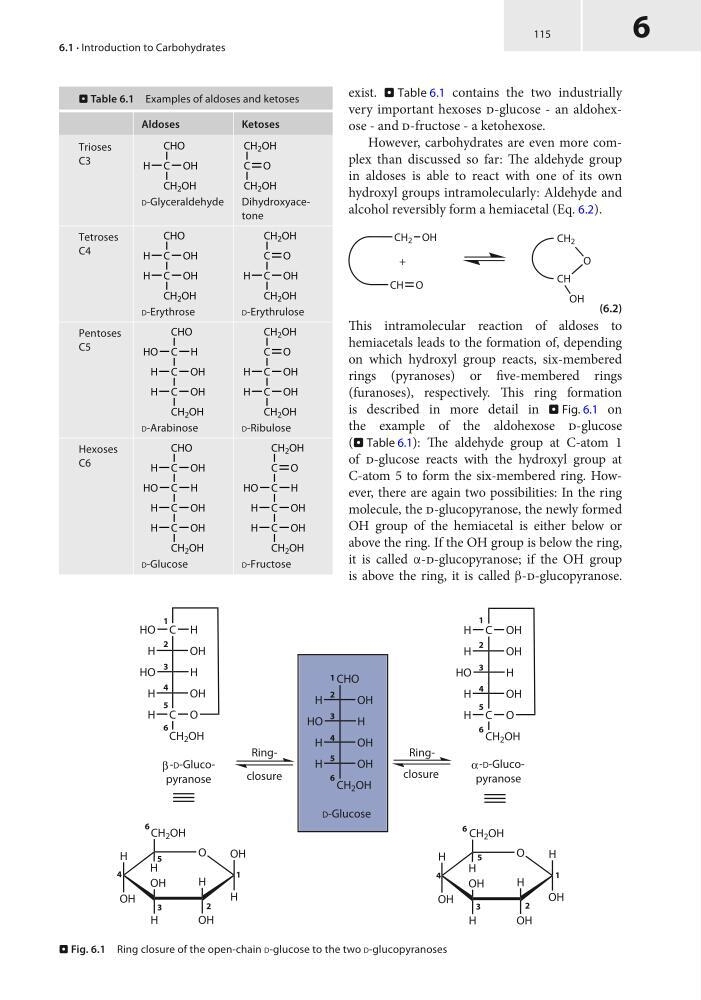
is described in more detail in . Fig. 6.1 on
the example of the aldohexose d-glucose
(. Table 6.1): The aldehyde group at C-atom 1
of d-glucose reacts with the hydroxyl group at
C-atom 5 to form the six-membered ring. However, there are again two possibilities: In the ring
molecule, the d-glucopyranose, the newly formed
OH group of the hemiacetal is either below or
above the ring. If the OH group is below the ring,
it is called α-d-glucopyranose; if the OH group
is above the ring, it is called β-d-glucopyranose.
(6.2)
CH
CH 2
O
+
OH
O
CH 2
CH
OH
. Table 6.1 Examples of aldoses and ketoses
Aldoses
Ketoses
Trioses
C3
d-Glyceraldehyde
Dihydroxyacetone
Tetroses
C4
d-Erythrose
d-Erythrulose
Pentoses
C5
d-Arabinose
d-Ribulose
Hexoses
C6
d-Glucose
d-Fructose
O
H
OH
OH
H
H
OH
H
OH
CH 2 OH
H
C
OH
H
H
HO
OH
H
C O
H
CH 2 OH
H
HO
CHO
OH
H
H
HO
OH
H
OH
H
CH 2 OH
C
OH
H
H
HO
OH
H
C O
H
CH 2 OH
OH
H
O
H
OH
H
OH
H
OH
H
OH
CH 2 OH
H
D-Glucose
Ringclosure
closure
-D-Glucopyranose
-D-Glucopyranose
1
2
3
4
5
6
1
2
3
4
5
6
1
1
1
2
2
2
3
3
3
4
4
4
5
5
5
6
6
6
β
α
. Fig. 6.1 Ring closure of the open-chain d-glucose to the two d-glucopyranoses
6.1 · Introduction to Carbohydrates
6
exist. . Table 6.1 contains the two industrially
very important hexoses d-glucose - an aldohexose - and d-fructose - a ketohexose.
However, carbohydrates are even more complex than discussed so far: The aldehyde group
in aldoses is able to react with one of its own
hydroxyl groups intramolecularly: Aldehyde and
alcohol reversibly form a hemiacetal (Eq. 6.2).
This intramolecular reaction of aldoses to
hemiacetals leads to the formation of, depending
on which hydroxyl group reacts, six-membered
rings (pyranoses) or five-membered rings
(furanoses), respectively. This ring formation
is described in more detail in . Fig. 6.1 on
the example of the aldohexose d-glucose
(. Table 6.1): The aldehyde group at C-atom 1
of d-glucose reacts with the hydroxyl group at
C-atom 5 to form the six-membered ring. However, there are again two possibilities: In the ring
molecule, the d-glucopyranose, the newly formed
OH group of the hemiacetal is either below or
above the ring. If the OH group is below the ring,
it is called α-d-glucopyranose; if the OH group
is above the ring, it is called β-d-glucopyranose.
(6.2)
CH
CH 2
O
+
OH
O
CH 2
CH
OH
. Table 6.1 Examples of aldoses and ketoses
Aldoses
Ketoses
Trioses
C3
d-Glyceraldehyde
Dihydroxyacetone
Tetroses
C4
d-Erythrose
d-Erythrulose
Pentoses
C5
d-Arabinose
d-Ribulose
Hexoses
C6
d-Glucose
d-Fructose
O
H
OH
OH
H
H
OH
H
OH
CH 2 OH
H
C
OH
H
H
HO
OH
H
C O
H
CH 2 OH
H
HO
CHO
OH
H
H
HO
OH
H
OH
H
CH 2 OH
C
OH
H
H
HO
OH
H
C O
H
CH 2 OH
OH
H
O
H
OH
H
OH
H
OH
H
OH
CH 2 OH
H
D-Glucose
Ringclosure
closure
-D-Glucopyranose
-D-Glucopyranose
1
2
3
4
5
6
1
2
3
4
5
6
1
1
1
2
2
2
3
3
3
4
4
4
5
5
5
6
6
6
β
α
. Fig. 6.1 Ring closure of the open-chain d-glucose to the two d-glucopyranoses
6.1 · Introduction to Carbohydrates