

95
5
BOX: The History of “Nitroglycerol”
Glyceryl trinitrate was discovered
as early as 1846 by the Italian
chemist Ascanio Sobrero. As
a liquid, this compound is
unstable and can easily explode
when heated or hit. In 1866,
Alfred Nobel discovered that
a mixture of glyceryl trinitrate
and diatomaceous earth
produced a deformable paste
that was easy and relatively
safe to handle. It could easily be
placed in drill holes to perform
rock blasting. Nobel called this
paste “dynamite” and thus
earned a huge fortune. Today,
the interest on these assets is
distributed annually as “Nobel
Prizes” to exceptionally creative
researchers. Nobel was fortunate
enough to invent dynamite at
exactly the right time: In the
second half of the nineteenth
century, numerous railway
lines were built in Europe, for
which many tunnels had to be
blown up. The construction of
canals also depended on the
new explosives: From 1879, the
first Panama Canal with a total
of 30,000 tons of dynamite was
blown free.
Today, glyceryl trinitrate no longer
plays a major role as an explosive.
Together with nitrocellulose, it is
still a component of propellants
and rocket fuels. It is also used
- in very small amounts - as a
drug in asthma, heart failure and
arteriosclerosis: Glyceryl trinitrate
decomposes rapidly in the body
and forms nitric oxide, which
expands the coronary arteries and
improves blood flow to the heart.
Vacuum
system
Recycle - HOAc
Reactor I
Reactor II
Evaporator
Triacetin
Waste
Acetic anhydride
Acetic acid
Glycerol
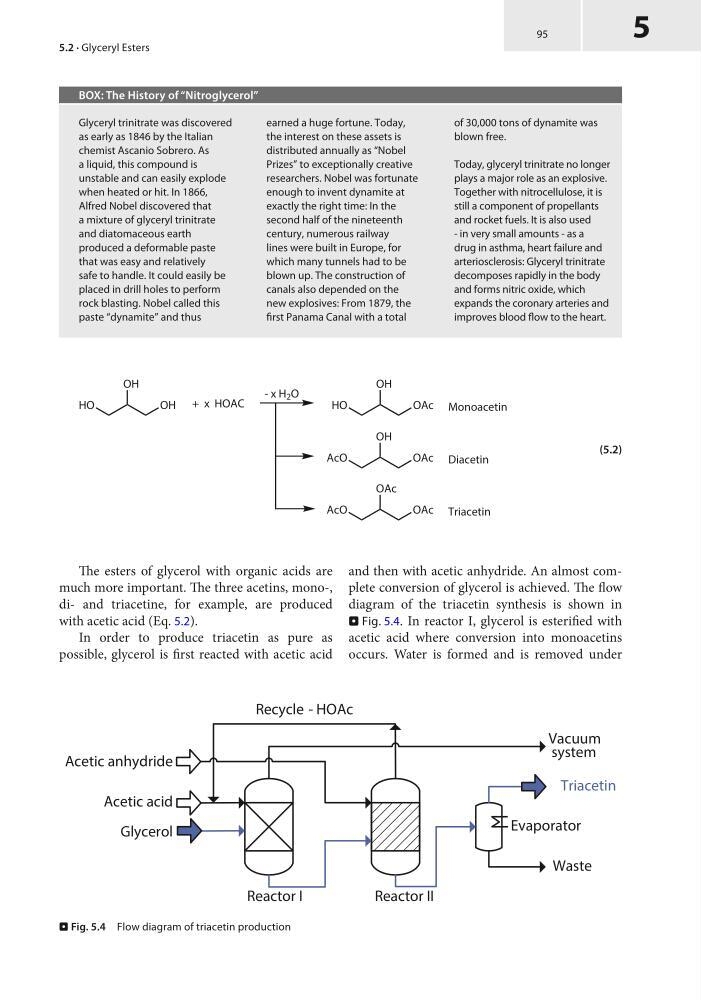
. Fig. 5.4 Flow diagram of triacetin production
5.2 · Glyceryl Esters
(5.2)
OH
HO
OH + x HOAC
OH
HO
OAc Monoacetin
OH
AcO
OAc Diacetin
OAc
AcO
OAc Triacetin
- x H 2 O
The esters of glycerol with organic acids are
much more important. The three acetins, mono-,
di- and triacetine, for example, are produced
with acetic acid (Eq. 5.2).
In order to produce triacetin as pure as
possible, glycerol is first reacted with acetic acid
and then with acetic anhydride. An almost complete conversion of glycerol is achieved. The flow
diagram of the triacetin synthesis is shown in
. Fig. 5.4. In reactor I, glycerol is esterified with
acetic acid where conversion into monoacetins
occurs. Water is formed and is removed under
5
BOX: The History of “Nitroglycerol”
Glyceryl trinitrate was discovered
as early as 1846 by the Italian
chemist Ascanio Sobrero. As
a liquid, this compound is
unstable and can easily explode
when heated or hit. In 1866,
Alfred Nobel discovered that
a mixture of glyceryl trinitrate
and diatomaceous earth
produced a deformable paste
that was easy and relatively
safe to handle. It could easily be
placed in drill holes to perform
rock blasting. Nobel called this
paste “dynamite” and thus
earned a huge fortune. Today,
the interest on these assets is
distributed annually as “Nobel
Prizes” to exceptionally creative
researchers. Nobel was fortunate
enough to invent dynamite at
exactly the right time: In the
second half of the nineteenth
century, numerous railway
lines were built in Europe, for
which many tunnels had to be
blown up. The construction of
canals also depended on the
new explosives: From 1879, the
first Panama Canal with a total
of 30,000 tons of dynamite was
blown free.
Today, glyceryl trinitrate no longer
plays a major role as an explosive.
Together with nitrocellulose, it is
still a component of propellants
and rocket fuels. It is also used
- in very small amounts - as a
drug in asthma, heart failure and
arteriosclerosis: Glyceryl trinitrate
decomposes rapidly in the body
and forms nitric oxide, which
expands the coronary arteries and
improves blood flow to the heart.
Vacuum
system
Recycle - HOAc
Reactor I
Reactor II
Evaporator
Triacetin
Waste
Acetic anhydride
Acetic acid
Glycerol
. Fig. 5.4 Flow diagram of triacetin production
5.2 · Glyceryl Esters
(5.2)
OH
HO
OH + x HOAC
OH
HO
OAc Monoacetin
OH
AcO
OAc Diacetin
OAc
AcO
OAc Triacetin
- x H 2 O
The esters of glycerol with organic acids are
much more important. The three acetins, mono-,
di- and triacetine, for example, are produced
with acetic acid (Eq. 5.2).
In order to produce triacetin as pure as
possible, glycerol is first reacted with acetic acid
and then with acetic anhydride. An almost complete conversion of glycerol is achieved. The flow
diagram of the triacetin synthesis is shown in
. Fig. 5.4. In reactor I, glycerol is esterified with
acetic acid where conversion into monoacetins
occurs. Water is formed and is removed under