

90
Chapter 5 · The Coproduct of Oleochemistry - Glycerol
5
Already at the beginning of the book section “fats
and oils”, we learned that fats and oils are triglycerides, i.e. triesters of glycerol. By cleaving these triesters
(7 Sect. 3.1) - no matter which method is used -
glycerol is automatically released as a coproduct. In
terms of quantity, the proportion of glycerol in fats is
certainly significant: In coconut oil (which is made up
of relatively short-chain fatty acids), the proportion by
weight of glycerol is 17%, in soya oil and tallow (with
long-chain fatty acids) approx. 10%.
Chapter Timetable
5 You will learn about the properties
of glycerol and where it can be
used.
5 The main part of this chapter deals with
the follow-up chemistry of glycerol,
which has been intensively investigated
in recent years.
. Table 5.1 Properties of glycerol
Property
Substance values
Appearance/behavior
Colorless, clear, hygroscopic liquid, non-corrosive, antiseptic
Melting point
Low: 18 °C (but mostly still liquid below)
Boiling point
High: 290 °C (under decomposition)
182 °C (at 3 hPa)
Toxicity
Non-toxic (permitted in food)
Density
1.26 g ml −1
Viscosity
Undiluted: high viscosity (1760 mPa s at 20 °C); as 50–60% aqueous solution: low viscosity
Miscibility
Miscible with water and ethanol, slightly soluble in ether, insoluble in hydrocarbons
BOX: A Brief Look at the History of Glycerol
The Swedish chemist and
pharmacist Karl Wilhelm Scheele
produced a “lead plaster” in
1779 by mixing olive oil with
lead oxide. As you already know
from 7 Sect. 3.1.3, he saponified
the triglyceride (at least partially)
and released glycerol. He put a
finger into his paste and realized
it tasted sweet. Since then,
this new compound has been
called “Scheele’s Sweet”. Only
three decades later, in 1813,
the Frenchman Michel–Eugène
Chevreul was able to prove that
fats are glycerol esters of fatty
acids and gave glycerol its final
trivial name in 1823, derived
from the Greek word for sweet
(glykys).
P.S.: Despite the great success of
Scheele, we strongly advise you
not to analyze unknown product
mixtures by tasting them.
Otherwise, it could have been
your last analysis!
5.1 Properties and Use of Glycerol
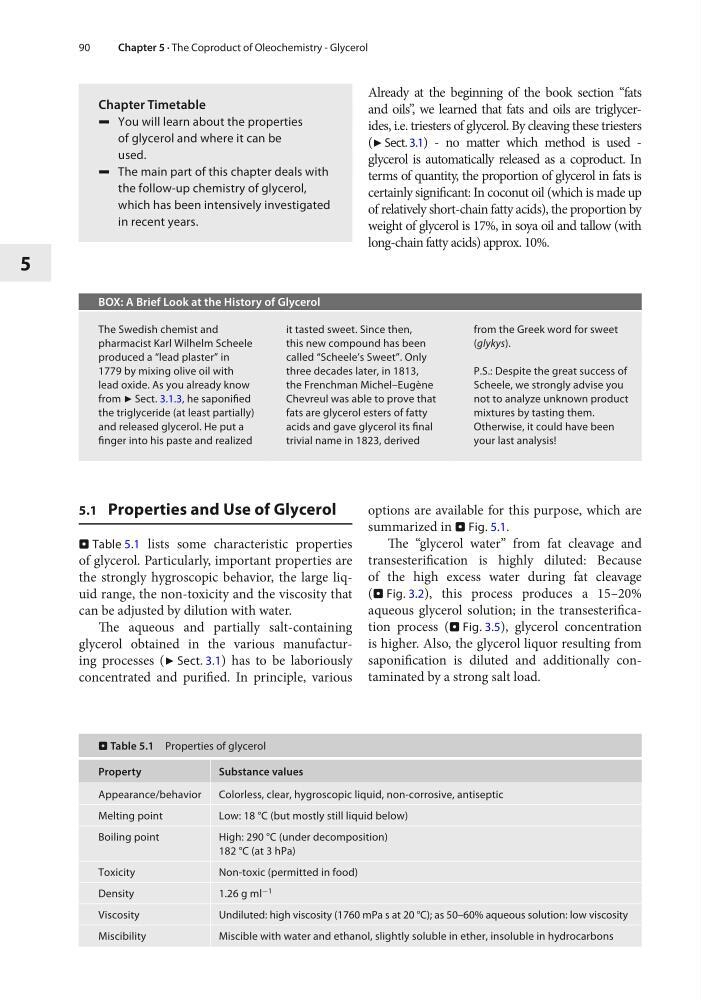
. Table 5.1 lists some characteristic properties
of glycerol. Particularly, important properties are
the strongly hygroscopic behavior, the large liquid range, the non-toxicity and the viscosity that
can be adjusted by dilution with water.
The aqueous and partially salt-containing
glycerol obtained in the various manufacturing processes (7 Sect. 3.1) has to be laboriously
concentrated and purified. In principle, various
options are available for this purpose, which are
summarized in . Fig. 5.1.
The “glycerol water” from fat cleavage and
transesterification is highly diluted: Because
of the high excess water during fat cleavage
(. Fig. 3.2), this process produces a 15–20%
aqueous glycerol solution; in the transesterification process (. Fig. 3.5), glycerol concentration
is higher. Also, the glycerol liquor resulting from
saponification is diluted and additionally contaminated by a strong salt load.
Chapter 5 · The Coproduct of Oleochemistry - Glycerol
5
Already at the beginning of the book section “fats
and oils”, we learned that fats and oils are triglycerides, i.e. triesters of glycerol. By cleaving these triesters
(7 Sect. 3.1) - no matter which method is used -
glycerol is automatically released as a coproduct. In
terms of quantity, the proportion of glycerol in fats is
certainly significant: In coconut oil (which is made up
of relatively short-chain fatty acids), the proportion by
weight of glycerol is 17%, in soya oil and tallow (with
long-chain fatty acids) approx. 10%.
Chapter Timetable
5 You will learn about the properties
of glycerol and where it can be
used.
5 The main part of this chapter deals with
the follow-up chemistry of glycerol,
which has been intensively investigated
in recent years.
. Table 5.1 Properties of glycerol
Property
Substance values
Appearance/behavior
Colorless, clear, hygroscopic liquid, non-corrosive, antiseptic
Melting point
Low: 18 °C (but mostly still liquid below)
Boiling point
High: 290 °C (under decomposition)
182 °C (at 3 hPa)
Toxicity
Non-toxic (permitted in food)
Density
1.26 g ml −1
Viscosity
Undiluted: high viscosity (1760 mPa s at 20 °C); as 50–60% aqueous solution: low viscosity
Miscibility
Miscible with water and ethanol, slightly soluble in ether, insoluble in hydrocarbons
BOX: A Brief Look at the History of Glycerol
The Swedish chemist and
pharmacist Karl Wilhelm Scheele
produced a “lead plaster” in
1779 by mixing olive oil with
lead oxide. As you already know
from 7 Sect. 3.1.3, he saponified
the triglyceride (at least partially)
and released glycerol. He put a
finger into his paste and realized
it tasted sweet. Since then,
this new compound has been
called “Scheele’s Sweet”. Only
three decades later, in 1813,
the Frenchman Michel–Eugène
Chevreul was able to prove that
fats are glycerol esters of fatty
acids and gave glycerol its final
trivial name in 1823, derived
from the Greek word for sweet
(glykys).
P.S.: Despite the great success of
Scheele, we strongly advise you
not to analyze unknown product
mixtures by tasting them.
Otherwise, it could have been
your last analysis!
5.1 Properties and Use of Glycerol
. Table 5.1 lists some characteristic properties
of glycerol. Particularly, important properties are
the strongly hygroscopic behavior, the large liquid range, the non-toxicity and the viscosity that
can be adjusted by dilution with water.
The aqueous and partially salt-containing
glycerol obtained in the various manufacturing processes (7 Sect. 3.1) has to be laboriously
concentrated and purified. In principle, various
options are available for this purpose, which are
summarized in . Fig. 5.1.
The “glycerol water” from fat cleavage and
transesterification is highly diluted: Because
of the high excess water during fat cleavage
(. Fig. 3.2), this process produces a 15–20%
aqueous glycerol solution; in the transesterification process (. Fig. 3.5), glycerol concentration
is higher. Also, the glycerol liquor resulting from
saponification is diluted and additionally contaminated by a strong salt load.