

78
P. Senthil Kumar and S. Suganya
Table 2 Intrinsic value of
fibers
Application
Intrinsic viscosity
value
Fibre grade Textiles
0.40–0.70
Technical
0.72–0.98
Film grade Biaxially oriented
PET film
0.60–0.70
Thermoforming sheet
0.70–1.00
from 210 to 280 °C. Newly-formed polyester in a long molten-ribbon are subject to
drying and cooling to brittle. Such a regular polyester chips are melted at 270 °C
to form a syrup-like solution [13]. It is further poured into a spinneret and forced
to produce special fibers through tiny holes. Flame retardant can be used in the
spinning stage. The mechanical characteristics of a fiber such as strength, tenacity
and resilience might fix when stretching force is applied. It is obvious that finished
materials are solid, strengthened, textured and twisted.
3.2 The Recovery of Polyester
The intended applications of PET polymer are based on their physical properties,
labeled with different grades which ultimately affects recycling. The molecular
weight of the polyester is measured in terms of the intrinsic viscosity (IV) that is
related to the material’s melting point, tensile strength and crystallinity index. PET
bottle resin has a higher IV and crystallinity, whereas fiber grade PET textiles and
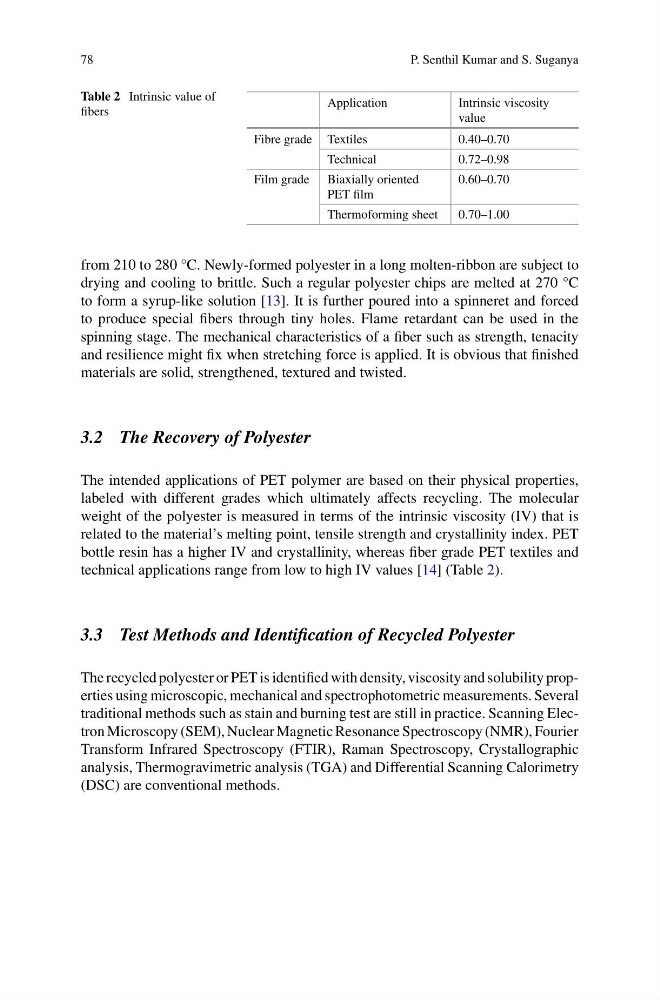
technical applications range from low to high IV values [14] (Table 2).
3.3 Test Methods and Identification of Recycled Polyester
The recycled polyester or PET is identified with density, viscosity and solubility properties using microscopic, mechanical and spectrophotometric measurements. Several
traditional methods such as stain and burning test are still in practice. Scanning Electron Microscopy (SEM), Nuclear Magnetic Resonance Spectroscopy (NMR), Fourier
Transform Infrared Spectroscopy (FTIR), Raman Spectroscopy, Crystallographic
analysis, Thermogravimetric analysis (TGA) and Differential Scanning Calorimetry
(DSC) are conventional methods.
P. Senthil Kumar and S. Suganya
Table 2 Intrinsic value of
fibers
Application
Intrinsic viscosity
value
Fibre grade Textiles
0.40–0.70
Technical
0.72–0.98
Film grade Biaxially oriented
PET film
0.60–0.70
Thermoforming sheet
0.70–1.00
from 210 to 280 °C. Newly-formed polyester in a long molten-ribbon are subject to
drying and cooling to brittle. Such a regular polyester chips are melted at 270 °C
to form a syrup-like solution [13]. It is further poured into a spinneret and forced
to produce special fibers through tiny holes. Flame retardant can be used in the
spinning stage. The mechanical characteristics of a fiber such as strength, tenacity
and resilience might fix when stretching force is applied. It is obvious that finished
materials are solid, strengthened, textured and twisted.
3.2 The Recovery of Polyester
The intended applications of PET polymer are based on their physical properties,
labeled with different grades which ultimately affects recycling. The molecular
weight of the polyester is measured in terms of the intrinsic viscosity (IV) that is
related to the material’s melting point, tensile strength and crystallinity index. PET
bottle resin has a higher IV and crystallinity, whereas fiber grade PET textiles and
technical applications range from low to high IV values [14] (Table 2).
3.3 Test Methods and Identification of Recycled Polyester
The recycled polyester or PET is identified with density, viscosity and solubility properties using microscopic, mechanical and spectrophotometric measurements. Several
traditional methods such as stain and burning test are still in practice. Scanning Electron Microscopy (SEM), Nuclear Magnetic Resonance Spectroscopy (NMR), Fourier
Transform Infrared Spectroscopy (FTIR), Raman Spectroscopy, Crystallographic
analysis, Thermogravimetric analysis (TGA) and Differential Scanning Calorimetry
(DSC) are conventional methods.