

76
P. Senthil Kumar and S. Suganya
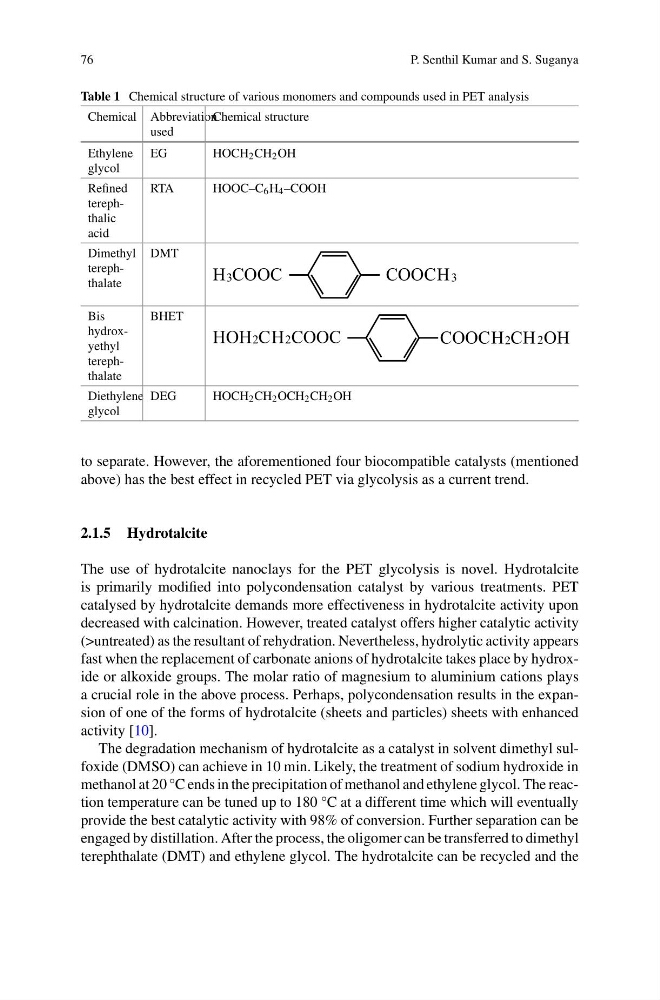
Table 1 Chemical structure of various monomers and compounds used in PET analysis
Chemical Abbreviation
used
Chemical structure
Ethylene
glycol
EG
HOCH 2 CH 2 OH
Refined
terephthalic
acid
RTA
HOOC–C 6 H 4 –COOH
Dimethyl
terephthalate
DMT
H3COOC
H3
COOC
Bis
hydroxyethyl
terephthalate
BHET
CH2
OH
CH 2
H2
2
COOC
COOC
HOH
Diethylene
glycol
DEG
HOCH 2 CH 2 OCH 2 CH 2 OH
to separate. However, the aforementioned four biocompatible catalysts (mentioned
above) has the best effect in recycled PET via glycolysis as a current trend.
2.1.5 Hydrotalcite
The use of hydrotalcite nanoclays for the PET glycolysis is novel. Hydrotalcite
is primarily modified into polycondensation catalyst by various treatments. PET
catalysed by hydrotalcite demands more effectiveness in hydrotalcite activity upon
decreased with calcination. However, treated catalyst offers higher catalytic activity
(>untreated) as the resultant of rehydration. Nevertheless, hydrolytic activity appears
fast when the replacement of carbonate anions of hydrotalcite takes place by hydroxide or alkoxide groups. The molar ratio of magnesium to aluminium cations plays
a crucial role in the above process. Perhaps, polycondensation results in the expansion of one of the forms of hydrotalcite (sheets and particles) sheets with enhanced
activity [10].
The degradation mechanism of hydrotalcite as a catalyst in solvent dimethyl sulfoxide (DMSO) can achieve in 10 min. Likely, the treatment of sodium hydroxide in
methanol at 20 °C ends in the precipitation of methanol and ethylene glycol. The reaction temperature can be tuned up to 180 °C at a different time which will eventually
provide the best catalytic activity with 98% of conversion. Further separation can be
engaged by distillation. After the process, the oligomer can be transferred to dimethyl
terephthalate (DMT) and ethylene glycol. The hydrotalcite can be recycled and the
P. Senthil Kumar and S. Suganya
Table 1 Chemical structure of various monomers and compounds used in PET analysis
Chemical Abbreviation
used
Chemical structure
Ethylene
glycol
EG
HOCH 2 CH 2 OH
Refined
terephthalic
acid
RTA
HOOC–C 6 H 4 –COOH
Dimethyl
terephthalate
DMT
H3COOC
H3
COOC
Bis
hydroxyethyl
terephthalate
BHET
CH2
OH
CH 2
H2
2
COOC
COOC
HOH
Diethylene
glycol
DEG
HOCH 2 CH 2 OCH 2 CH 2 OH
to separate. However, the aforementioned four biocompatible catalysts (mentioned
above) has the best effect in recycled PET via glycolysis as a current trend.
2.1.5 Hydrotalcite
The use of hydrotalcite nanoclays for the PET glycolysis is novel. Hydrotalcite
is primarily modified into polycondensation catalyst by various treatments. PET
catalysed by hydrotalcite demands more effectiveness in hydrotalcite activity upon
decreased with calcination. However, treated catalyst offers higher catalytic activity
(>untreated) as the resultant of rehydration. Nevertheless, hydrolytic activity appears
fast when the replacement of carbonate anions of hydrotalcite takes place by hydroxide or alkoxide groups. The molar ratio of magnesium to aluminium cations plays
a crucial role in the above process. Perhaps, polycondensation results in the expansion of one of the forms of hydrotalcite (sheets and particles) sheets with enhanced
activity [10].
The degradation mechanism of hydrotalcite as a catalyst in solvent dimethyl sulfoxide (DMSO) can achieve in 10 min. Likely, the treatment of sodium hydroxide in
methanol at 20 °C ends in the precipitation of methanol and ethylene glycol. The reaction temperature can be tuned up to 180 °C at a different time which will eventually
provide the best catalytic activity with 98% of conversion. Further separation can be
engaged by distillation. After the process, the oligomer can be transferred to dimethyl
terephthalate (DMT) and ethylene glycol. The hydrotalcite can be recycled and the