

74
P. Senthil Kumar and S. Suganya
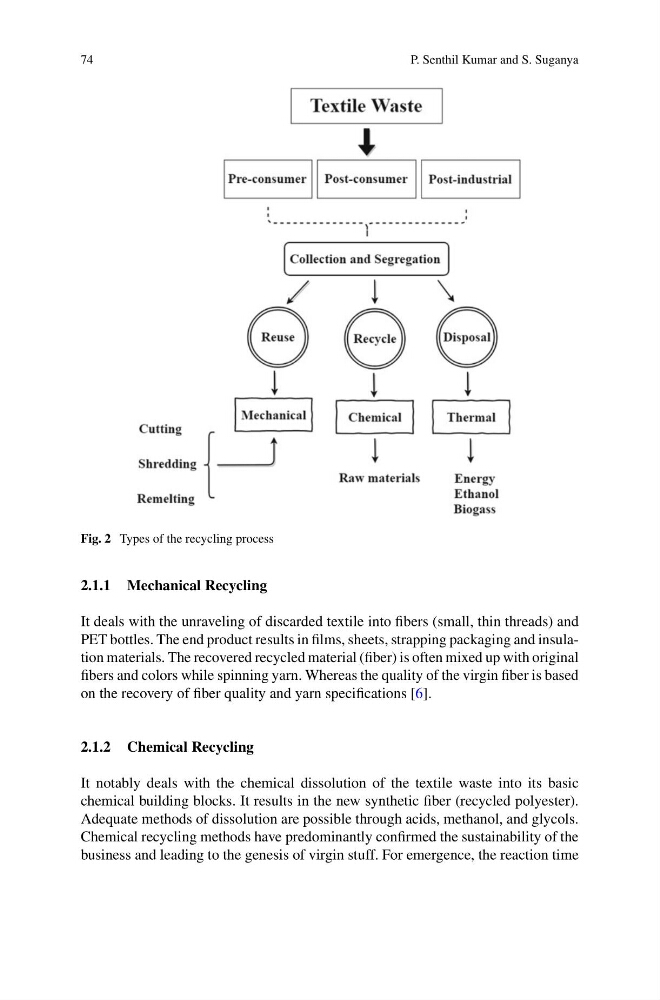
Fig. 2 Types of the recycling process
2.1.1 Mechanical Recycling
It deals with the unraveling of discarded textile into fibers (small, thin threads) and
PET bottles. The end product results in films, sheets, strapping packaging and insulation materials. The recovered recycled material (fiber) is often mixed up with original
fibers and colors while spinning yarn. Whereas the quality of the virgin fiber is based
on the recovery of fiber quality and yarn specifications [6].
2.1.2 Chemical Recycling
It notably deals with the chemical dissolution of the textile waste into its basic
chemical building blocks. It results in the new synthetic fiber (recycled polyester).
Adequate methods of dissolution are possible through acids, methanol, and glycols.
Chemical recycling methods have predominantly confirmed the sustainability of the
business and leading to the genesis of virgin stuff. For emergence, the reaction time
P. Senthil Kumar and S. Suganya
Fig. 2 Types of the recycling process
2.1.1 Mechanical Recycling
It deals with the unraveling of discarded textile into fibers (small, thin threads) and
PET bottles. The end product results in films, sheets, strapping packaging and insulation materials. The recovered recycled material (fiber) is often mixed up with original
fibers and colors while spinning yarn. Whereas the quality of the virgin fiber is based
on the recovery of fiber quality and yarn specifications [6].
2.1.2 Chemical Recycling
It notably deals with the chemical dissolution of the textile waste into its basic
chemical building blocks. It results in the new synthetic fiber (recycled polyester).
Adequate methods of dissolution are possible through acids, methanol, and glycols.
Chemical recycling methods have predominantly confirmed the sustainability of the
business and leading to the genesis of virgin stuff. For emergence, the reaction time