

Studies on Recycled Polyester
35
2.3 Melt Spinning in Laboratory Scale
Before the melt spinning, all the PET materials were completely dried to remove
the moisture. A capillary rheometer (Rheograph 2003, Göttfert, Germany) equipped
with an air aspirator was used for PET melt spinning (Fig. 1b). The air aspirator
was installed directly 16 cm below the die, on the same centerline. The optimized
experimental parameters have been explored in the preliminary work, which are: the
die with length L of 10 mm and diameter D of 0.5 mm; extrusion speed of the piston
v 0 equal to 0.1 mm/s. Therefore, according to Eq. (3) [37, 38], the apparent shear
rate ˙
γ a of the PET materials in this study can be thus obtained as in ˙
γ a = 921.6 s
−1 .
˙
γ a = 4Q/π R
3
= 8 · v 0 · D
2
0 /D
3
(3)
where Q refers to the throughput of the materials in the extrusion direction, and R is
the radius of the die used during the extrusion process, and D 0 refers to the diameter
of the piston, with D 0 = 12 mm.
Two processing temperatures of 270 and 280 °C were applied for the melt spinning
process in this study. Considering the difference on T m for both types of polyester
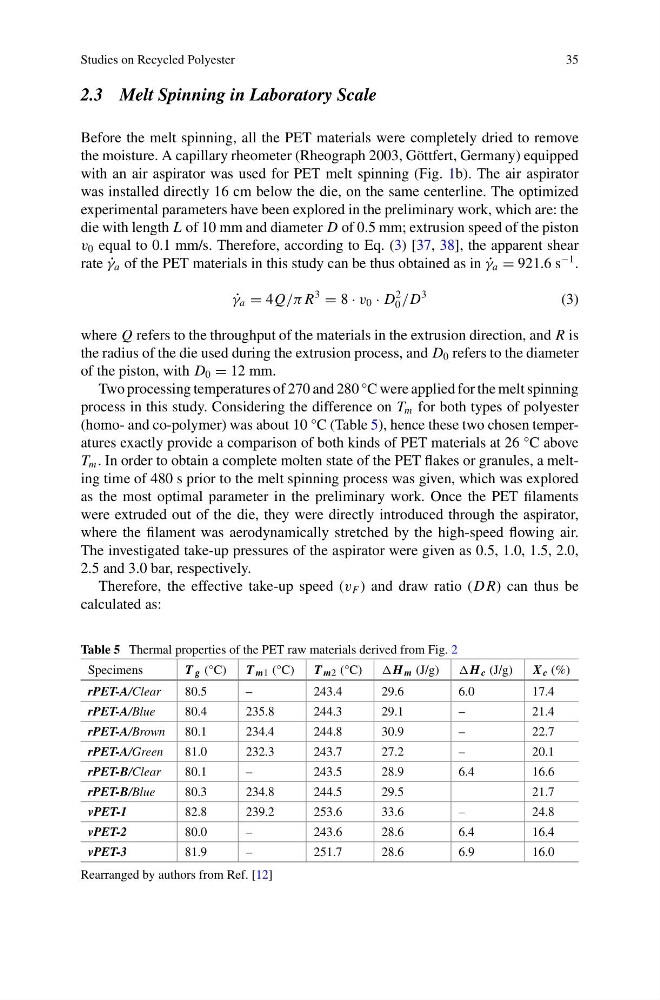
(homo- and co-polymer) was about 10 °C (Table 5), hence these two chosen temperatures exactly provide a comparison of both kinds of PET materials at 26 °C above
T m . In order to obtain a complete molten state of the PET flakes or granules, a melting time of 480 s prior to the melt spinning process was given, which was explored
as the most optimal parameter in the preliminary work. Once the PET filaments
were extruded out of the die, they were directly introduced through the aspirator,
where the filament was aerodynamically stretched by the high-speed flowing air.
The investigated take-up pressures of the aspirator were given as 0.5, 1.0, 1.5, 2.0,
2.5 and 3.0 bar, respectively.
Therefore, the effective take-up speed (v F ) and draw ratio (D R) can thus be
calculated as:
Table 5 Thermal properties of the PET raw materials derived from Fig. 2
Specimens
T g (°C)
T m1 (°C)
T m2 (°C)
H m (J/g)
H c (J/g)
X c (%)
rPET-A/Clear
80.5
–
243.4
29.6
6.0
17.4
rPET-A/Blue
80.4
235.8
244.3
29.1
–
21.4
rPET-A/Brown
80.1
234.4
244.8
30.9
–
22.7
rPET-A/Green
81.0
232.3
243.7
27.2
–
20.1
rPET-B/Clear
80.1
–
243.5
28.9
6.4
16.6
rPET-B/Blue
80.3
234.8
244.5
29.5
21.7
vPET-1
82.8
239.2
253.6
33.6
–
24.8
vPET-2
80.0
–
243.6
28.6
6.4
16.4
vPET-3
81.9
–
251.7
28.6
6.9
16.0
Rearranged by authors from Ref. [12]
35
2.3 Melt Spinning in Laboratory Scale
Before the melt spinning, all the PET materials were completely dried to remove
the moisture. A capillary rheometer (Rheograph 2003, Göttfert, Germany) equipped
with an air aspirator was used for PET melt spinning (Fig. 1b). The air aspirator
was installed directly 16 cm below the die, on the same centerline. The optimized
experimental parameters have been explored in the preliminary work, which are: the
die with length L of 10 mm and diameter D of 0.5 mm; extrusion speed of the piston
v 0 equal to 0.1 mm/s. Therefore, according to Eq. (3) [37, 38], the apparent shear
rate ˙
γ a of the PET materials in this study can be thus obtained as in ˙
γ a = 921.6 s
−1 .
˙
γ a = 4Q/π R
3
= 8 · v 0 · D
2
0 /D
3
(3)
where Q refers to the throughput of the materials in the extrusion direction, and R is
the radius of the die used during the extrusion process, and D 0 refers to the diameter
of the piston, with D 0 = 12 mm.
Two processing temperatures of 270 and 280 °C were applied for the melt spinning
process in this study. Considering the difference on T m for both types of polyester
(homo- and co-polymer) was about 10 °C (Table 5), hence these two chosen temperatures exactly provide a comparison of both kinds of PET materials at 26 °C above
T m . In order to obtain a complete molten state of the PET flakes or granules, a melting time of 480 s prior to the melt spinning process was given, which was explored
as the most optimal parameter in the preliminary work. Once the PET filaments
were extruded out of the die, they were directly introduced through the aspirator,
where the filament was aerodynamically stretched by the high-speed flowing air.
The investigated take-up pressures of the aspirator were given as 0.5, 1.0, 1.5, 2.0,
2.5 and 3.0 bar, respectively.
Therefore, the effective take-up speed (v F ) and draw ratio (D R) can thus be
calculated as:
Table 5 Thermal properties of the PET raw materials derived from Fig. 2
Specimens
T g (°C)
T m1 (°C)
T m2 (°C)
H m (J/g)
H c (J/g)
X c (%)
rPET-A/Clear
80.5
–
243.4
29.6
6.0
17.4
rPET-A/Blue
80.4
235.8
244.3
29.1
–
21.4
rPET-A/Brown
80.1
234.4
244.8
30.9
–
22.7
rPET-A/Green
81.0
232.3
243.7
27.2
–
20.1
rPET-B/Clear
80.1
–
243.5
28.9
6.4
16.6
rPET-B/Blue
80.3
234.8
244.5
29.5
21.7
vPET-1
82.8
239.2
253.6
33.6
–
24.8
vPET-2
80.0
–
243.6
28.6
6.4
16.4
vPET-3
81.9
–
251.7
28.6
6.9
16.0
Rearranged by authors from Ref. [12]