

24
G. Martínez-Barrera et al.
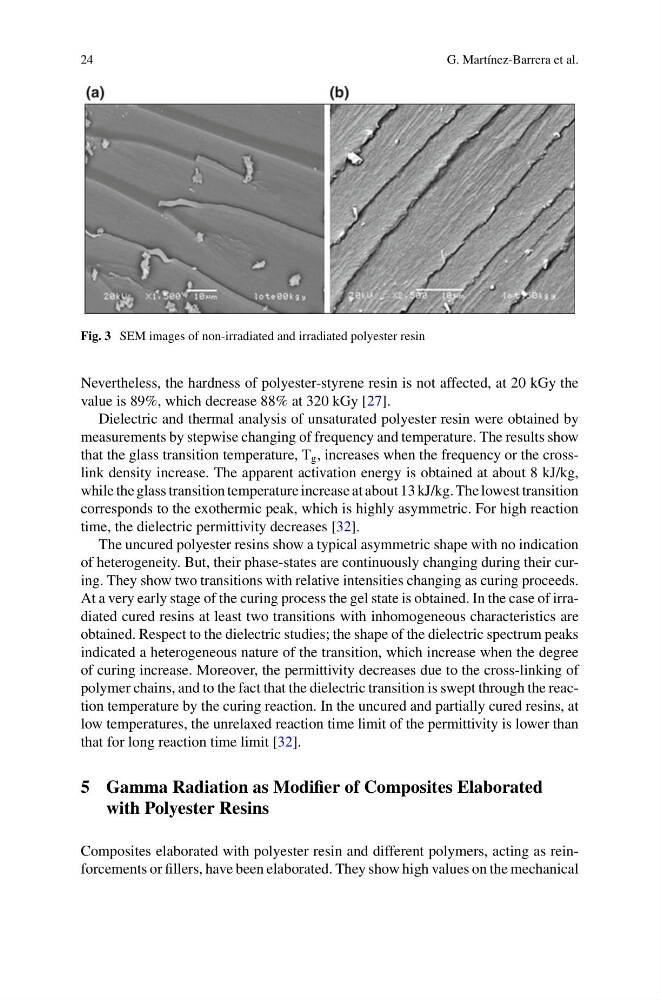
Fig. 3 SEM images of non-irradiated and irradiated polyester resin
Nevertheless, the hardness of polyester-styrene resin is not affected, at 20 kGy the
value is 89%, which decrease 88% at 320 kGy [27].
Dielectric and thermal analysis of unsaturated polyester resin were obtained by
measurements by stepwise changing of frequency and temperature. The results show
that the glass transition temperature, T g , increases when the frequency or the crosslink density increase. The apparent activation energy is obtained at about 8 kJ/kg,
while the glass transition temperature increase at about 13 kJ/kg. The lowest transition
corresponds to the exothermic peak, which is highly asymmetric. For high reaction
time, the dielectric permittivity decreases [32].
The uncured polyester resins show a typical asymmetric shape with no indication
of heterogeneity. But, their phase-states are continuously changing during their curing. They show two transitions with relative intensities changing as curing proceeds.
At a very early stage of the curing process the gel state is obtained. In the case of irradiated cured resins at least two transitions with inhomogeneous characteristics are
obtained. Respect to the dielectric studies; the shape of the dielectric spectrum peaks
indicated a heterogeneous nature of the transition, which increase when the degree
of curing increase. Moreover, the permittivity decreases due to the cross-linking of
polymer chains, and to the fact that the dielectric transition is swept through the reaction temperature by the curing reaction. In the uncured and partially cured resins, at
low temperatures, the unrelaxed reaction time limit of the permittivity is lower than
that for long reaction time limit [32].
5 Gamma Radiation as Modifier of Composites Elaborated
with Polyester Resins
Composites elaborated with polyester resin and different polymers, acting as reinforcements or fillers, have been elaborated. They show high values on the mechanical
G. Martínez-Barrera et al.
Fig. 3 SEM images of non-irradiated and irradiated polyester resin
Nevertheless, the hardness of polyester-styrene resin is not affected, at 20 kGy the
value is 89%, which decrease 88% at 320 kGy [27].
Dielectric and thermal analysis of unsaturated polyester resin were obtained by
measurements by stepwise changing of frequency and temperature. The results show
that the glass transition temperature, T g , increases when the frequency or the crosslink density increase. The apparent activation energy is obtained at about 8 kJ/kg,
while the glass transition temperature increase at about 13 kJ/kg. The lowest transition
corresponds to the exothermic peak, which is highly asymmetric. For high reaction
time, the dielectric permittivity decreases [32].
The uncured polyester resins show a typical asymmetric shape with no indication
of heterogeneity. But, their phase-states are continuously changing during their curing. They show two transitions with relative intensities changing as curing proceeds.
At a very early stage of the curing process the gel state is obtained. In the case of irradiated cured resins at least two transitions with inhomogeneous characteristics are
obtained. Respect to the dielectric studies; the shape of the dielectric spectrum peaks
indicated a heterogeneous nature of the transition, which increase when the degree
of curing increase. Moreover, the permittivity decreases due to the cross-linking of
polymer chains, and to the fact that the dielectric transition is swept through the reaction temperature by the curing reaction. In the uncured and partially cured resins, at
low temperatures, the unrelaxed reaction time limit of the permittivity is lower than
that for long reaction time limit [32].
5 Gamma Radiation as Modifier of Composites Elaborated
with Polyester Resins
Composites elaborated with polyester resin and different polymers, acting as reinforcements or fillers, have been elaborated. They show high values on the mechanical